



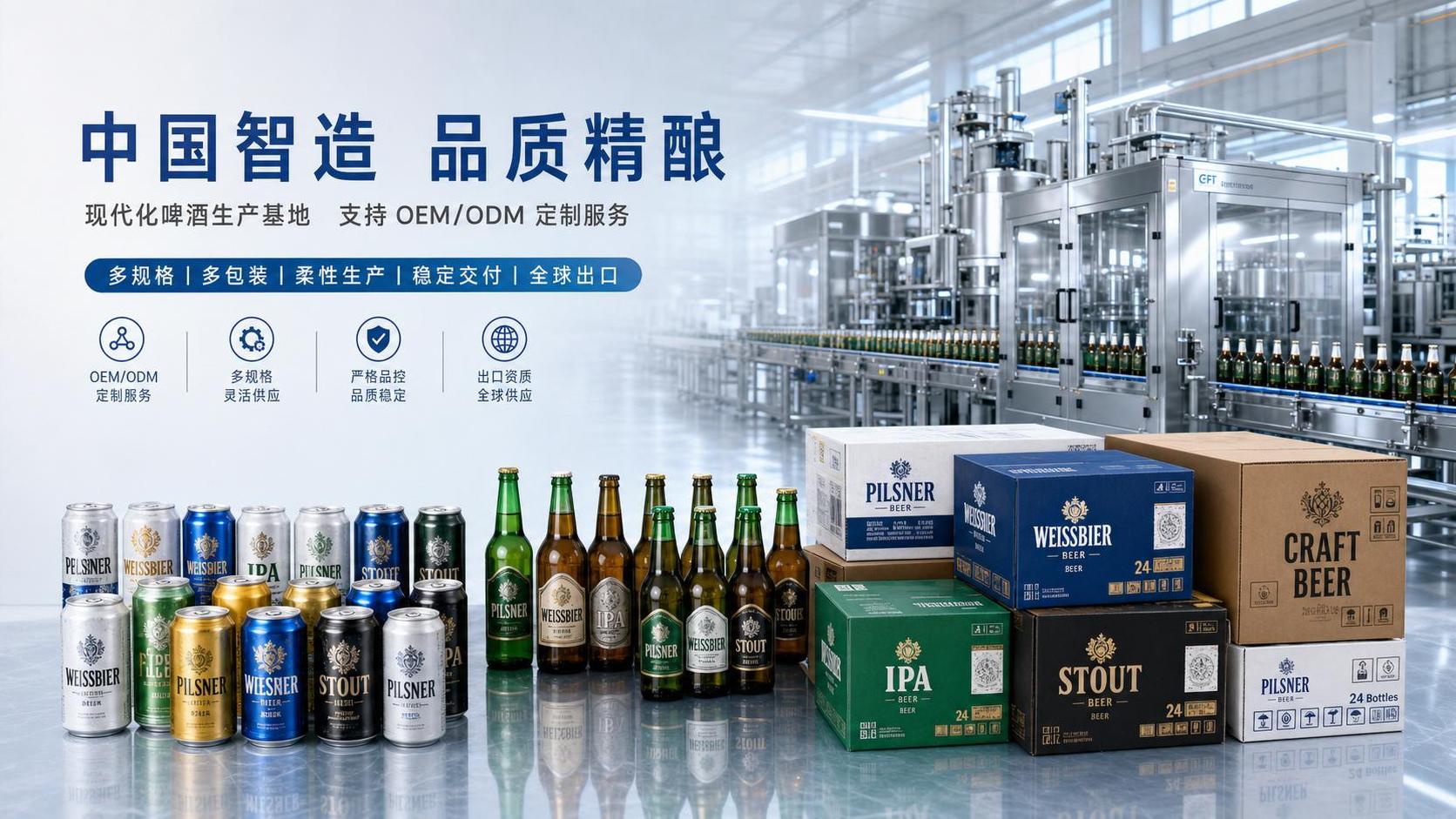
When does a Chinese beer factory make more sense than contract brewing?
Choosing between contract brewing and a Chinese beer factory is rarely only about unit price.
It affects recipe ownership, supply continuity, packaging flexibility, and how quickly a beer brand can respond to market shifts.
In practice, contract brewing works well for early testing.
But once volumes grow, channel requirements become stricter, and product lines expand, a Chinese beer factory often creates better long-term value.
That is especially true in craft beer, where taste consistency and launch speed directly influence repeat orders.
A capable Chinese beer factory can support OEM and ODM projects, classic lager programs, German wheat recipes, sugar-free low-calorie options, fruit beer lines, and functional specialty beers.
The real question is not which model sounds more flexible.
The better question is when direct factory cooperation gives stronger control over margin, quality, and scalable supply.
Is contract brewing still the right starting point?
Sometimes, yes.
Contract brewing is often useful when a new beer concept needs fast validation without investing in a broader manufacturing relationship.
It can reduce early setup work, especially if the first goal is to test one SKU in a limited region.
The trade-off appears later.
Many contract brewers run shared schedules, shared raw material pools, and standardized packaging priorities.
That can limit recipe adjustments, delay seasonal launches, or complicate private label differentiation.
A Chinese beer factory becomes more attractive when the business is moving beyond a trial phase.
- You need recurring production instead of occasional batches.
- You want a wider portfolio, not a single beer style.
- You require branded cans, bottles, trays, or mixed packaging formats.
- You need export-ready supply documents and stable fulfillment.
This is where direct factory cooperation starts to outperform a simple brewing arrangement.
What advantages does a Chinese beer factory offer once volume grows?
The biggest advantage is control at multiple levels, not only brewing itself.
A Chinese beer factory can coordinate formulation, production planning, packaging development, and shipping support within one operating system.
That matters when growth creates complexity.
For example, a retail program may need low-calorie beer in cans, wheat beer in bottles, and fruit beer for seasonal promotion.
Managing that through contract brewing can become fragmented.
Working with a Chinese beer factory often improves execution in several ways.
- Better planning for repeat orders and promotional peaks.
- More room for OEM or ODM customization.
- Clearer quality checkpoints from raw materials to finished goods.
- Easier expansion into online and offline channels across different markets.
Jinpai Beer fits this type of model well because the range is already broad.
That means product development does not begin from zero each time a channel needs a new beer concept.
More importantly, a Chinese beer factory with ongoing R&D is better positioned to adjust sweetness, alcohol level, calorie profile, or flavor direction without restarting the entire supply plan.
How should you compare contract brewing and a Chinese beer factory in practical terms?
A useful comparison should focus on decision points that affect long-term economics.
The table below summarizes the most common evaluation areas.
In many beverage projects, the more complex the go-to-market plan becomes, the more valuable a Chinese beer factory looks.
What signals suggest direct factory cooperation will improve margin and speed?
A common mistake is to wait too long before changing the production model.
If several of the following signals are already visible, a Chinese beer factory may offer a better operating structure.
- Order frequency is increasing, but lead times are becoming less predictable.
- The market asks for custom flavors, reduced sugar, or functional beer variations.
- Packaging revisions happen often for retail, bar, or supermarket channels.
- Margin pressure is rising because too many suppliers touch the same project.
- Quality claims or specification changes take too long to resolve.
In actual supply chains, direct factory communication saves time because technical, packaging, and commercial questions can be handled in parallel.
That is particularly useful for beer categories with shorter promotional windows.
Fruit-flavored beer, low-calorie beer, and specialty concepts often need faster iteration than a standard contract setup can comfortably support.
A Chinese beer factory with established wholesale and global channel experience can also simplify scaling from one region to multiple markets.
Where do buyers misjudge the risks?
The most frequent misjudgment is focusing only on quoted brewing cost.
That number matters, but it is not the full landed decision.
A lower initial quote can become expensive if it creates reformulation delays, inconsistent packaging, or missed launch windows.
Another issue is assuming all factories offer the same level of beer development support.
A strong Chinese beer factory should be evaluated on process depth, not only capacity.
- Can it support both stable classics and trend-driven launches?
- Can it manage OEM and ODM projects without losing speed?
- Can it align product taste with local market preferences?
- Can it maintain export documentation and supply continuity?
It is also worth checking whether the partner understands different retail environments.
Beer sold through bars, supermarkets, and online channels rarely performs well with a one-format strategy.
This is one reason a Chinese beer factory with broader product and channel experience often reduces commercial risk.
What should you confirm before choosing a Chinese beer factory?
A better decision comes from a structured review, not a quick price comparison.
Before moving forward, confirm whether the factory can support the next stage of growth, not just the first shipment.
If the answers are clear and operational, not vague and promotional, the factory is usually worth deeper evaluation.
Jinpai Beer is a relevant example because its craft beer capability spans product development, production, and distribution support across multiple beer categories.
That kind of integrated structure is often what makes a Chinese beer factory more effective than contract brewing once growth, customization, and global supply need to work together.
Final takeaway: when is the switch worth making?
A Chinese beer factory is usually the better choice when beer production is no longer a short test, but a repeatable business model.
If the project needs stable quality, flexible packaging, broader style development, and smoother global supply, direct factory cooperation often delivers stronger results.
Contract brewing still has value for limited launches.
However, when the goal is to build margin, protect brand consistency, and expand across channels, a Chinese beer factory usually offers the more durable platform.
The next practical step is simple.
Map your expected volume, target beer styles, packaging needs, and launch calendar.
Then compare contract brewing and Chinese beer factory options against those real operating requirements, not against headline price alone.
Thank you very much for writing to us. Please leave your message and contact information, we will reply to you within 24 hours.