



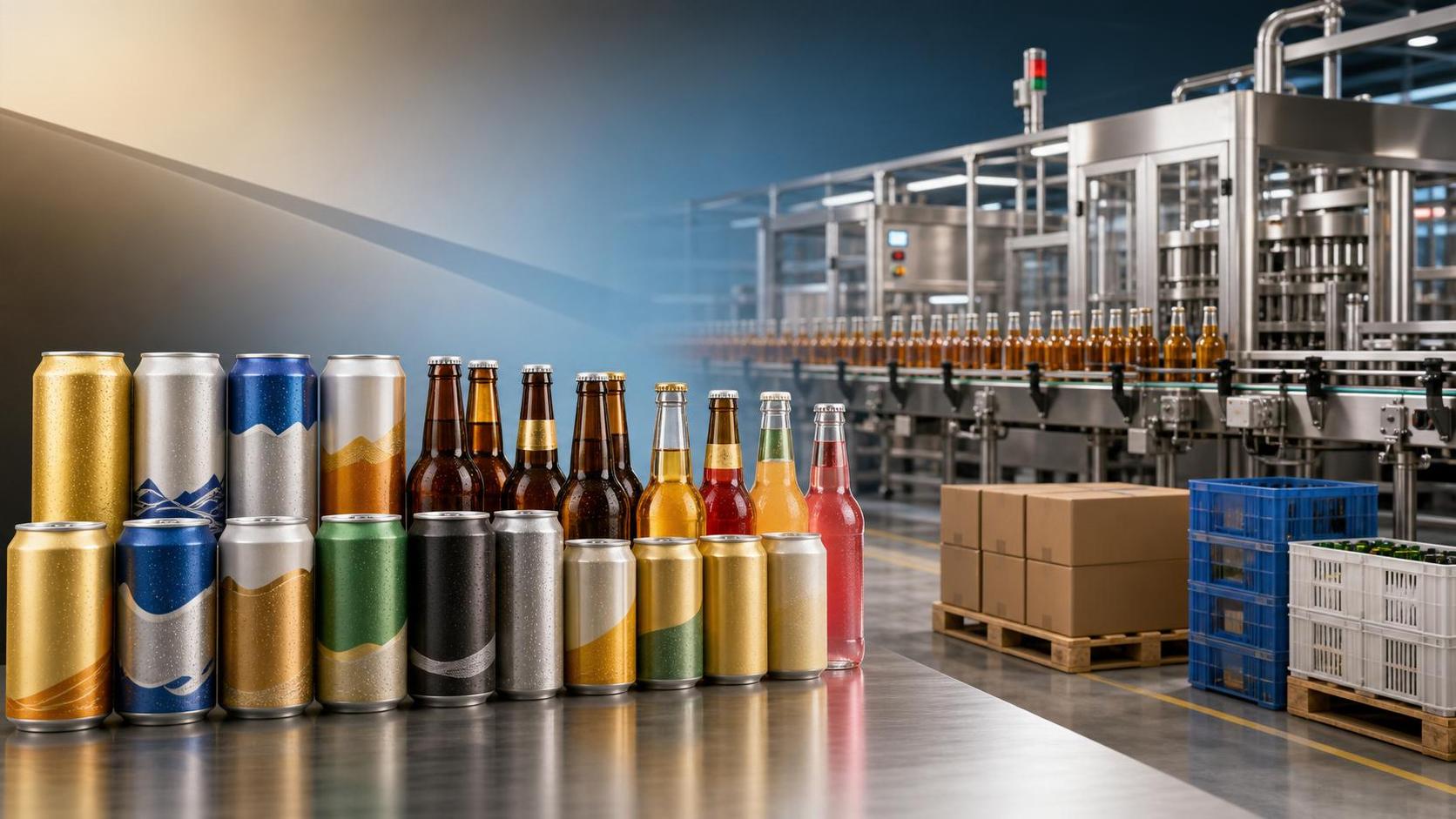
Chinese Beer Factory vs Local Supplier: Key Trade-Offs
Choosing between a Chinese beer factory and a local supplier can shape your margins, inventory model and growth pace.
The decision is rarely just about unit price.
It also affects quality consistency, packaging freedom, launch speed and how easily you respond to market shifts.
For many buyers, a Chinese beer factory offers strong manufacturing depth and better customization.
A local supplier often offers faster replenishment and simpler communication.
That means the best option depends on your sales channels, product roadmap and risk tolerance.
In practical sourcing work, the smarter choice is the one that supports your business model over time.
What a Chinese Beer Factory Usually Offers
A Chinese beer factory is usually built for scale, process control and flexible product development.
This matters when you need more than standard private label inventory.
For example, Jinpai Beer develops and produces craft beer across several categories.
Its range includes classic lager, German wheat, sugar-free low-calorie beer, fruit beer and functional specialty beer.
That variety gives buyers more room to match local preferences.
It also supports OEM and ODM programs for importers, bars, supermarkets and chain retailers.
- Broader beer styles and flavor options
- Better packaging customization for different channels
- More competitive cost at higher volumes
- Ability to align product specs with target market demand
So, if your plan involves brand building, differentiated SKUs or multi-market expansion, a Chinese beer factory may fit better.
What a Local Supplier Typically Does Better
A local supplier usually wins on speed and proximity.
If you need smaller orders, urgent restocking or short planning cycles, that advantage is real.
Local stock can reduce shipping uncertainty and simplify after-sales coordination.
This is especially useful for seasonal promotions or test-market launches.
However, the trade-off often appears in price, product range and customization depth.
A local supplier may rely on fixed catalogs rather than full product development support.
That can be enough for standard resale.
It becomes limiting when your category needs innovation or a stronger price position.
Cost Comparison Beyond the Unit Price
Cost is usually the first reason buyers consider a Chinese beer factory.
In many cases, factory-direct pricing is lower than buying through a local intermediary.
But total landed cost should be the real benchmark.
That includes freight, import duties, warehousing, compliance checks and safety stock.
In short, a Chinese beer factory often delivers better economics when order volume is predictable.
A local supplier can look cheaper when your demand is small, uncertain or highly fragmented.
Quality Control and Product Consistency
Quality concerns often shape first impressions of overseas sourcing.
Still, quality depends more on supplier capability than geography alone.
A strong Chinese beer factory usually operates with documented production standards and batch control.
That matters for beer taste stability, shelf life and packaging accuracy.
The bigger question is whether the supplier can match your market specifications every time.
- Ask for product specifications and batch testing records
- Review packaging standards for cans, bottles and labels
- Confirm alcohol content, ingredient claims and shelf life data
- Request pre-shipment samples before final approval
A local supplier may feel easier to audit quickly.
Yet if that supplier is simply reselling, control over formulation changes may be limited.
That is where a direct Chinese beer factory can offer clearer accountability.
Lead Time, Inventory Pressure and Flexibility
Lead time is one of the clearest trade-offs.
A local supplier can often deliver much faster.
That helps when your forecast accuracy is weak or promotions change with little notice.
By contrast, a Chinese beer factory requires production scheduling, export preparation and ocean or air transport.
This longer cycle adds planning pressure.
However, longer lead time does not always mean lower flexibility.
If your volumes are stable, a Chinese beer factory can support rolling production and scheduled shipments.
That approach can actually improve planning discipline and reduce ad hoc buying.
In real operations, the question is not just speed.
It is whether your supply model matches your sales rhythm.
Customization, Branding and Market Positioning
This is where a Chinese beer factory often creates the biggest strategic edge.
If you want exclusive recipes, private label packaging or market-specific claims, factory-level support matters.
A standard local supplier may offer limited artwork changes, but not full concept development.
That difference is important in crowded beer categories.
Buyers now need more than generic lager.
They need products that speak to health, flavor exploration and differentiated shelf presence.
A Chinese beer factory with OEM and ODM capability can help build that advantage faster.
- Launch sugar-free or low-calorie beer for wellness-driven segments
- Develop fruit-flavored beer for younger retail demand
- Adapt can sizes and labels for supermarkets, bars or e-commerce
- Create exclusive SKUs for distributors and regional partners
Risk Factors to Review Before Deciding
Every sourcing model carries risk.
The goal is not to avoid risk completely.
The goal is to understand which risks you can manage better.
- Check compliance requirements for your destination market before ordering.
- Review MOQ against your actual sell-through rate, not optimistic forecasts.
- Confirm communication speed during sampling, revisions and shipment booking.
- Assess whether the supplier supports long-term product updates.
- Model worst-case timelines, especially for peak season imports.
A Chinese beer factory is often the better choice when these controls are clearly defined.
A local supplier becomes safer when your business depends on rapid replenishment and low inventory exposure.
Which Option Fits Different Buying Scenarios
The right answer becomes clearer when tied to actual demand patterns.
This is why many growing importers use a hybrid model.
They source core volume from a Chinese beer factory and keep a local supplier for urgent gaps.
That balance protects service levels while preserving margin and brand control.
Final Decision Criteria
If your priority is long-term margin, product differentiation and scalable supply, a Chinese beer factory usually has the stronger case.
If your priority is speed, low-volume flexibility and simpler local coordination, a local supplier may be more practical.
The best sourcing decision comes from matching supply structure to commercial reality.
Review your annual volume, target channels, customization needs and acceptable lead time.
Then compare suppliers using the same scorecard.
For businesses seeking craft beer variety, OEM or ODM support, and global wholesale cooperation, a capable Chinese beer factory can become more than a vendor.
It can become a long-term growth partner.
The practical next step is simple: shortlist suppliers, request samples, compare landed cost and test responsiveness before committing to scale.
Thank you very much for writing to us. Please leave your message and contact information, we will reply to you within 24 hours.