



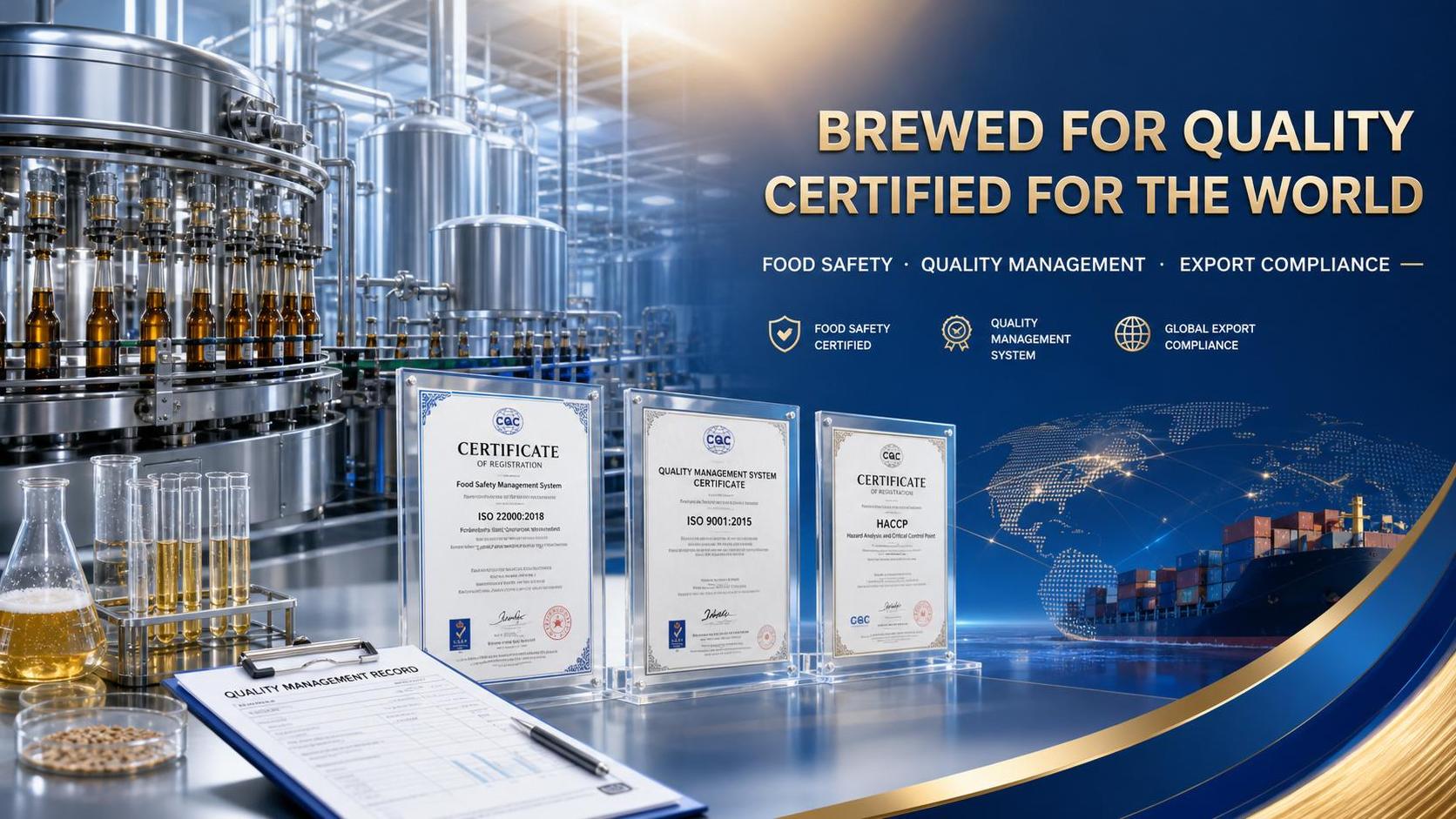
Why do certifications matter when choosing a Chinese beer factory?
A capable Chinese beer factory is not judged by packaging alone. The real proof sits in its certification system, audit records and daily execution.
For beer, quality issues rarely come from one single step. They usually involve raw materials, brewing hygiene, filling control, storage and export documentation.
That is why certifications matter. They help verify whether the factory manages risks in a structured and repeatable way.
In practical terms, the right certifications reduce supplier screening time, support internal audits and make OEM or wholesale cooperation easier to standardize.
This is especially relevant for a Chinese beer factory serving multiple channels, from bars and supermarkets to cross-border retail and private label programs.
For example, breweries that develop classic lager, German wheat, sugar-free low-calorie beer, fruit beer and specialty functional products often face different control points.
A broader product mix usually demands stronger documentation, validated procedures and clearer evidence of compliance.
Which certifications should a Chinese beer factory have first?
The short answer is this: start with food safety, legal production and quality management. Without those, other claims have limited value.
A reliable Chinese beer factory should normally be able to show the following core credentials.
- A valid food production license required for beer manufacturing in China.
- HACCP or an equivalent food safety control system focused on process hazards.
- ISO 22000 or FSSC 22000 for documented food safety management.
- ISO 9001 for quality management consistency across purchasing, production and complaint handling.
- Product testing reports from qualified laboratories for microbiology, alcohol content and labeling items.
If export is involved, the factory may also need destination-specific registrations or declarations. Those are not always permanent certificates, but they are still essential.
The table below helps separate what is usually mandatory from what is strongly recommended.
Is HACCP enough, or should you ask for ISO 22000 as well?
This is one of the most common questions. HACCP is important, but on its own it is not always enough.
HACCP focuses on hazard analysis and critical control points. It is very useful for brewing, filtration, filling and sanitation controls.
ISO 22000 goes further. It links hazard control with management responsibilities, documentation, internal audits, corrective action and communication across the supply chain.
If the Chinese beer factory supports OEM projects, custom formulas or multi-country distribution, ISO 22000 often gives stronger assurance than HACCP alone.
That becomes more relevant when the product range is complex. Fruit-flavored beer, sugar-free low-calorie beer and functional beer can create additional control points.
These may include sweetener management, flavor stability, allergen review, fermentation consistency and label claim verification.
A better way to judge the factory is not to ask which certificate sounds better. Ask how the system works in production.
- Are CCP limits clearly defined and recorded?
- Are cleaning verification records available for fillers and tanks?
- How are nonconforming batches isolated and investigated?
- How often are internal audits and management reviews completed?
A certificate opens the door. The records behind it show whether the control system is alive.
What export and market-specific certifications may also be needed?
A Chinese beer factory can be fully compliant in China and still fall short in an export project. That gap often appears in labeling, registration or customer-specific approval.
Different markets may require different supporting files, even for the same beer recipe.
In actual projects, the more common checks include ingredient declarations, nutrition panel rules, shelf-life evidence, packaging compliance and country-specific import registrations.
Some buyers also ask for BRCGS, Sedex or environmental documentation. These are not universal for beer, but they can matter in retail or branded supply chains.
For long-term cooperation, ask the Chinese beer factory whether it has experience with online and offline global channels. That usually affects documentation discipline.
A brewery exporting craft beer to supermarkets, restaurants and bars in different countries often develops stronger version control for labels and batch records.
Needless to say, export readiness is not one paper. It is the ability to convert certification into usable compliance files.
How can you verify whether a Chinese beer factory certificate is actually reliable?
A certificate should never be reviewed in isolation. The safer method is to compare the certificate with plant reality, product scope and recent records.
Start by checking the issuing body, validity period and exact scope. Sometimes the certificate covers beverages broadly, but not the specific beer process you need.
Then check whether the site address matches the real production location. This sounds basic, but it prevents avoidable risk.
After that, review evidence that the system is operating, not just framed on a wall.
- Recent internal audit reports and corrective actions.
- Finished product testing trends, not only one passing report.
- Traceability drills from raw materials to packaged beer.
- Supplier approval files for malt, hops, yeast, flavors and cans or bottles.
- Change control records for formula, process or packaging updates.
If the Chinese beer factory offers OEM or ODM services, also check how it manages custom labels, formula confidentiality and specification approval.
That is where many certification systems are tested in real life, especially when several SKUs move through the same line.
What are the common mistakes when reviewing brewery certifications?
One common mistake is assuming that more certificates always mean lower risk. A shorter list with strong execution can be more reliable than a longer list with weak control.
Another mistake is focusing only on food safety and ignoring legal or commercial fit. A Chinese beer factory may pass audits but still struggle with export labeling or batch consistency.
It is also risky to ignore product-specific needs. Low-calorie, fruit or functional beer may require extra attention to ingredient claims, stability and sensory consistency.
A third mistake is reviewing certificates only at onboarding. In longer supply relationships, the more useful approach is periodic revalidation.
That can include annual certificate updates, trend review of deviations and confirmation that new SKUs still fit the approved process scope.
When a brewery supplies many retail channels worldwide, certification should be treated as a dynamic control tool, not a one-time checkbox.
What should you ask before starting OEM, wholesale or long-term cooperation?
Before moving forward, build a short but practical review list. It helps turn certification claims into a real approval decision.
- Which certificates are current, and which products do they cover?
- Can the factory provide recent audit summaries and corrective action evidence?
- What export documents can be prepared for the target market?
- How are formula changes, packaging changes and rework controlled?
- What is the complaint response process for sensory, leakage or microbiological issues?
A strong Chinese beer factory should answer these questions clearly and back them with records.
That matters whether the project involves standard lager, wheat beer or customized craft beer for different distribution channels.
In the end, the best certification strategy is not about collecting badges. It is about confirming legal compliance, stable brewing control and export readiness in one connected review.
If you are comparing suppliers, start with the mandatory licenses, then check food safety systems, then verify market-specific documents against your target channels.
That sequence keeps the evaluation practical and makes it easier to choose a Chinese beer factory with lower operational risk and better long-term fit.
Thank you very much for writing to us. Please leave your message and contact information, we will reply to you within 24 hours.