



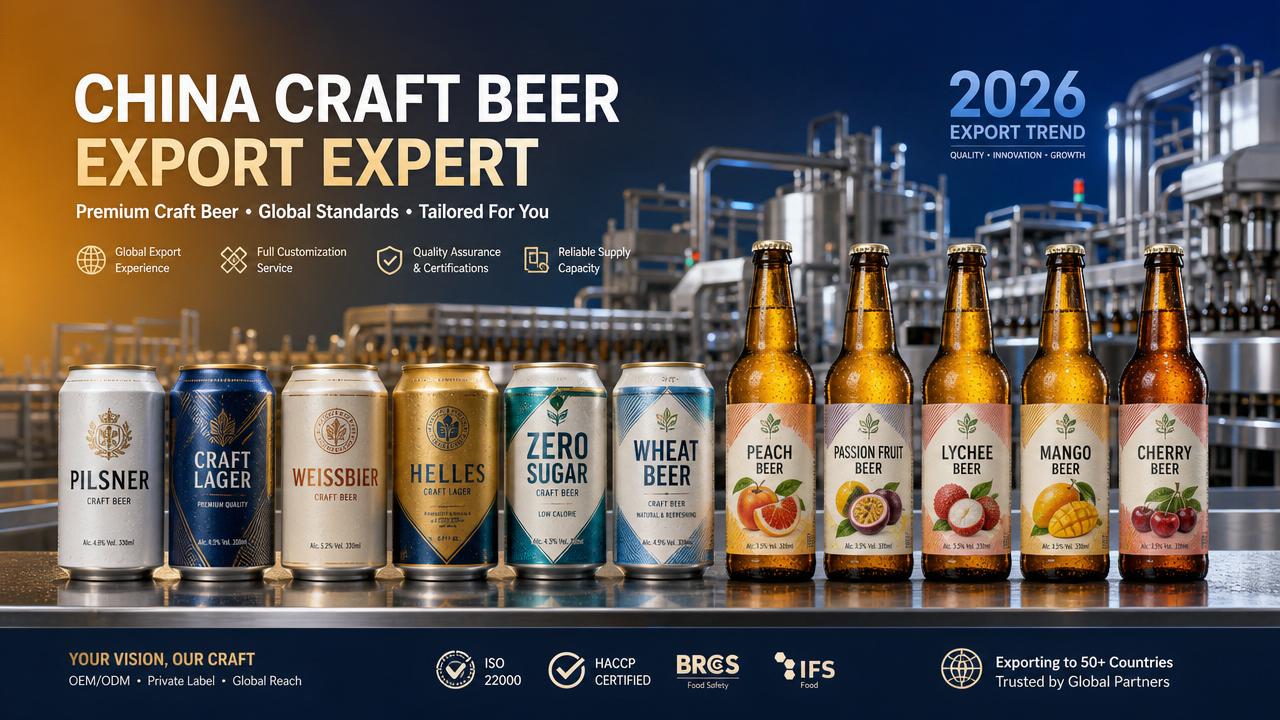
As global buyers refine sourcing plans for 2026, Chinese craft beer factory export trends are becoming a key signal for pricing, product innovation and private-label opportunities. From classic lager and German wheat to sugar-free, fruit and functional beers, manufacturers are adapting quickly to changing retail and on-trade demand. This overview helps information-focused readers understand what is shaping orders, partnerships and market potential in the year ahead.
For most buyers, the main question is not whether China can export craft beer, but how factory capabilities are changing and which shifts will matter most in 2026 orders.
The short answer is clear: Chinese suppliers are moving beyond low-cost volume production and competing more on flexibility, formulation speed, private-label support and export-ready compliance.
That matters for importers, distributors and retail brand owners who need reliable supply, differentiated products and better margins in a market where consumer preferences are fragmenting quickly.
What Information-Focused Buyers Are Really Trying to Learn
When people search for Chinese craft beer factory export trends, they are usually comparing sourcing options rather than looking for general industry background or beer culture commentary.
They want to know whether Chinese factories can support 2026 demand with stable quality, attractive pricing, customized product development and fewer operational risks across export markets.
They also want evidence of which beer categories are gaining traction, how packaging decisions affect channel fit, and where private-label opportunities are strongest for new launches.
In other words, the search intent is practical. Readers are trying to assess supplier relevance, market timing and order potential before entering deeper negotiations or sampling programs.
Why 2026 Orders Will Be Shaped More by Product Mix Than by Volume Alone
One of the biggest shifts in Chinese craft beer factory export activity is the move from standard SKUs toward more segmented and channel-specific product portfolios.
In earlier export cycles, many buyers focused heavily on a few familiar styles such as lager or wheat beer, with limited variation in format or positioning.
For 2026, that approach looks less competitive. Retailers and hospitality buyers increasingly want products aligned with wellness, flavor novelty, local consumer habits and shelf differentiation.
This is why product mix is becoming a stronger order driver than simple production scale. Factories that can offer broader style coverage are better positioned to win export business.
Classic lager remains important because it supports higher-volume mainstream distribution and gives private-label buyers a lower-risk entry point in many price-sensitive markets.
German wheat beer continues to perform well because it balances familiarity and craft appeal. It is often easier to place in supermarkets, casual dining and specialty retail channels.
At the same time, sugar-free and low-calorie beer is gaining strategic importance. Buyers increasingly see it as a way to connect with health-conscious consumers without leaving the beer category.
Fruit-flavored beer is also attracting attention, especially in younger consumer segments and in markets where approachable flavor profiles improve trial rates and repeat purchases.
Functional specialty beers, while still a narrower segment, are becoming useful for brand storytelling. They can help distributors position a line as innovative rather than interchangeable.
How Chinese Factories Are Adapting to Demand for Customization
A major reason the Chinese craft beer factory export market is drawing more interest is the growing availability of OEM and ODM support for different buyer types.
For many importers, customization is no longer a bonus. It is a requirement, especially when shelf competition is intense and retailers expect exclusive or differentiated offerings.
Chinese factories are responding by improving recipe development, packaging design coordination, flavor adjustment and minimum order flexibility across multiple beer styles.
This is especially relevant for distributors building private-label ranges. They may need one dependable core lager, one wheat beer and one trend-led product for faster market testing.
Factories with strong R&D capabilities can shorten this process by translating a market brief into sample formulations more efficiently than suppliers focused only on standard exports.
That speed matters because timing often determines whether a buyer captures a retail listing window, a seasonal promotion cycle or a new hospitality account rollout.
For 2026, buyers should expect the most competitive exporters to present not just products, but solution packages built around channel use, target consumer and price architecture.
Which Beer Categories Are Likely to Drive Export Growth in 2026
Not every product trend will translate into large export orders, so buyers should distinguish between attention-grabbing innovations and commercially durable categories.
Classic lager will remain the foundation of many export programs because it has wide consumer acceptance, efficient production economics and simpler positioning across multiple channels.
German wheat is likely to keep growing in markets where drinkers want a more premium feel without moving into highly bitter or experimental craft styles.
Sugar-free low-calorie beer may become one of the most strategically important segments, especially for supermarket chains, convenience formats and urban retail channels.
The reason is simple: this segment supports premiumization and health-oriented messaging at the same time, giving buyers more room to define a modern brand narrative.
Fruit-flavored beer will likely remain strong for entry-level craft consumers, social drinking occasions and markets where sweeter or lighter profiles broaden category participation.
Functional specialty beers are less predictable in volume, but they can be highly useful in selective markets where novelty and concept-driven branding influence purchase decisions.
For buyers, the best 2026 strategy may not be choosing one trend, but combining a stable core range with one or two higher-interest extensions for margin and visibility.
Pricing Pressure Is Real, but Buyers Are Looking Beyond the Lowest Quote
Price remains a major factor in Chinese craft beer factory export decisions, yet 2026 sourcing behavior is becoming more nuanced than simple quote comparison.
Buyers are increasingly evaluating total value, including formulation quality, packaging consistency, export experience, document accuracy and responsiveness during development and fulfillment.
A cheaper offer can lose its advantage quickly if it creates delays, inconsistent taste profiles, damaged packaging or relabeling costs after arrival in the destination market.
This is why many informed buyers are shifting from pure unit-price thinking toward landed-value analysis. They want fewer surprises and more control over long-term margin stability.
Chinese factories that can maintain competitive cost structures while offering stronger service support may therefore outperform lower-priced suppliers with weaker coordination capabilities.
In practical terms, 2026 orders are likely to favor exporters that combine acceptable pricing with customization, dependable lead times and export documentation competence.
Compliance and Export Readiness Are Becoming Stronger Selection Filters
Another key trend shaping Chinese craft beer factory export decisions is stricter buyer attention to compliance, labeling and destination-market readiness.
This is particularly important for readers in the research phase, because product appeal means little if the factory cannot support smooth customs clearance or market entry requirements.
Buyers increasingly want clarity on ingredients, alcohol content accuracy, shelf life, packaging specifications and the factory’s ability to meet local language or format rules.
They also care about consistency between samples, production batches and commercial shipments. Any mismatch can damage trust and increase launch risk for importers or retailers.
For that reason, experienced exporters are improving internal quality control and communication workflows, not just brewing capability. Documentation discipline has become part of competitiveness.
In 2026, factories that present themselves as export-ready partners rather than simply product manufacturers are likely to win more serious international conversations.
Packaging Choices Will Influence Channel Success More Than Many Buyers Expect
Packaging is often treated as a secondary topic, but it is increasingly central to order planning in the Chinese craft beer factory export market.
The right packaging format affects shipping efficiency, shelf presentation, consumer perception and suitability for bars, supermarkets, restaurants and online retail channels.
For example, standard cans may work well for mainstream retail and logistics efficiency, while premium bottle formats can support upscale restaurant or gifting positioning.
Private-label buyers should also consider how design complexity influences production timelines, approval cycles and minimum order planning across multiple SKUs.
Factories able to advise on both technical and commercial packaging implications can add real value, especially for buyers entering new markets or launching unfamiliar categories.
For 2026, packaging decisions should be evaluated alongside product style, target channel and expected sell-through speed, not as a late-stage branding detail.
What Makes a Chinese Craft Beer Export Partner More Competitive Today
Not all manufacturers are equally prepared for international craft beer business, even if they can produce similar product types on paper.
The more competitive factories usually show strength across several areas: recipe development, consistent brewing standards, private-label service, channel understanding and export coordination.
They are also more likely to communicate clearly about lead times, sampling stages, order adjustments and the trade-offs between customization, cost and production efficiency.
For buyers, this matters because the ideal supplier is rarely the one with the longest product list alone. It is the one that can translate market goals into executable supply plans.
That is especially true for businesses serving restaurants, bars, supermarkets and mixed retail networks, where product fit and replenishment reliability directly affect account growth.
Companies such as Jinpai Beer reflect this broader market direction by combining craft beer R&D, diversified production and OEM/ODM support across classic and trend-led categories.
A supplier with that range can be useful for buyers who want to test multiple positioning paths without managing several factories at the same time.
How Buyers Can Evaluate 2026 Opportunities More Effectively
For readers in the information-gathering stage, the best next step is not rushing into large volume discussions, but building a structured comparison framework.
Start by identifying your likely channel mix. A product suited to bars may not perform the same way in supermarkets or online retail environments.
Then compare suppliers based on category strength, customization support, compliance readiness, packaging options and communication efficiency, not only price or catalog breadth.
Ask which beer styles are strongest in their current export business, how they support private-label development and what flexibility exists around formulation and format.
It is also wise to assess whether the factory understands your commercial goals. A technically capable producer may still be a poor fit if it lacks market orientation.
For 2026 planning, buyers should also think in portfolio terms. A combination of classic, health-led and flavor-led products may provide better resilience than a single-style approach.
Conclusion: The Real Meaning of Chinese Craft Beer Factory Export Trends for 2026
The most important takeaway is that Chinese craft beer factory export growth is no longer defined mainly by cost advantage or generic capacity.
It is being shaped by broader capabilities: product diversification, private-label support, export readiness, packaging flexibility and responsiveness to changing consumer demand.
For information-focused readers, this means evaluating Chinese suppliers through a commercial lens. The key question is not simply who can produce beer, but who can support market success.
In 2026, the strongest opportunities are likely to come from factories that offer a dependable core range while helping buyers develop differentiated products for specific channels and audiences.
Buyers who understand these trends early will be better positioned to place smarter orders, reduce sourcing risk and build more competitive beer portfolios for the year ahead.
Thank you very much for writing to us. Please leave your message and contact information, we will reply to you within 24 hours.