



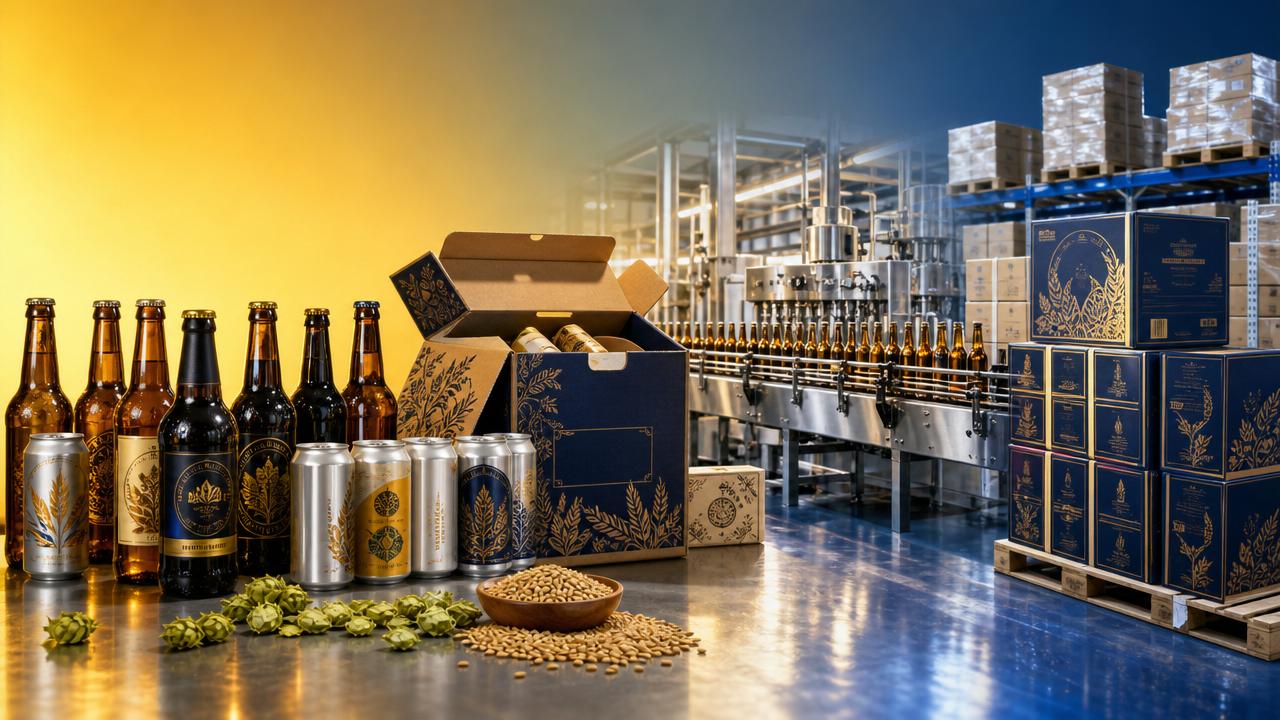
For buyers evaluating Chinese craft beer factory export options, choosing between OEM and private label affects cost, branding, speed to market and long-term competitiveness.
Jinpai Beer combines craft beer R&D, flexible production and global supply experience to help distributors, retailers and hospitality channels find the right export model.
This guide explains the practical differences, advantages and decision factors behind each model, so commercial teams can make a more confident sourcing decision.
What buyers usually want to know first: which model is better?
If the goal is fast market entry with limited development effort, private label is often the more efficient route for importers, retailers and hospitality groups.
If the goal is stronger product differentiation, custom recipes or channel-specific positioning, OEM usually creates more long-term strategic value despite a higher coordination burden.
In Chinese craft beer factory export projects, there is no universal winner. The better choice depends on brand maturity, target market, order scale and internal operating capability.
For business evaluators, the key question is not simply price. It is which model best balances margin, risk, branding control and supply reliability.
Understanding the difference between OEM and private label
In export beverage sourcing, OEM generally means the factory produces beer according to the buyer’s custom requirements, including recipe, alcohol level, packaging format or sensory profile.
Private label usually means the buyer sells products under its own brand, but based on existing or slightly adjusted formulas already supported by the manufacturer.
These two models can overlap in practice. Some suppliers call a semi-customized product OEM even when the liquid base is largely standard.
That is why procurement teams should ask detailed questions about recipe ownership, packaging flexibility, minimum order quantity and compliance responsibility before comparing quotations.
When private label makes more commercial sense
Private label is often the best starting point for supermarket chains, distributors, restaurant groups and bar operators that want a branded product without lengthy development cycles.
The biggest advantage is speed. A capable Chinese craft beer factory export partner can usually move faster when it uses proven formulations and existing production processes.
This helps reduce development risk, especially in markets where the buyer is still testing consumer demand for wheat beer, fruit beer or sugar-free low-calorie beer.
Private label also lowers technical pressure on the buyer. The factory already understands process stability, shelf life control and flavor consistency for the chosen beer style.
For commercial teams, this can improve launch predictability. Lead times, packaging timelines and regulatory document preparation are usually easier to estimate.
Another benefit is lower initial investment. Buyers may avoid repeated sample rounds, complex pilot testing and recipe adjustment costs that often come with deeper OEM development.
Private label is especially suitable when the brand value comes more from channel strength, retail presentation or localized marketing than from a fully proprietary product concept.
When OEM is the better long-term strategy
OEM becomes more attractive when the buyer wants a beer that is difficult to replace, easier to defend and better aligned with a differentiated market position.
For example, a distributor may want a functional specialty beer, a region-specific fruit profile or a sugar-free recipe tailored to local health-conscious consumers.
In these cases, OEM offers more room to build real product uniqueness instead of relying mainly on packaging design and sales execution.
OEM can also strengthen pricing power. When the liquid profile is customized, buyers are less exposed to direct comparison with similar off-the-shelf products from competing importers.
This is valuable in crowded retail and hospitality environments where margin pressure is high and brand substitution happens quickly.
For established beverage businesses, OEM supports portfolio architecture. A company can develop separate recipes for bars, premium retail, convenience channels or seasonal promotions.
However, buyers should be realistic. OEM requires clearer briefs, more internal approvals, longer validation and stronger cooperation with the factory on production feasibility.
Cost is more than unit price: how to compare the real economics
Many sourcing decisions fail because buyers compare only ex-works pricing instead of the total economics of the project.
Private label often has lower upfront cost, but that does not automatically mean better long-term profitability if the product lacks differentiation and faces intense price competition.
OEM may have higher sampling, design coordination and minimum order commitments, yet it can improve gross margin if it creates a stronger premium story.
Business evaluators should compare at least six cost layers: product cost, packaging cost, development cost, logistics cost, compliance cost and inventory risk.
They should also consider marketing efficiency. A distinctive beer may reduce the amount of discounting and promotional pressure needed to gain shelf presence.
In Chinese craft beer factory export planning, total landed cost should be measured together with expected sell-through, repeat order probability and channel-specific margin performance.
This broader view gives decision-makers a more accurate basis than a simple price-per-can or price-per-bottle comparison.
Brand control, product control and who owns the market story
For many buyers, the real issue is not only manufacturing. It is control over the brand story and how much of that story comes from the product itself.
Private label gives strong brand ownership on the surface because the label belongs to the buyer, but the beer itself may be less exclusive.
OEM usually gives deeper product control because the buyer can shape flavor, style direction and market positioning more intentionally.
If the company wants to build a long-term brand asset, it should ask whether consumers will remember only the packaging or also the actual drinking experience.
That distinction matters in craft beer, where repeat purchase is closely linked to taste consistency, style authenticity and perceived originality.
A reliable export factory should be able to explain where the buyer controls formula decisions, where the factory provides technical guidance and how future modifications are handled.
Operational risks buyers should assess before choosing either model
Commercial teams often underestimate operational risk when discussing OEM versus private label. Yet execution risk can determine whether a profitable concept succeeds in real markets.
Key risks include unstable taste consistency, unclear packaging approval workflows, delayed raw material procurement and incomplete export documentation.
For OEM projects, another risk is over-customization. A recipe that sounds attractive in theory may become expensive, slow or difficult to reproduce at scale.
For private label projects, the main risk is weak defensibility. If the product is easy to imitate, distributors may face aggressive competition from similar offers.
Buyers should also review MOQ flexibility, sample confirmation procedures, quality claims handling and the supplier’s willingness to support multiple packaging formats.
A strong Chinese craft beer factory export partner reduces uncertainty by documenting processes clearly and aligning technical feasibility with commercial expectations from the beginning.
How to evaluate a Chinese craft beer factory export partner
Choosing between OEM and private label only makes sense after confirming whether the factory can support the model properly.
First, assess product breadth. A supplier with experience in lager, German wheat, fruit beer, sugar-free low-calorie beer and specialty functional beer is usually more adaptable.
Second, review R&D capability. This is critical for OEM, but it also matters for private label because even standard products may need market-specific tuning.
Third, examine packaging and customization options. Can the factory handle cans, bottles, label changes, carton design and channel-specific presentation efficiently?
Fourth, ask about export experience. International distribution requires understanding of shelf life expectations, document accuracy, loading plans and communication discipline.
Fifth, verify production consistency and scalability. A sample that tastes good is not enough if the factory cannot maintain that result across repeat orders.
Finally, evaluate cooperation quality. Fast response, transparent quotation logic and realistic lead time commitments are often better indicators than promotional claims.
Which model fits which buyer profile?
Private label usually fits buyers entering a new category, launching a store brand, testing demand or expanding product lines with lower complexity.
It also suits hospitality groups that need a branded beverage quickly for chain restaurants, bars or event channels without creating a fully custom recipe.
OEM usually fits established distributors, regional beverage brands or importers with a clear market gap to target and enough volume to justify development effort.
It is also suitable for businesses that want to create exclusive offerings for premium retail, on-trade accounts or health-oriented consumer segments.
If the organization has limited technical bandwidth, private label is often the safer first move. If it has stronger category strategy and long-term brand ambition, OEM may deliver more value.
A practical decision framework for business evaluators
Start with the market objective. Are you trying to launch quickly, defend margin, build exclusivity or fill a channel gap?
Then define the level of product uniqueness required. If standard quality with branded packaging is enough, private label may be the efficient answer.
If unique flavor, nutritional positioning or format innovation is commercially important, OEM deserves closer attention despite the added complexity.
Next, test internal readiness. Can your team manage sampling cycles, technical decisions, packaging approvals and forecast planning effectively?
After that, compare factory capabilities against your intended route. Not every supplier that offers OEM truly has strong development depth, and not every private label program is flexible enough.
Finally, model three scenarios: conservative, expected and growth case. This helps reveal whether the chosen export model still makes sense under different demand outcomes.
Why Jinpai Beer can support both routes
Jinpai Beer combines craft beer R&D, production and distribution capabilities, making it suitable for buyers comparing private label simplicity with OEM customization.
Its portfolio covers classic lager, German wheat, sugar-free low-calorie beer, fruit-flavored beer and functional specialty beers, which supports multiple channel strategies.
For buyers wanting faster commercialization, Jinpai Beer can support private label projects based on proven styles with tailored branding and packaging options.
For buyers seeking stronger differentiation, its OEM and ODM services provide room for recipe development, market adaptation and customized product planning.
Because the company serves global online and offline channels, it also understands the practical needs of distributors, supermarkets, bars, restaurants and broader retail networks.
That combination matters in Chinese craft beer factory export cooperation, where technical capability and commercial execution need to work together.
Conclusion: choose the model that matches your market strategy, not just your initial budget
For most buyers, private label is the faster and lower-risk option for launching a branded beer program, especially when speed and manageable complexity matter most.
OEM is usually the better path when product uniqueness, premium positioning and long-term defensibility are central to the business case.
The smartest decision comes from comparing market goals, internal capability, total economics and supplier strength as one connected framework.
In the end, successful Chinese craft beer factory export sourcing is not about choosing the trendier term. It is about choosing the model that fits your commercial reality.
With the right manufacturing partner, both OEM and private label can create strong results. The difference is whether the route matches your growth strategy and execution capacity.
Thank you very much for writing to us. Please leave your message and contact information, we will reply to you within 24 hours.