



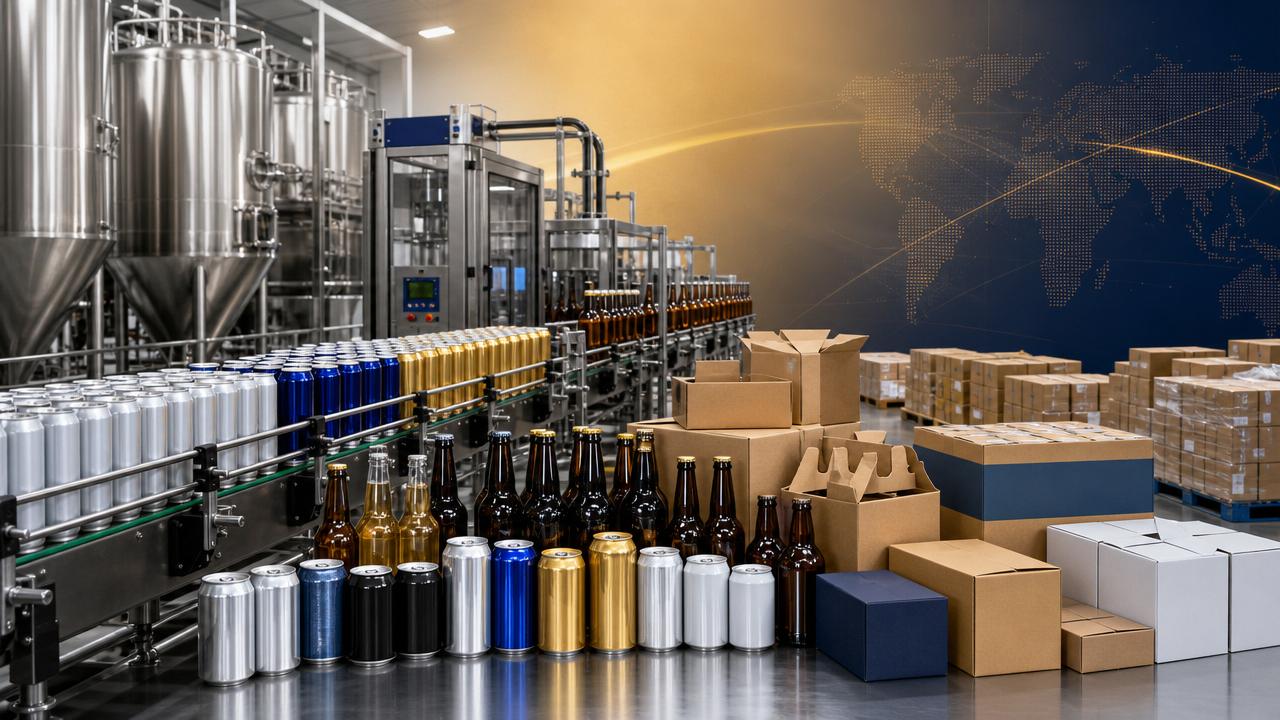
Choosing a Chinese beer factory for private label is not only about unit cost. Lead time, flexible scaling and stable output shape the success of every beverage launch.
In beer sourcing, delays can affect seasonal promotions, retail shelf timing and distributor confidence. A factory that scales smoothly helps protect cash flow and brand reputation.
This guide explains how a Chinese beer factory for private label typically manages development, MOQ, brewing cycles, packaging schedules and export readiness.
It also shows how Jinpai Beer supports OEM and ODM projects across classic lager, German wheat, sugar-free low-calorie beer, fruit beer and functional specialty beer categories.
Understanding the role of a Chinese beer factory for private label
A Chinese beer factory for private label produces beer under a buyer’s own brand, formula preference and packaging design.
Services often include recipe adjustment, pilot brewing, can or bottle sourcing, label application, carton design and export documentation.
Compared with simple wholesale supply, private label projects require closer control over flavor consistency, packaging accuracy and delivery milestones.
In the beer and beverage sector, factory capability matters because brewing is time-sensitive. Fermentation, filtration, maturation and filling all require coordinated scheduling.
Core service areas
- OEM beer production based on existing recipes
- ODM development for custom flavor positioning
- Packaging customization for cans, bottles and cartons
- Bulk supply for online and offline retail channels
- Export support for international beverage distribution
Lead time structure from concept to shipment
Lead time is one of the most important indicators when evaluating a Chinese beer factory for private label.
Beer production is not an instant process. Even a standard lager needs time for brewing, fermentation, conditioning, filling and quality release.
Custom packaging can extend the schedule further, especially for printed cans, special bottles or mixed-flavor retail packs.
Typical project timeline
For repeat orders, timelines are usually shorter. Approved recipes and stable packaging specifications reduce setup time and simplify production planning.
Factors that change lead time
- Beer style and fermentation duration
- Seasonal production peaks before holidays
- Imported ingredient requirements
- Custom packaging complexity
- Label compliance for destination markets
Production scale and MOQ planning
A capable Chinese beer factory for private label should support both pilot launches and larger commercial volumes.
MOQ does not only reflect brewing cost. It also relates to packaging supplier minimums, line efficiency and warehouse batch management.
Small trial orders are useful for market testing, but they need realistic expectations on packaging options and unit economics.
Common scale levels
Jinpai Beer offers a broad product range, which helps align MOQ decisions with category strategy rather than forcing one standard solution.
Classic lager may fit larger mainstream volumes. Fruit-flavored beer or functional beer can start with more focused launch quantities.
Current industry focus in private label beer sourcing
The market for Chinese beer factory for private label services has become more sophisticated. Buyers now compare more than basic brewing capacity.
- Faster launch cycles for seasonal and promotional beer lines
- Demand for low-calorie and sugar-free formulations
- Growth of fruit-flavored and specialty beer categories
- Higher attention to export labeling and food safety documents
- Pressure for reliable replenishment across online and offline channels
These shifts favor breweries with internal R&D, diverse recipes and organized production scheduling.
Jinpai Beer’s portfolio reflects these trends through craft beer development, customized solutions and worldwide channel coverage.
Business value of scalable beer production
The right Chinese beer factory for private label reduces uncertainty across planning, logistics and sales execution.
Reliable scaling improves launch timing. It also helps maintain flavor consistency when moving from a sample batch to larger shipment volumes.
This is especially important in beer, where carbonation, aroma and mouthfeel can shift if process control is weak.
Practical value areas
- Lower launch risk through staged volume planning
- Better shelf availability with predictable replenishment
- Improved brand control through custom packaging
- Wider category expansion using one brewery partner
- Greater supply stability across multiple retail channels
Typical product and channel scenarios
Different beer styles and routes to market require different production planning assumptions.
Evaluation points before selecting a factory
Before confirming a Chinese beer factory for private label, it is useful to review technical and operational details together.
Key checks
- Ask for a clear production calendar, not only a price quote.
- Confirm MOQ by beer type and packaging format.
- Review sample consistency against future mass production standards.
- Check whether the brewery supports both OEM and ODM workflows.
- Verify export documents, shelf-life testing and labeling support.
- Understand contingency plans for raw material or packaging delays.
A strong partner should communicate realistic capacity, not just theoretical maximum output.
It should also match product style with process requirements, especially for wheat beer, fruit beer or functional formulations.
Next-step planning for a private label beer project
A successful launch starts with clear decisions on beer style, packaging, quantity target and shipment window.
When these inputs are defined early, a Chinese beer factory for private label can create a more accurate lead time and scaling plan.
Jinpai Beer supports private label development through R&D, production, wholesale supply and customized beer solutions for global distribution.
For projects involving classic lager, German wheat, sugar-free low-calorie beer, fruit-flavored beer or functional specialty beers, detailed discussion of volume, recipe and packaging is the best next step.
With the right manufacturing structure, lead time becomes manageable, scaling becomes predictable and long-term beverage growth becomes easier to support.
Related Posts
- ▶ What Makes a Chinese Beer Factory Competitive in Global Contract Brewing? Quality Consistency, Scalability, and IP Protection Frameworks
- ▶ How Chinese Beer Factory Export Performance Differs by Destination: EU Tariff Quotas vs. Southeast Asia Local Content Rules
- ▶ Why Malt Drink Factories Often Underestimate Water Treatment Needs for Beer Production — Hardness, Chlorine, and Silica Implications
Online Message
Thank you very much for writing to us. Please leave your message and contact information, we will reply to you within 24 hours.