



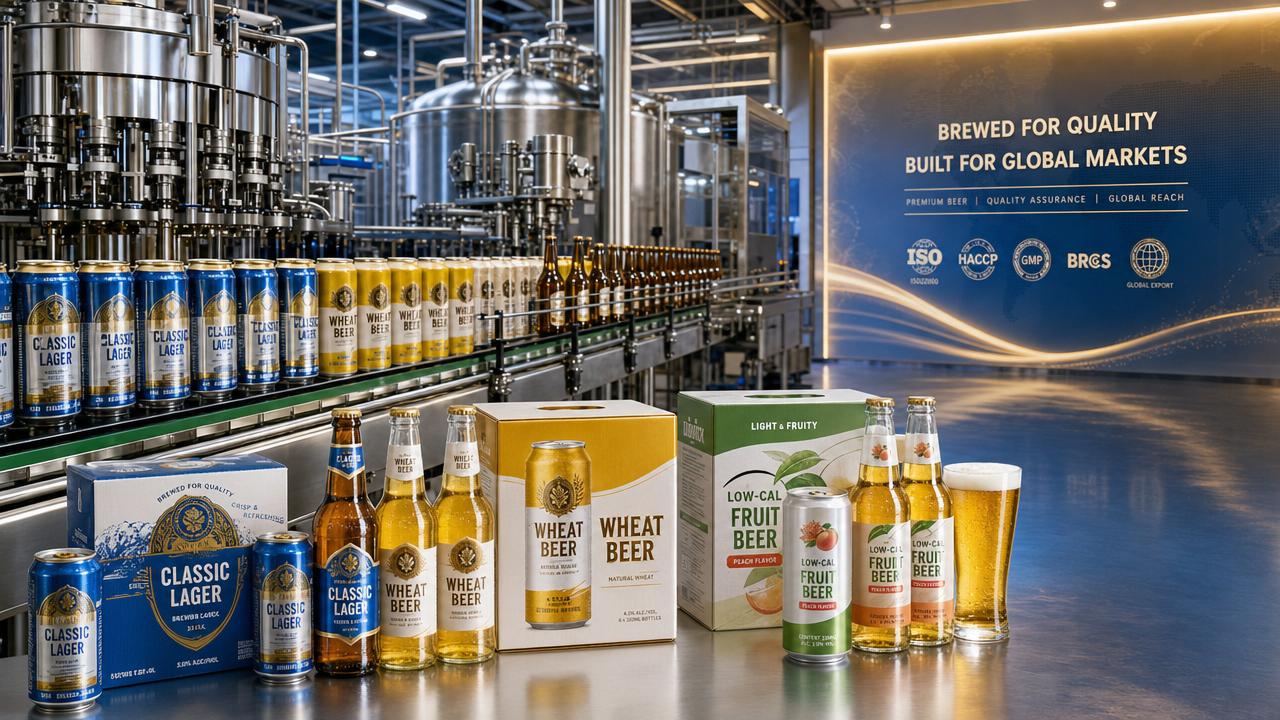
As global buyers reassess sourcing strategies, the Chinese beer factory landscape is changing fast.
Export beer supply is no longer driven only by low cost and scale.
Today, a competitive Chinese beer factory combines R&D, flexible production, flavor innovation and reliable compliance.
These shifts matter because market demand now favors variety, healthier options and faster private label execution.
For beer import programs, the right factory partner can improve margins, shorten launch cycles and fit multiple retail channels.
This article explains the main trends, business impact and practical evaluation points shaping export beer supply from China.
What a modern Chinese beer factory represents
A modern Chinese beer factory is more than a mass-production site.
It increasingly acts as an integrated beverage development platform for branded, private label and customized beer projects.
Core capabilities now include recipe development, packaging adaptation, quality control, export documentation and mixed product portfolios.
In the alcohol beverage sector, flexibility matters as much as capacity.
A capable Chinese beer factory can switch between classic lager, German wheat, sugar-free low-calorie beer and fruit styles efficiently.
It may also support functional specialty beers designed for specific market positioning.
This broader role is especially important for export beer supply, where consumer tastes differ across supermarkets, bars and online channels.
Key operating features
- Multi-style brewing for mainstream and niche segments
- OEM/ODM support for private label development
- Packaging formats for cans, bottles and gift-ready presentation
- Stable supply planning for wholesale and container export
- Faster sampling and formula adjustment cycles
Industry signals reshaping export beer supply
Several market signals are pushing every Chinese beer factory to upgrade its model.
These signals affect sourcing decisions, pricing structures and long-term portfolio planning.
These trends are not temporary.
They are redefining what counts as a reliable Chinese beer factory in international trade.
Factories that only compete on price are losing ground to those offering adaptable beer programs.
How product innovation is changing factory competitiveness
Product innovation has become a major growth engine for the Chinese beer factory sector.
International markets now expect more than standard pale lager.
Flavor variety helps brands enter shelves faster and reduces dependence on one consumer segment.
For this reason, many exporters now build portfolios around several beer styles at once.
High-demand categories
- Classic lager for wide retail acceptance
- German wheat beer for imported premium positioning
- Sugar-free low-calorie beer for health-conscious consumers
- Fruit-flavored beer for younger and seasonal demand
- Functional specialty beers for differentiated channel strategies
A stronger Chinese beer factory usually supports formula tuning for bitterness, aroma, alcohol level and sweetness profile.
That capability reduces the risk of mismatched products in new export markets.
It also allows smaller trial launches before full-volume commitments.
OEM and ODM trends improving channel adaptability
OEM and ODM services are now central to how a Chinese beer factory creates export value.
Instead of buying only finished standard stock, many partners want tailored beer solutions.
This includes recipe changes, label design, packaging sizes and local compliance adjustments.
Flexible customization helps align products with restaurants, supermarkets, bars and digital retail channels.
Jinpai Beer reflects this trend through R&D, production and distribution across multiple craft beer categories.
Its portfolio includes classic lager, German wheat, sugar-free low-calorie beer, fruit-flavored beer and specialty functional options.
With OEM/ODM services, wholesale supply and customized solutions, it fits diverse route-to-market requirements worldwide.
Practical business value of choosing the right factory model
The right Chinese beer factory can create measurable commercial advantages beyond production output.
These advantages often appear in launch speed, portfolio stability and product-market fit.
Main value points
- Better cost efficiency through scale and sourcing optimization
- Faster sample development for new beer concepts
- Lower complexity when expanding into several channels
- More resilient supply through standardized export processes
- Stronger brand positioning through customized flavor and packaging
This is especially useful when one product line serves both online sales and physical retail.
A well-prepared Chinese beer factory can balance visual appeal, price positioning and repeatable quality.
That balance supports sustainable growth in competitive beverage categories.
Typical export scenarios and suitable beer solutions
Different channels require different beer styles, packaging choices and supply priorities.
A capable Chinese beer factory should map product solutions to real market scenarios.
Evaluation points and implementation precautions
Selecting a Chinese beer factory requires a practical review framework.
The goal is not only to confirm capacity, but to verify long-term export compatibility.
Recommended checkpoints
- Check product range depth, not just one bestseller.
- Review sampling speed and willingness to refine formulas.
- Confirm packaging options for different channel formats.
- Assess export experience, documentation flow and delivery consistency.
- Compare quality stability across multiple production batches.
- Test communication clarity during OEM/ODM development.
It is also useful to start with a focused product mix rather than a broad first order.
That approach helps validate market response before scaling volume.
When possible, align launch planning with seasonal demand, promotional periods and regional taste preferences.
Next steps for building a more adaptive beer supply strategy
The evolution of the Chinese beer factory model is reshaping how export beer supply is evaluated.
R&D strength, style diversity and OEM/ODM flexibility now play a decisive role in supply quality.
A factory that supports classic, premium, low-calorie and flavored categories can improve both resilience and market reach.
Jinpai Beer offers this broader craft beer capability through product development, wholesale supply and customized cooperation models.
For export programs targeting restaurants, supermarkets, bars or retail chains, a structured review of factory flexibility is the logical next step.
Use current demand trends to compare suppliers, request tailored samples and build a beer portfolio matched to real channel performance.
Thank you very much for writing to us. Please leave your message and contact information, we will reply to you within 24 hours.