



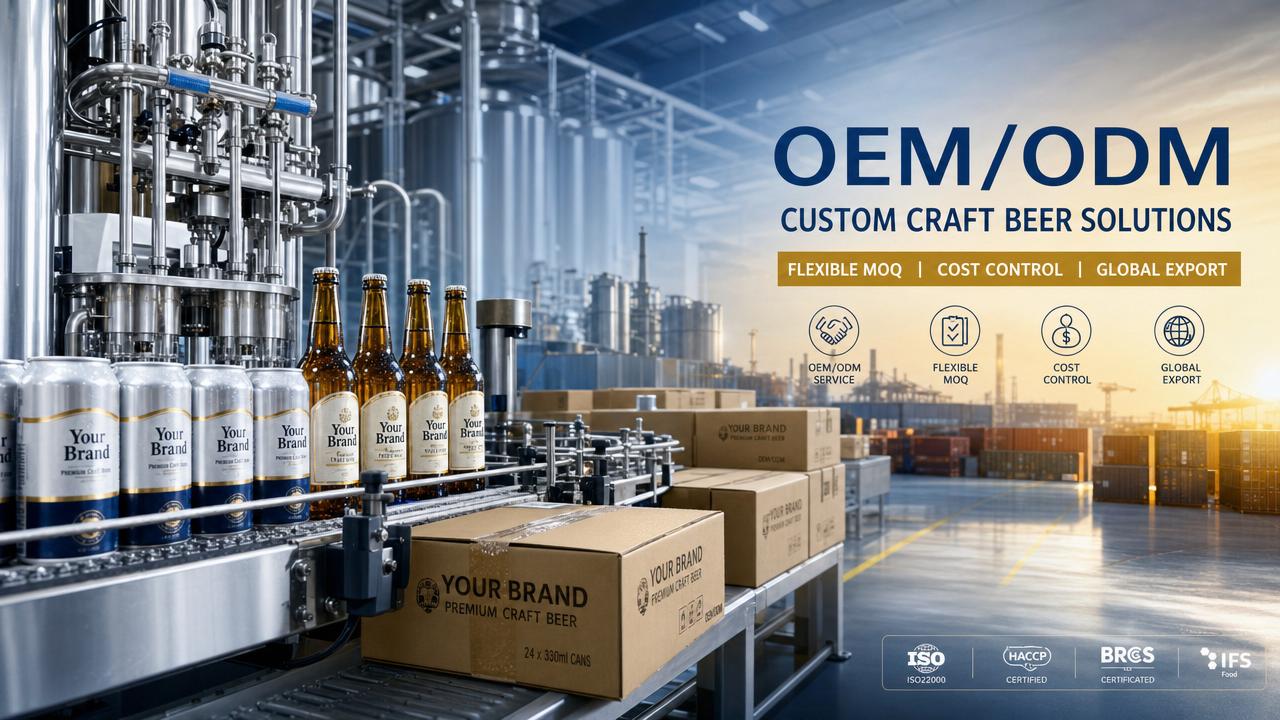
Chinese Beer Factory for Private Label in 2026: What Is Changing
Choosing a reliable Chinese beer factory for private label is becoming more strategic as 2026 approaches.
Cost pressure, packaging flexibility, and MOQ adjustments are reshaping sourcing decisions across the beverage market.
Jinpai Beer supports private label programs through craft beer R&D, OEM/ODM production, and export-ready supply coordination.
Its portfolio covers classic lager, German wheat, sugar-free low-calorie beer, fruit-flavored beer, and functional specialty beers.
When evaluating a Chinese beer factory for private label, a structured review helps reduce hidden cost, timeline risk, and quality inconsistency.
Why a Structured Review Matters Before Confirming Supply
Beer sourcing is no longer only about unit price.
Formula stability, label compliance, carton efficiency, and minimum production volume now affect profitability just as much.
A Chinese beer factory for private label may offer attractive quotations, yet real value depends on process transparency and execution consistency.
For 2026, buyers should expect more variation in raw material costs, can supply planning, and batch-based MOQ models.
That is why a practical checklist creates better comparisons between suppliers, product lines, and packaging combinations.
Key Points to Check When Comparing a Chinese Beer Factory for Private Label
- Confirm whether the factory develops both standard and customized recipes, including lager, wheat, low-calorie, fruit beer, and functional styles for different retail and on-premise channels.
- Check how MOQ changes by SKU, packaging format, alcohol level, and printing method, because 2026 orders may be split by production line efficiency.
- Review quotation structure carefully, including liquid price, can or bottle cost, carton fee, label charge, palletization, and export documentation.
- Ask about ingredient sourcing stability for malt, hops, fruit concentrate, sweeteners, and functional additives, especially for long-term private label programs.
- Verify quality control steps such as gravity testing, microbiology review, packaging inspection, and shelf-life validation before shipment release.
- Check whether the Chinese beer factory for private label supports OEM, ODM, formula adjustment, and sample iteration without excessive delay.
- Review packaging options like slim cans, standard cans, glass bottles, mixed cartons, and display-ready cases for market-specific merchandising needs.
- Confirm export experience, labeling compliance support, and document accuracy for customs, food registration, and destination-specific alcohol regulations.
- Measure lead time from sample approval to mass production, because promotional launches often fail when packaging artwork timing is underestimated.
- Ask whether the supplier can consolidate multiple beer styles into one shipment to improve container utilization and reduce landed cost.
2026 Cost and MOQ Signals Worth Watching
Several trends are likely to influence every Chinese beer factory for private label in 2026.
First, packaging materials may remain more volatile than beer liquid cost.
Printed cans, specialty lids, and lower-volume carton runs can increase the final quote faster than recipe upgrades.
Second, some factories are shifting from one fixed MOQ to tiered MOQ by packaging and formulation complexity.
That means a standard lager may start lower, while fruit beer or functional beer may require larger batches.
Third, mixed-SKU orders are becoming more important.
Factories with flexible scheduling can help reduce inventory pressure while maintaining container efficiency.
Fourth, compliance-related design revisions can add indirect cost.
A capable Chinese beer factory for private label should identify labeling issues before production begins.
Typical cost drivers to review
- Beer style complexity and ingredient type
- Can, bottle, tray, and carton specifications
- Pasteurization, filtration, and shelf-life requirements
- Artwork revisions and printing setup
- Container loading efficiency and route planning
How Product Type Affects Factory Selection
Classic lager and German wheat
These styles usually offer more stable production planning and simpler ingredient forecasting.
For a Chinese beer factory for private label, they often support lower development risk and easier repeat ordering.
Sugar-free low-calorie beer
This segment needs tighter formula verification, flavor balance testing, and clear nutrition communication.
Check whether the factory can maintain taste consistency across batches while meeting target positioning.
Fruit-flavored beer
Fruit profiles can raise both ingredient cost and MOQ requirements.
Ask about concentrate sourcing, color stability, sweetness control, and sediment management before approval.
Functional specialty beers
These products require careful positioning, ingredient compatibility, and destination-market labeling review.
A qualified Chinese beer factory for private label should explain technical limits early, not after sample confirmation.
Commonly Missed Risks During Factory Evaluation
Assuming the lowest quote means the best margin
A low opening quote may exclude packaging upgrades, document fees, or extra sampling rounds.
Ignoring the relationship between MOQ and artwork
Small liquid batches may still face high packaging thresholds if printed cans or custom cartons are required.
Overlooking shelf-life fit for the target channel
Beer for supermarkets, bars, and cross-border shipping does not always follow the same storage rhythm.
Approving samples without confirming mass production parameters
Pilot samples can differ from regular batches unless brewing, carbonation, and filling conditions are aligned.
Neglecting multi-channel packaging needs
Retail shelves, restaurants, and e-commerce distribution often need different carton strength and display formats.
Practical Steps for Smoother Execution
- Start with one core beer style and one adjacent variant to compare demand without creating excessive SKU complexity.
- Request a full cost breakdown from the Chinese beer factory for private label before discussing discounts or annual targets.
- Align recipe, packaging, labeling, and shipping assumptions in one confirmation document before deposit payment.
- Test whether mixed-order production is possible if your range includes lager, wheat, and flavored products.
- Reserve time for compliance review and artwork correction, especially for alcohol statements and nutrition-related claims.
- Plan reorder timing using realistic sea freight and customs timelines rather than ideal factory completion dates.
FAQ About Choosing a Chinese Beer Factory for Private Label
What MOQ is reasonable for 2026?
There is no universal number.
MOQ depends on beer type, packaging style, and printing setup, so comparison should be made by full project structure.
Can one factory support several beer categories?
Yes, if production lines, formulation capability, and raw material control are mature.
Jinpai Beer provides multiple styles for private label development under OEM/ODM cooperation.
How can landed cost be reduced without lowering quality?
Improve carton efficiency, combine compatible SKUs, simplify packaging components, and avoid unnecessary artwork complexity.
Next Steps for Better Sourcing Decisions
The best Chinese beer factory for private label is not simply the one with the cheapest offer.
It is the supplier that can match product goals, MOQ reality, packaging strategy, and consistent export execution.
For 2026 planning, reviewing formula capability, flexible production, and transparent costing should come first.
Jinpai Beer combines craft beer development, OEM/ODM customization, wholesale supply, and global channel experience to support long-term brand growth.
A focused checklist, a clear sample plan, and a complete cost review will make every private label decision more reliable.
Thank you very much for writing to us. Please leave your message and contact information, we will reply to you within 24 hours.