



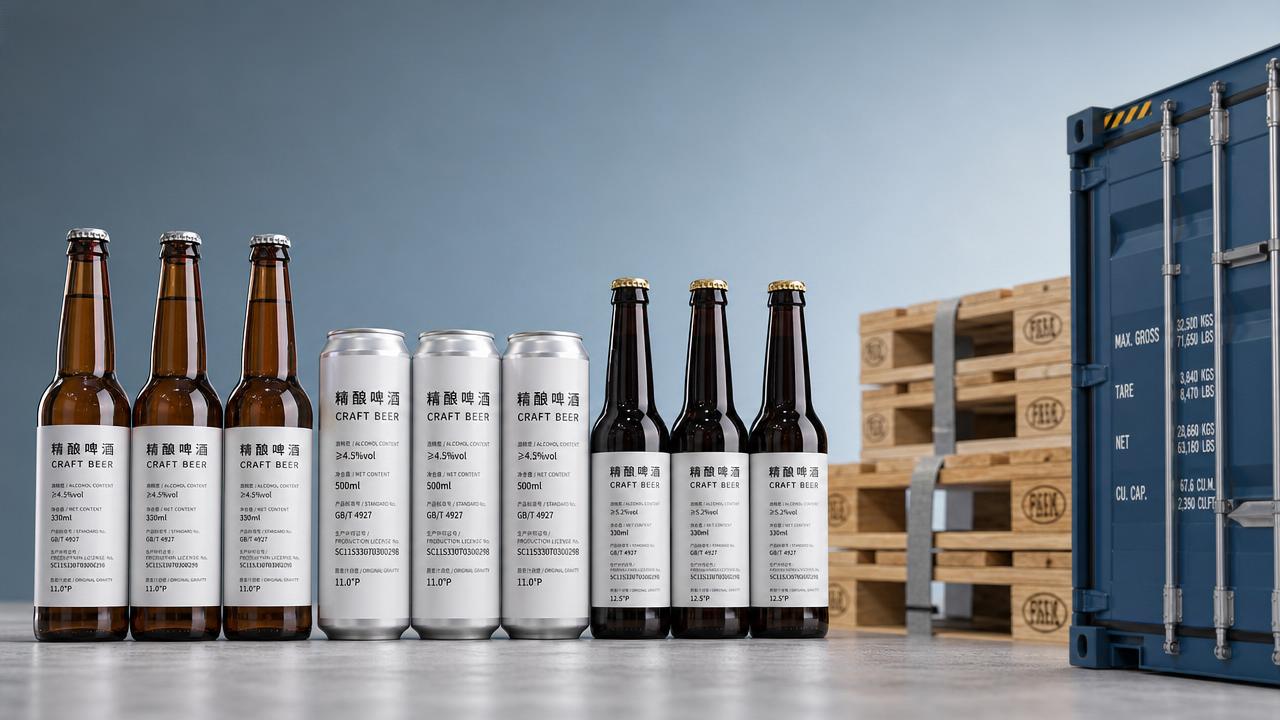
When evaluating China beer OEM partnerships, finance leaders often overlook hidden cost drivers—labeling compliance surcharges, inland logistics markups, and punitive small-batch minimums that erode margin predictability. At Jinpai Beer, we transparently break down every line item: from GB-standard label printing and bilingual regulatory certification to bonded warehouse handling and flexible MOQs starting at 500 cases. This isn’t just cost clarity—it’s budget control for procurement teams scaling craft beer distribution across restaurants, supermarkets, and retail channels globally.
What Exactly Is “China Beer OEM” — And Why Do Hidden Fees Accumulate?
“China beer OEM” refers to private-label brewing in China under a partner’s brand—where formulation, packaging, and regulatory compliance are managed by the manufacturer, not the client.
Unlike contract bottling in mature markets, China beer OEM involves layered compliance layers: national food safety standards (GB 4927), bilingual labeling rules, customs-bonded logistics, and provincial-level inspection protocols.
Hidden fees emerge when these requirements are treated as afterthoughts—not integrated into quoting, scheduling, or documentation workflows.
Labeling Compliance: More Than Just Printing Costs
Labeling is the #1 source of unexpected charges in China beer OEM engagements.
- GB-compliant artwork verification (mandatory bilingual Chinese/English, alcohol content, allergen statements, net volume, producer license number)
- Pre-print approval by local market supervision bureau—often requiring physical sample submission
- Reprint penalties for minor text edits post-approval (e.g., font size adjustments, QR code relocation)
- Batch-specific label variants for export vs. domestic sale—each requiring separate approvals
At Jinpai Beer, all label design, translation, and approval support is included in base OEM pricing. No surcharge for first-time submissions. No fee for up to two revision rounds per SKU.
Logistics Within China: The “Last 300 Kilometers” Trap
Many partners assume FOB Shanghai covers full port readiness—but inland transport, bonded warehousing, and customs coordination are rarely bundled.
Common unbundled costs include:
- Truck freight from brewery (Shandong or Guangdong) to designated port or bonded warehouse
- Storage fees during label approval delays or container scheduling gaps
- Customs declaration service fees—especially for multi-SKU shipments with varying HS codes
- Temperature-controlled haulage surcharges for craft lagers or fruit-flavored beers
Jinpai Beer operates dual logistics hubs—in Qingdao (for North Asia/EU exports) and Shenzhen (for SEA/US West Coast). All inland movement, bonded storage (up to 45 days free), and customs filing are quoted upfront—no “logistics escalation clauses.”
Small-Batch Minimums: When “MOQ” Means Margin Risk
Standard China beer OEM MOQs range from 1,500–3,000 cases. But those numbers hide real constraints:
- Minimum per SKU—not per order—so launching three flavors means tripling the base quantity
- MOQ recalculations if ABV, sugar content, or can/glass format changes between batches
- No carryover: unused volume from one order doesn’t offset next order’s MOQ
- Penalty pricing for orders below MOQ—often +28%–42% per case
Jinpai Beer offers true flexibility: 500-case MOQ per SKU, no format-based requalification, and 90-day volume rollover across consecutive orders. Ideal for test launches in supermarkets or limited-edition bar collabs.
How Jinpai Beer Structures Transparent China Beer OEM Pricing
Our cost breakdown eliminates ambiguity. Here’s how it maps to actual production workflow:
Choosing the Right Partner for China Beer OEM: 3 Actionable Checks
Before signing an agreement, verify these three operational checkpoints:
- Ask for a live label approval timeline. If they cite “2–4 weeks” without specifying bureau response windows or resubmission cycles, expect delays.
- Request a logistics map. Confirm whether inland movement originates from their owned facility—or a third-party toll brewer (which adds markup).
- Test MOQ flexibility. Submit a 3-SKU request totaling 600 cases. A transparent partner will quote pro-rata—not default to 1,500 per SKU.
Jinpai Beer provides all three—on demand, with no NDA required.
China beer OEM shouldn’t mean budget surprises. It should mean predictable scaling—whether launching sugar-free low-calorie beer in Berlin supermarkets, German wheat in Tokyo izakayas, or fruit-flavored variants in Miami beach bars. With Jinpai Beer, every cost is mapped, justified, and controllable before the first batch ferments.
Contact us today for a no-obligation cost breakdown tailored to your target SKUs, volumes, and destination markets. We’ll deliver full line-item transparency—and a sample batch within 18 working days.
Thank you very much for writing to us. Please leave your message and contact information, we will reply to you within 24 hours.