



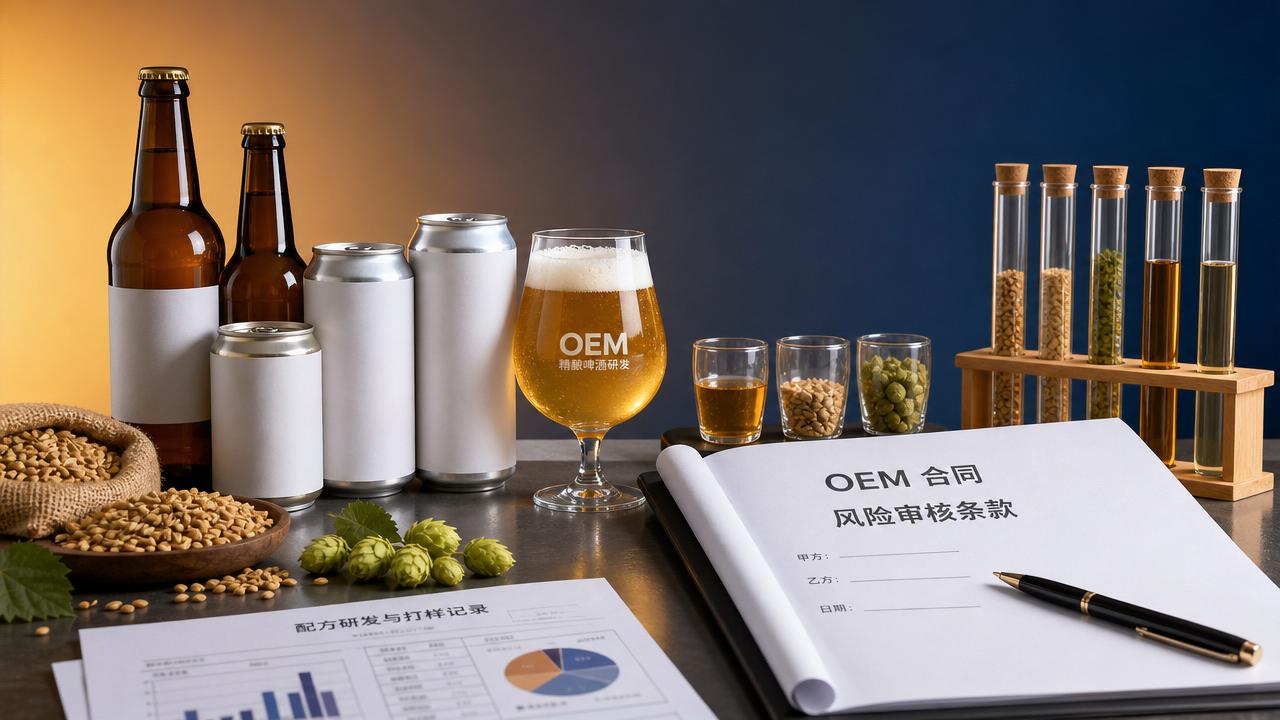
For business evaluators sourcing private-label beer, a key question is: Do China beer OEM factories offer R&D support? The short answer is yes, many do, but the real commercial value depends on whether that support is clearly defined in the contract. A factory may be able to develop recipes, adjust taste profiles, create low-calorie or fruit-flavored variants, and help with packaging adaptation, yet buyers still face avoidable risk if terms around trials, compliance, acceptance standards, exclusivity, and intellectual property are vague.
For buyers assessing Chinese beer manufacturers, the issue is not simply technical capability. It is whether the supplier’s R&D process is structured, whether deliverables are measurable, and whether contract terms protect your timeline, market strategy, and product ownership. This matters even more when the project involves customized craft beer, functional beer, sugar-free formulations, or market-specific regulatory requirements.
This article focuses on the main legal and commercial risks hidden in beer OEM R&D arrangements. It is written for business evaluators who need to judge supplier reliability, compare proposals, and reduce the risk of costly reformulation, launch delays, quality disputes, or weak ownership rights after product development is complete.
What business evaluators are really trying to confirm
When buyers search “Do China beer OEM factories offer R&D support,” they are rarely asking a simple yes-or-no technical question. Their real search intent is commercial due diligence. They want to know whether a Chinese beer OEM can support product customization in a way that is scalable, contractually reliable, compliant with target markets, and worth the investment.
In practice, target readers usually care about five issues. First, can the factory translate a product concept into a stable formula? Second, who pays for and owns the development work? Third, how many rounds of sampling and revision are included? Fourth, can the final beer legally enter the intended market? Fifth, what happens if the approved sample and mass production batch do not match?
That means the article should not spend much time on generic praise about China manufacturing or broad descriptions of craft beer trends. Those points do little to help procurement, sourcing, or strategy teams. What helps is a decision framework: what R&D support normally includes, where contracts are often weak, and what clauses should be reviewed before any payment, pilot run, or market launch commitment.
Yes, many China beer OEM factories offer R&D support, but the scope varies widely
Many established beer OEM and ODM factories in China do provide some form of research and development support. This may include recipe development, flavor adjustment, alcohol-by-volume tuning, bitterness and aroma balancing, functional ingredient integration, sugar reduction, shelf-life testing, packaging adaptation, and sample production. More advanced suppliers may also assist with consumer positioning or benchmarking against competitor products.
However, “R&D support” can mean very different things from one supplier to another. In some factories, it refers only to modifying an existing base formula. In others, it may include custom formulation from scratch, ingredient sourcing support, iterative sample testing, stability studies, and preparation of documentation for export or labeling review. Buyers should therefore never assume that two suppliers are offering the same service just because both claim OEM/ODM capability.
For business evaluators, the key takeaway is this: the question is not whether support exists, but whether the support is detailed, priced, and enforceable. If the proposal does not clearly define what the factory will actually do, the buyer may overestimate the supplier’s development strength and underestimate downstream risk.
The first major risk: unclear R&D deliverables
The most common problem in contract review is vague wording around development scope. Terms such as “assist with formula development” or “provide sample support” sound acceptable at first glance, but they are too broad to protect the buyer. A contract should define what the supplier must deliver and how success will be judged.
For example, if the buyer requests a fruit-flavored wheat beer or a sugar-free low-calorie beer, the agreement should specify target product characteristics. These may include alcohol content range, bitterness level, color, carbonation standard, sweetness profile, ingredient restrictions, calorie target, sensory benchmark, and packaging format. If these standards are omitted, disputes later become subjective and difficult to resolve.
From an evaluation perspective, unclear deliverables create three types of exposure. First, the supplier may stop after one sample and still claim the service is complete. Second, the buyer may continue requesting revisions without knowing the additional cost. Third, neither side has an objective acceptance basis, which can delay launch or damage the business relationship.
A stronger contract uses measurable outputs. It should identify the number of sample rounds included, the testing criteria, the timeline for each revision cycle, and the documents or specifications that define final approval. This protects both parties and makes supplier performance assessable rather than impression-based.
Sampling and pilot batch terms often create hidden cost and timing disputes
Product development in beer almost always requires sampling, tasting, technical feedback, and pilot production. Yet many OEM contracts do not clearly separate lab sample, pilot batch, and commercial batch stages. That creates confusion over cost responsibility, lead time, and approval standards.
Business evaluators should ask whether the quoted price includes initial sample creation, how many reformulations are covered, whether pilot brewing is mandatory before mass production, and who bears ingredient or packaging costs during development. This is especially important for specialty beers using imported hops, fruit concentrates, nutraceutical ingredients, or custom can and label designs.
A weak contract may let the supplier charge separately for each revision without a clear rate card. It may also allow broad schedule flexibility, which means development can drag on far longer than expected. In seasonal or trend-driven categories, such as summer fruit beer or functional craft beer, time-to-market can matter as much as formula quality.
Good contract drafting should therefore include a development schedule with milestones. It should define target dates for first sample, revised sample, pilot batch, packaging proof, and commercial production decision. It should also identify what events justify extension, such as ingredient shortages, regulatory changes, or buyer-side revision delays.
Formula ownership and intellectual property should never be assumed
One of the most sensitive issues in beer OEM R&D is ownership of the final formula. Buyers often believe that if they paid a development fee, they automatically own the recipe. Suppliers may believe that unless ownership is expressly transferred, the underlying formula, process know-how, or adaptation method remains theirs. Without a clear clause, both sides may hold different assumptions.
This matters most when the product has strategic value. If a buyer is developing a signature craft beer line, a market-exclusive sugar-free beer, or a functional specialty product for a chain retail program, uncertainty over formula ownership can weaken future bargaining power. The buyer may later find that the factory can supply a similar product to another customer, or that changing manufacturers requires redevelopment from the beginning.
Contracts should clearly distinguish among several rights: ownership of the formula, right to use the formula, exclusivity by territory or channel, ownership of packaging design, ownership of trademarks, and confidentiality of technical and commercial information. Even if a supplier retains core process know-how, the buyer may still require exclusive commercialization rights for a specific market or branded product line.
For evaluators, a practical rule is simple: if exclusivity or ownership matters to the business case, it must be expressed directly. General confidentiality language is not enough. Nor is a statement that “customized products shall not be disclosed.” The contract should define exactly what is exclusive, where, for how long, and under what production volume or purchase conditions.
Compliance risk is often underestimated in custom beer projects
Another major reason buyers ask, “Do China beer OEM factories offer R&D support,” is concern about regulatory fit. A factory may be able to produce a good-tasting beer, but that does not mean the product can be legally sold in the destination market under the intended claims, ingredient list, or labeling format.
This risk is higher for functional beers, low-calorie claims, sugar-free positioning, fruit additions, novel ingredients, and cross-border e-commerce products. Different markets may restrict health-related wording, require specific declarations, or apply technical rules to additives, allergens, alcohol statements, deposit terms, barcode systems, and language format.
Contracts should therefore clarify whether compliance review is included in the supplier’s R&D support and, if so, to what extent. Some factories can help align formulation and labeling with export experience, but they may not act as legal advisors for every destination country. Buyers should avoid assuming full regulatory responsibility has been transferred to the manufacturer unless the agreement clearly states so.
A better approach is to allocate responsibility in writing. The factory may confirm product specifications, production records, ingredient information, and manufacturing compliance in China. The buyer may remain responsible for legal review in the target market, trademark clearance, and final claim approval. Where possible, the contract should require cooperation in providing technical files, samples, and supporting documents needed for import or retail review.
Mass production consistency is a bigger risk than the first successful sample
Many private-label projects fail not because the sample was poor, but because the commercial batch did not match the approved sample. In beer manufacturing, slight changes in raw material source, fermentation control, filtration, carbonation, or storage conditions can affect taste, aroma, mouthfeel, clarity, and shelf stability.
For that reason, business evaluators should focus heavily on the link between R&D approval and production quality control. If the approved sample becomes the commercial benchmark, the contract should say so. It should also define allowable tolerance ranges for key indicators such as ABV, bitterness, color, dissolved CO2, microbiological standards, and packaging integrity.
This is especially important for craft and specialty beers, where flavor character is part of the brand promise. A generic statement like “quality shall comply with factory standards” may not be enough if your product positioning depends on a distinctive taste profile. The buyer should know whether retention samples are kept, how long they are stored, and how sensory disputes will be handled if the production lot differs from the signed-off sample.
In commercial terms, this is where a supplier’s R&D support should connect with quality assurance. The best OEM partners do not treat development as a one-time lab exercise. They build a path from concept to repeatable production, with specifications, process control, and issue-response procedures that reduce batch variation risk.
Exclusivity, channel conflict, and market protection need careful review
Business evaluators often assess beer OEM projects not only for product feasibility, but for strategic defensibility. If the buyer invests in product development for a supermarket program, regional distribution plan, or bar chain rollout, they want to know whether the same or similar beer could be sold by the factory to competing buyers.
This is where exclusivity terms become critical. Some buyers need formula exclusivity. Others only need packaging exclusivity, private-label confidentiality, or channel protection within a specific country. The correct structure depends on the business model, but the contract should define it precisely.
Vague expectations are dangerous. A buyer may assume that custom flavor work creates exclusivity by default, while the factory may treat the project as a routine adaptation of a standard base beer. Without clear restrictions, the supplier may legally sell a near-identical product under another label, particularly if the buyer does not own the formula or has not negotiated market exclusivity.
Well-drafted terms should define the protected product scope, geographic territory, sales channel, duration, and remedies for breach. They should also address whether exclusivity is conditional on minimum order quantities or annual purchase targets. This prevents future conflict and helps evaluators measure whether the supplier arrangement supports long-term brand value.
Minimum order quantity and pricing clauses can distort the real cost of R&D support
Some Chinese beer OEM factories advertise R&D support at low or zero upfront cost, but recover the expense through pricing, minimum order quantity, packaging requirements, or later formula change fees. That does not automatically make the offer bad, but it does mean evaluators should calculate total project cost rather than judge only the initial quotation.
A low development fee can still result in poor economics if the contract requires a large MOQ, limits packaging flexibility, or charges heavily for recipe adjustments after the first production run. Likewise, a factory offering broader technical support may appear more expensive upfront but reduce long-term risk through better process control, faster launch, and fewer compliance or quality issues.
The right evaluation method is to compare suppliers on total commercial impact: development fee, sample charges, testing costs, pilot run cost, MOQ, unit price, lead time, revision flexibility, and post-launch support. This gives a much more accurate picture of whether the OEM partner’s R&D support truly adds value.
What a stronger China beer OEM contract should include
For practical evaluation, buyers should look for several core elements in the development and manufacturing agreement. First, the product brief should be attached or clearly referenced, including target style, flavor profile, specification range, ingredient restrictions, packaging format, and intended market. Second, the R&D service scope should define the number of sample rounds, pilot procedures, and expected deliverables.
Third, the agreement should allocate costs for development, testing, packaging proofing, and rework. Fourth, the timeline should list milestones and extension triggers. Fifth, approval standards should define when a sample or pilot batch is considered accepted. Sixth, formula ownership, exclusivity, and confidentiality should be expressly stated rather than implied.
Seventh, the contract should address compliance support, document provision, and responsibility boundaries for destination-market regulations. Eighth, quality control terms should connect the approved sample to production standards and dispute handling. Ninth, price adjustment rules, MOQ, reorder conditions, and change request procedures should be transparent. Finally, termination and post-termination rights should clarify what happens to developed formulas, packaging materials, and unused inventory.
These points do not replace legal review, but they give business evaluators a practical checklist to identify which factory is offering a structured partnership and which is relying on broad promises.
How to judge whether a supplier’s R&D support is commercially credible
In supplier assessment, credibility comes from evidence, not from catalog language. Ask the factory to explain its development workflow from concept intake to final production. Request examples of how it handled custom beer projects, how many sample rounds are typical, what testing it performs, and how it manages consistency between pilot and mass production.
It is also useful to evaluate communication discipline. A supplier that can convert your business concept into a written development brief, timeline, specification sheet, and revision log is more likely to manage R&D professionally. This matters because many project failures come from misalignment rather than lack of brewing skill.
For categories such as classic lager, German wheat, fruit-flavored beer, sugar-free low-calorie beer, or functional specialty beers, the ideal OEM partner is one that combines formulation flexibility with transparent commercial terms. Buyers should prefer factories that can discuss both the technical path and the contractual structure needed to protect launch success.
Conclusion: the right question is not only whether R&D support exists, but whether the contract makes it usable
So, do China beer OEM factories offer R&D support? In many cases, yes. But for business evaluators, that answer is only the beginning. The true issue is whether the support is defined clearly enough to protect your investment, your schedule, your compliance position, and your product differentiation.
The biggest risks usually come from unclear deliverables, weak sampling terms, uncertain formula ownership, incomplete compliance responsibility, poor linkage between approved samples and mass production, and vague exclusivity arrangements. These are contract problems as much as manufacturing problems.
If a supplier can provide strong technical capability and a clear contractual framework, China beer OEM can be a highly effective route for private-label development and market-specific beer innovation. If the contract leaves major points open, even a technically capable factory may become a commercial risk. For that reason, the best sourcing decision is made not by asking whether R&D support is available, but by testing whether that support is specific, measurable, and enforceable before production begins.
Thank you very much for writing to us. Please leave your message and contact information, we will reply to you within 24 hours.