



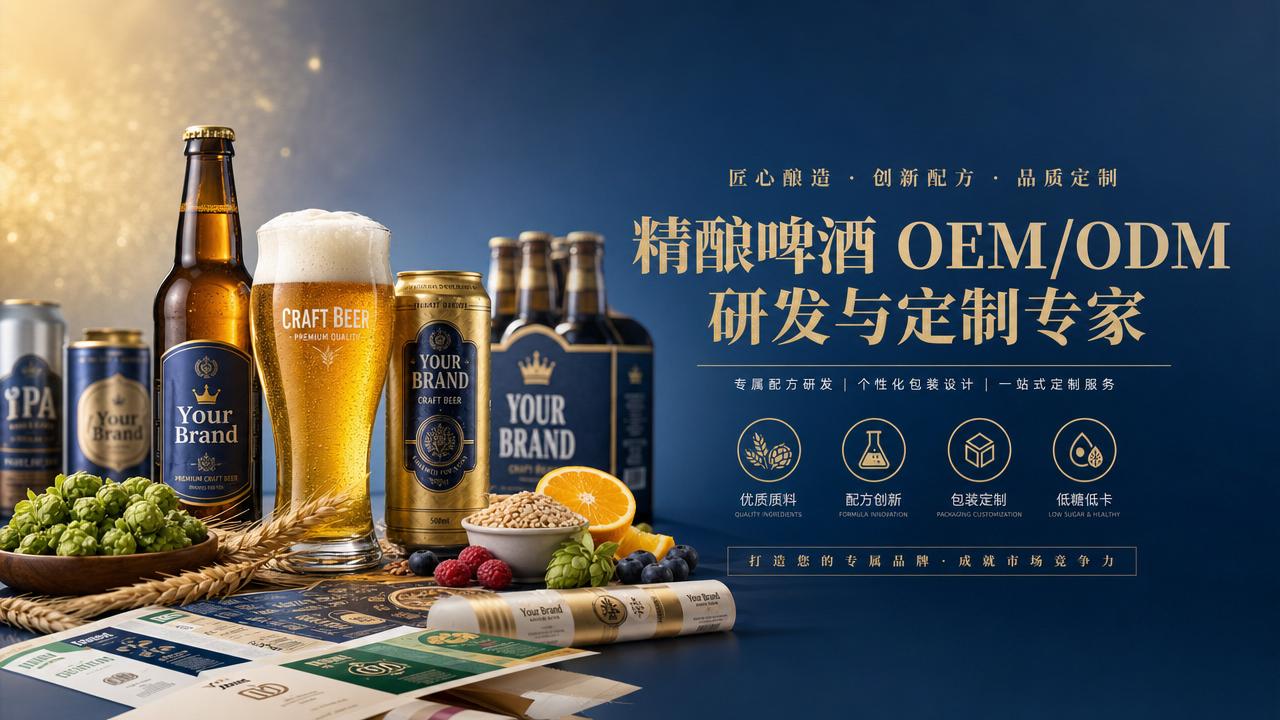
For distributors, agents and private label buyers evaluating supply partners, one question matters most: Do China beer OEM factories offer R&D support? In today’s competitive beverage market, strong R&D can turn a standard beer line into a differentiated, profitable brand. From flavor innovation and sugar-free formulas to functional specialty beers and packaging customization, China beer OEMs are increasingly helping partners accelerate private label growth with market-driven product development.
Understanding R&D Support in China Beer OEM Production
When businesses ask, “Do China beer OEM factories offer R&D support,” the answer increasingly depends on the factory’s technical depth rather than simple production capacity. In the past, many OEM suppliers focused mainly on contract brewing and packaging execution. Today, leading China beer OEM factories often provide integrated services that include recipe development, sensory testing, ingredient selection, packaging adaptation, shelf-life review and trend-based product planning.
In practical terms, R&D support means a private label project does not start with a fixed formula alone. It begins with positioning: classic lager for mass retail, German wheat for premium channels, sugar-free low-calorie beer for health-conscious consumers, fruit beer for younger audiences, or functional specialty beer for niche differentiation. This is why the question “Do China beer OEM factories offer R&D support” matters far beyond brewing. It directly affects speed to market, brand uniqueness and long-term repeat sales.
For example, Jinpai Beer is engaged in the R&D, production and distribution of craft beer, with a broad portfolio covering classic lager, German wheat, sugar-free low-calorie beer, fruit-flavored beer and functional specialty beers. Combined with OEM/ODM services, wholesale supply and customized solutions, this type of capability allows a private label partner to move from concept to channel-ready product with fewer development gaps.
Why the Market Is Asking Whether China Beer OEM Factories Offer R&D Support
The private label beer market is changing quickly. Buyers no longer compete only on low pricing or standard packaging. They also compete on flavor distinction, healthier positioning, local market fit and speed of new product rollout. That shift is one major reason the search term “Do China beer OEM factories offer R&D support” has become more relevant across global beverage sourcing.
Several market signals explain this trend:
These shifts mean that simple toll manufacturing is often not enough. A capable China beer OEM partner is expected to act as a product development collaborator. So, when evaluating whether China beer OEM factories offer R&D support, the better question may be: how deep, flexible and commercially relevant is that support?
What Strong R&D Support Usually Includes
Not every supplier defines R&D in the same way. Some only adjust alcohol level or bitterness. Others provide a more complete development process that aligns product design with consumer demand and channel strategy. High-quality R&D support from China beer OEM factories often includes the following areas:
- Formula development: creating new beer recipes or adapting existing formulations for target markets.
- Style extension: expanding from standard lager into wheat beer, fruit beer, low-calorie beer or functional specialty beer.
- Sensory optimization: balancing aroma, body, bitterness, sweetness and aftertaste based on market preference.
- Ingredient evaluation: selecting malt, hops, yeast, fruit components or functional ingredients with cost and taste in mind.
- Packaging compatibility: adapting formulas for cans, bottles or multipack retail formats while protecting flavor stability.
- Compliance alignment: adjusting product data, labeling details and specifications for export destination requirements.
This is where the question “Do China beer OEM factories offer R&D support” becomes highly specific. Real support should reduce trial-and-error, improve launch confidence and help match the product to channel conditions. A beer designed for bar taps or premium restaurants may need a different profile from a beer made for supermarket shelves or online retail bundles.
Business Value for Private Label Growth
Private label growth depends on more than finding a brewer with spare capacity. Sustainable growth usually comes from owning a product identity that can be repeated, expanded and defended. That is why many sourcing decisions now revolve around whether China beer OEM factories offer R&D support that can generate brand value.
R&D support creates business value in four main ways. First, it improves differentiation. A customized fruit-flavored beer or a sugar-free low-calorie beer can give a private label brand a clearer position than a generic lager. Second, it shortens development cycles because formula testing and packaging decisions are handled closer to production. Third, it improves portfolio planning by making line extensions easier. Fourth, it helps control risk because the product is tested for taste consistency, process fit and market relevance before full rollout.
For global channels, this flexibility matters even more. Restaurants may prefer distinctive craft-style options. Supermarkets may need mainstream lager with stable cost structure. Bars may want wheat beer or seasonal flavors. Online channels may respond well to limited-edition fruit beer packs or healthier drinking concepts. A China beer OEM with active R&D support can help align product development with each route to market rather than forcing one formula into every channel.
Common Product Directions Supported by China Beer OEM R&D
A practical way to assess whether China beer OEM factories offer R&D support is to review the types of products they can help develop. The stronger the R&D team, the wider and more relevant the product roadmap tends to be.
Factories with this range can support both initial launch and product line expansion. That makes the answer to “Do China beer OEM factories offer R&D support” much more meaningful when tied to actual portfolio outcomes.
How to Evaluate R&D Capability Before Choosing a Supplier
Because R&D support varies widely, evaluation should be evidence-based. It is not enough to rely on a general claim in a brochure. A structured review can reveal whether a factory can truly support private label growth.
- Ask for examples of developed beer styles, including sugar-free, fruit-flavored or functional specialty projects.
- Review whether sample development is available and how many adjustment rounds are supported.
- Check if the team can recommend packaging formats based on channel and shelf positioning.
- Confirm whether export documentation, product specifications and labeling coordination are part of the service flow.
- Assess communication speed, because effective R&D depends on translating market feedback into product changes quickly.
A dependable China beer OEM partner should be able to discuss flavor goals, consumer positioning, channel suitability and production feasibility in one conversation. That integrated approach is often the clearest sign that China beer OEM factories offer R&D support with real commercial value.
Practical Considerations for Long-Term Cooperation
Long-term success in private label beer comes from building a supply relationship that supports iteration, not just fulfillment. Once a first SKU performs well, the next opportunity usually involves line extensions, seasonal launches or packaging refreshes. An OEM with R&D capacity can support these changes without restarting the entire sourcing process.
It is also useful to align expectations early on key points such as minimum order structure, sample approval standards, flavor tolerance, packaging material options and lead time for revised formulas. This reduces misunderstanding and helps new products move through development more smoothly. In many cases, the strongest private label results come from partners that treat beer development as an ongoing process shaped by market response.
So, do China beer OEM factories offer R&D support? Many now do, but the quality of that support is what determines whether a private label beer brand can grow with confidence. Factories that combine brewing expertise, product innovation, packaging flexibility and global supply experience are in a much better position to support modern beverage brands.
Next Step for Private Label Beer Development
If the goal is to build a competitive beer portfolio, the next step is to evaluate not only production cost but also development capability. A supplier such as Jinpai Beer, with experience in craft beer R&D, production and worldwide distribution, can support OEM/ODM projects across classic lager, German wheat, sugar-free low-calorie beer, fruit-flavored beer and functional specialty beer categories.
A practical starting point is to define the target channel, preferred beer style, packaging format and desired market positioning, then request a tailored proposal with sample planning. That approach makes it easier to verify whether China beer OEM factories offer R&D support that matches brand goals, launch timelines and long-term expansion plans.
Thank you very much for writing to us. Please leave your message and contact information, we will reply to you within 24 hours.