



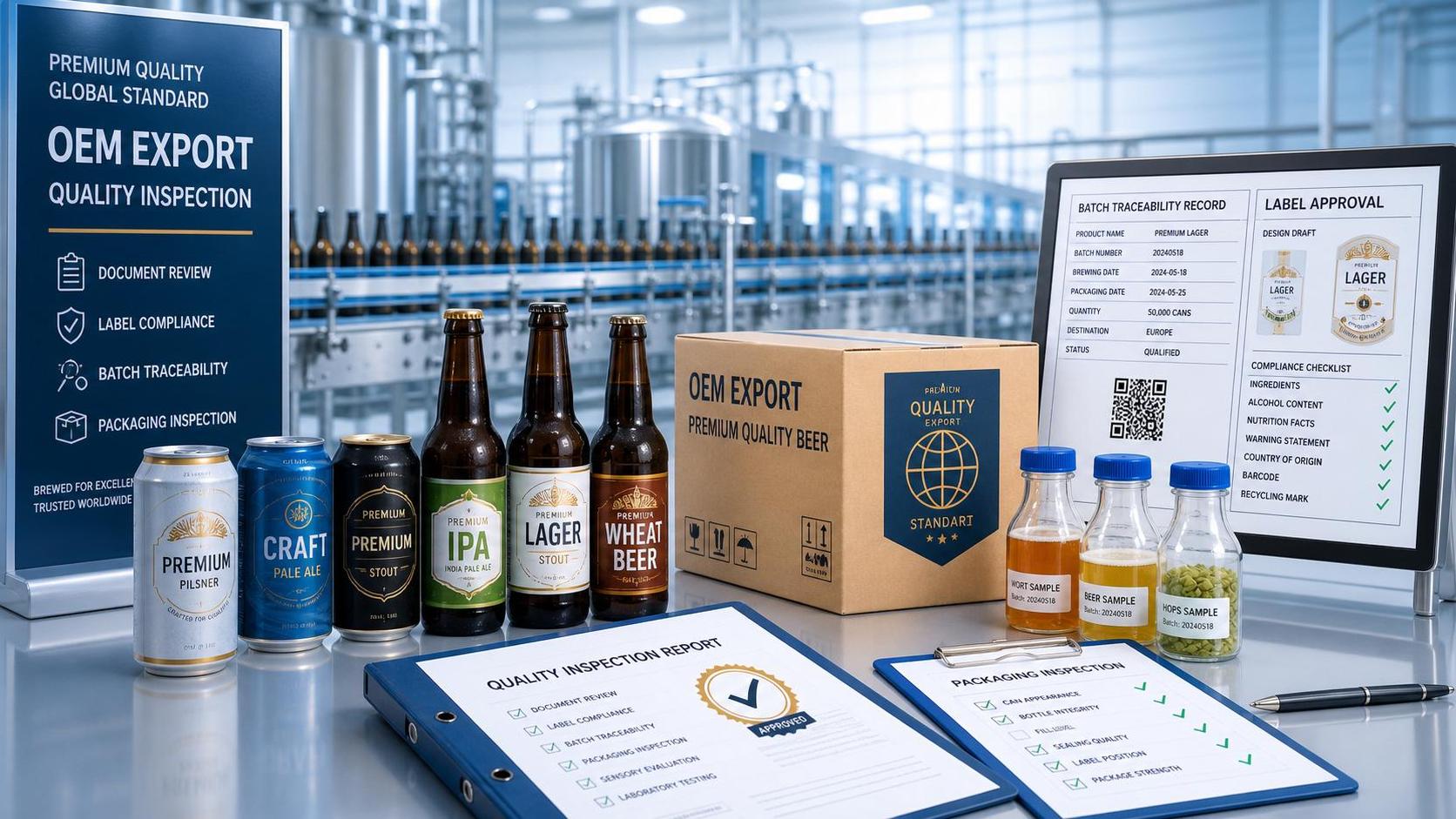
For private-label beer projects, document review is often where quality risk becomes visible. China beer OEM export quality standards are not defined by one certificate alone. They are reflected in a set of manufacturing, testing, labeling, and export records that show whether a brewery can deliver stable product quality across batches and markets.
That matters even more in beer, where formulation, yeast behavior, packaging, and cold-chain exposure can all affect shelf life and flavor. A supplier may offer a broad portfolio, from classic lager and German wheat to sugar-free low-calorie beer, fruit beer, and functional specialty beer, but range is only useful when the underlying controls are reliable.
In practice, the most useful review approach is simple: request the documents that prove legal operation, process discipline, ingredient traceability, product testing, and export readiness. This is the working foundation behind China beer OEM export quality standards.
What China Beer OEM Export Quality Standards Really Cover
The phrase sounds regulatory, but it is broader than compliance paperwork. It covers how a brewery manages production from raw material intake to finished goods release.
For export beer, that includes recipe consistency, sanitation controls, microbiological safety, packaging integrity, labeling accuracy, and records that can stand up to importer review.
It also includes commercial realities. OEM and ODM projects often involve customized alcohol levels, flavor systems, can sizes, carton marks, and destination-specific labeling. Each change increases the need for documented control.
So when assessing China beer OEM export quality standards, the real question is not whether documents exist. It is whether those documents connect into a credible quality system.
The First Documents to Request
The first layer should confirm that the brewery is legally registered, licensed, and operating within a recognized food production framework.
These records do not prove product excellence on their own. They do show whether the supplier has a formal operating base, which is the minimum entry point for evaluating China beer OEM export quality standards.
Manufacturing Records That Reveal Process Control
A technically sound brewery should be able to provide controlled records from brewhouse to packaging line. This is where many evaluations become more meaningful.
Batch production records
Request sample batch sheets for recent production runs. They should show brew date, tank number, ingredient lot usage, fermentation timing, gravity readings, filtration or maturation steps, and packaging release data.
If the brewery handles both standard lager and more sensitive products such as fruit beer or functional beer, batch records should reflect different control points for each style.
Cleaning and sanitation logs
Beer quality fails quickly when CIP and sanitation discipline are weak. Ask for cleaning schedules, chemical concentration records, verification logs, and equipment sanitation procedures.
Equipment calibration and maintenance
Flow meters, thermometers, pressure gauges, dissolved oxygen instruments, and filling equipment should have maintenance and calibration records. Without them, data quality is uncertain.
Ingredient Control Is Central to Export Beer Quality
China beer OEM export quality standards depend heavily on traceable raw materials. Imported malt, local adjuncts, hops, fruit concentrates, sweeteners, enzymes, and functional additives all need documented approval and traceability.
The key records usually include supplier lists, raw material specifications, incoming inspection reports, and certificates of analysis for critical ingredients.
- Malt and adjunct specifications, including moisture and extract indicators
- Hop or hop extract records, including origin and alpha acid details where relevant
- Yeast management records, especially for strain identity and reuse control
- Fruit flavoring or botanical additive documents for specialty products
- Water quality testing, because brewing water directly affects stability and flavor
This becomes especially important for sugar-free low-calorie beer and functional specialty beer. These products often involve more formulation complexity, more claim sensitivity, and more labeling risk.
Product Testing Documents Buyers Should Not Skip
If there is one area that directly supports China beer OEM export quality standards, it is finished product testing. A brewery should be able to show both routine internal testing and, where needed, third-party reports.
Core finished beer parameters
- Alcohol by volume
- Original wort concentration or extract reference
- Bitterness, color, and pH where applicable
- Carbon dioxide level
- Dissolved oxygen after filling
- Microbiological release results
Shelf-life and packaging stability evidence
Request shelf-life validation records, especially for canned beer exported through long shipping cycles. Oxygen pickup, seam integrity, crown performance, and transport simulation can be more relevant than a marketing specification sheet.
For mixed-flavor lines or fruit beer programs, microbial challenge and flavor stability records are worth reviewing. These products often face more variation over time.
Packaging, Labeling, and Market Access Files
A good beer can still become a difficult export product if packaging and labels are poorly controlled. This is where China beer OEM export quality standards connect with destination market compliance.
Ask for packaging material specifications for cans, bottles, ends, crowns, labels, trays, and cartons. These should include barrier or strength characteristics relevant to storage and shipping.
Label review records are just as important. Ingredient declarations, allergen statements, net content, alcohol statements, production coding, shelf-life format, and importer information must match the destination market rules.
How to Read the Documents, Not Just Collect Them
A common mistake is treating document collection as a checklist exercise. Strong China beer OEM export quality standards are visible in consistency across records.
Names, product styles, capacities, and dates should align across licenses, test reports, batch logs, and export documents. If records look polished but disconnected, the system may be weaker than it appears.
It also helps to compare paperwork against the business model. A brewery offering OEM, ODM, wholesale supply, and customized beer solutions for supermarkets, bars, restaurants, and retail channels should have controls that support both standard SKUs and tailored projects.
That is especially relevant when evaluating broader portfolios like those seen at established craft beer producers such as Jinpai Beer. A wide product matrix can be a strength, but only when the documentation shows repeatable control across styles.
Practical Next Steps Before Supplier Approval
After the initial review, narrow the assessment to the products and markets that matter most. A low-calorie canned lager for supermarket retail does not carry the same document priorities as a fruit-flavored draft-style export for bars.
- Build a document matrix by product style and destination market
- Request recent, not historic, batch and testing samples
- Check whether third-party reports match internal release data
- Review one complete lot from raw material intake to shipment file
- Confirm label compliance before final artwork approval
This approach turns China beer OEM export quality standards from a vague concept into a practical approval framework. It also makes later discussions on pilot runs, specification lock, and long-term cooperation more efficient.
The clearest next move is to define the document set that matches the beer style, packaging format, and export destination under review. Once that framework is in place, supplier comparison becomes more objective and far less dependent on sales claims.
Thank you very much for writing to us. Please leave your message and contact information, we will reply to you within 24 hours.