


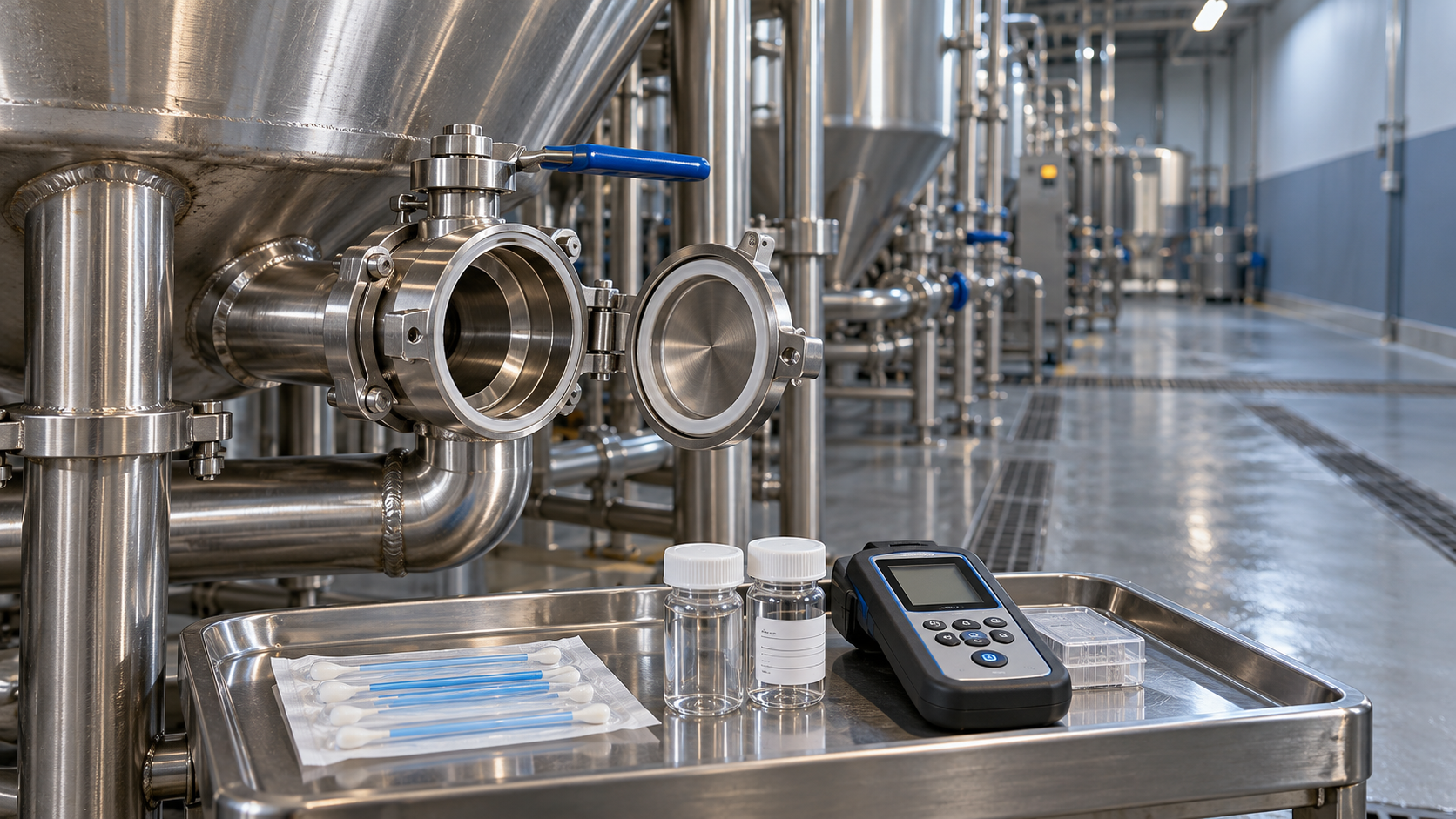
A spotless tank can still hide residues and microorganisms that threaten beer quality. Brewery CIP validation establishes whether a defined cleaning procedure consistently achieves measurable acceptance criteria.
For quality control and safety teams, a completed cycle is only supporting evidence. Defensible approval requires process records, equipment coverage checks, residue testing and appropriate microbiological results.
In a beer factory producing classic lager, wheat beer and fruit-flavored products, different soils and equipment configurations require validation based on actual cleaning challenges.
This guide explains how to select challenging conditions, define acceptance limits, sample meaningful locations and decide when equipment can safely return to production after cleaning.
What evidence actually proves tanks and pipework are clean?
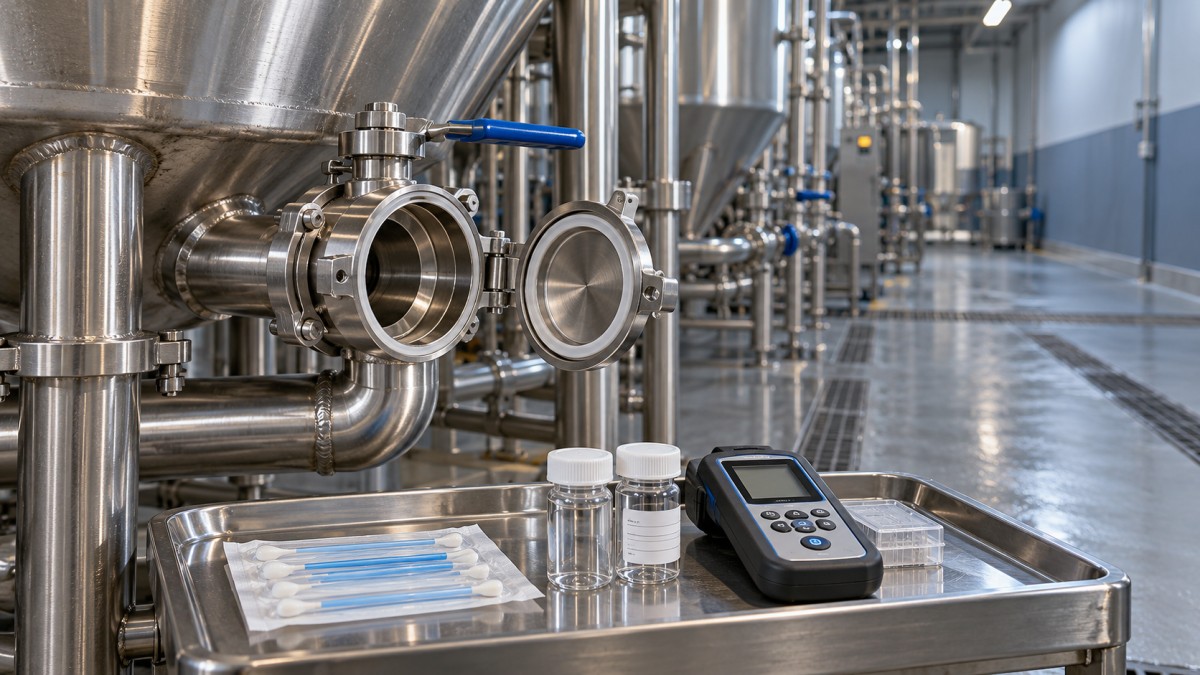
A useful validation package connects three questions: did cleaning solution reach every relevant surface, did the process remove targeted soils, and did subsequent sanitation control microorganisms?
Cleaning removes product residues and deposits. Sanitizing reduces microorganisms on adequately cleaned surfaces. Evidence supporting one activity cannot automatically establish that the other worked effectively.
Validation demonstrates that a specified procedure can repeatedly meet predetermined requirements under defined conditions. Routine verification checks whether that validated procedure remains effective during production.
For example, recorded temperature and conductivity can confirm that certain operating conditions were achieved. They cannot independently prove that a shadowed valve cavity became clean.
Likewise, a low ATP result at an accessible tank outlet cannot establish cleanliness throughout an entire circuit. Sampling must represent its most difficult locations too.
Approve equipment using combined evidence against written criteria. Investigate contradictory findings rather than allowing a favorable process chart to override a failed residue or microbiological result.
Which products and equipment should challenge your validation?
Start by mapping each cleaning circuit, including tanks, transfer lines, pumps, valves, instruments and return routes. Confirm that drawings reflect the actual installed equipment configuration.
Walk the system with production, engineering and quality personnel. Identify poorly drained sections, spray shadows, valve seats, sample ports, gaskets and branches with limited circulation.
Group equipment only when design, cleaning action and operating conditions justify equivalence. Similar tank capacity alone does not establish that two vessels are equally cleanable.
Select representative products by their cleaning burden. Wheat proteins, yeast deposits, hop material and fruit solids may create different challenges requiring separate evaluation or justified grouping.
Mineral scale and beerstone require particular attention because an effective organic-soil cleaning cycle may leave inorganic deposits behind. Confirm whether a separate descaling step is necessary.
Include the longest permitted dirty hold time, relevant product contact temperatures and realistic residue drying. Freshly emptied equipment may substantially underestimate the difficulty of routine cleaning.
Document why each chosen challenge represents other products or circuits. Where evidence does not support grouping, validate the additional condition instead of assuming broad coverage.
Define acceptance criteria before running the study
Write an approved protocol before collecting results. Specify equipment boundaries, product challenges, operating ranges, sampling locations, analytical methods, acceptance criteria and responsibilities for reviewing deviations.
Acceptance criteria should address visible cleanliness, relevant product residues, cleaning chemical carryover and microbiological control where applicable. Each criterion needs a documented technical or regulatory basis.
Do not borrow a universal ATP limit from another brewery. Instrument design, swab chemistry, surface condition and sampling technique influence readings and their practical interpretation.
Establish ATP action limits using manufacturer guidance and site data from demonstrably clean surfaces. Confirm that the method can distinguish acceptable conditions from meaningful contamination.
Choose residue methods for the actual hazard or quality concern. Options include protein assays, product-specific methods and validated allergen tests where cross-contact assessment requires them.
A general protein result does not prove absence of a specific allergen. Method suitability, detection capability and recovery from the sampled surface must support the conclusion.
Define microbiological targets, sample volumes, incubation conditions and acceptance limits with qualified laboratory input. Consider relevant beer-spoilage organisms alongside hazards identified through the food safety assessment.
Specify what happens when any criterion fails, including equipment hold, investigation, recleaning and reassessment. Predetermined decisions prevent convenient reinterpretation after unfavorable results arrive during review.
Show that the cleaning cycle reaches its operating window
Document each cycle stage: initial rinse, detergent circulation, intermediate rinse, any acid treatment, final rinse and sanitation. Explain the purpose and required conditions of each.
Control cleaning time, chemical concentration, temperature and mechanical action together. Settings must suit the equipment, soil, chemical supplier instructions and materials of construction involved in cleaning.
Measure meaningful conditions at relevant locations. A hot supply line does not prove that the return stream or distant equipment surfaces experienced the required temperature.
Use calibrated instruments and confirm that recorded circulation time reflects time within the specified operating range. Startup heating or filling periods may not provide equivalent cleaning.
Conductivity can support concentration control when calibrated for the chemical, temperature and water conditions. Use appropriate chemical analysis when conductivity cannot reliably resolve the question.
For pipework, assess flow through each intended route and branch. For tanks, verify spray device operation, coverage, positioning and performance under the actual installed conditions.
A suitable coverage test, such as a correctly executed riboflavin assessment, can reveal spray shadows. It demonstrates coverage under test conditions, not complete cleaning effectiveness.
Challenge the lower permitted operating limits where justified and safe. Passing only at unusually favorable settings provides weak evidence for a broader routine operating window.
Sample the locations most likely to reveal failure
Build a sampling map around risk, not convenience. Include difficult surfaces such as valve cavities, gasket interfaces, tank outlets and locations beyond complex routing arrangements.
Combine direct surface sampling with rinse sampling where appropriate. Swabs examine specific accessible areas; rinse samples can represent broader circuits but may dilute localized contamination.
Define swab area, technique, extraction method and transport conditions. For rinse samples, specify collection point, timing and volume so results remain comparable across validation runs.
Assess recovery and analytical interference before relying on results. A negative test offers limited reassurance if the method poorly recovers the residue from that surface.
Separate sampling stages according to the question. Post-cleaning samples assess soil removal; post-sanitation samples assess microbial control, using procedures that avoid compromising equipment awaiting production.
Use suitable neutralizers for residual sanitizers when required by the microbiological method. Otherwise, sanitizer carried into the sample may suppress growth and create misleading results.
Consider the longest permitted clean hold time before reuse. Equipment that passes immediately after sanitation may become unacceptable after extended storage, moisture retention or handling.
Record inaccessible locations explicitly and justify alternative evidence. Where dismantling is necessary for inspection, plan hygienic reassembly and any required repeat sanitation before production resumes.
How many successful runs are enough to approve the process?
The number of validation runs should reflect process variability, equipment complexity and risk. Three consecutive successful runs are common practice, but not a universal legal requirement.
Choose a study design that captures meaningful differences between shifts, operators or production conditions where these affect cleaning. Repeating an identical favorable setup may miss variability.
Each run should meet every applicable criterion within the defined operating window. An unexplained failure cannot be averaged away by several acceptable results elsewhere in the study.
Review failures against both cleaning performance and test reliability. Possible causes include blocked spray devices, incorrect valve routing, exhausted detergent, sampling errors or unsuitable laboratory methods.
Correct the demonstrated cause and assess whether the protocol requires additional runs. Changes to parameters or equipment may alter the validation scope and invalidate earlier evidence.
The final report should connect raw records, laboratory results, deviations and conclusions. State precisely which products, circuits, operating ranges and hold times the approval covers.
Turn validation into practical release and monitoring rules
Routine verification should confirm critical cycle conditions for each cleaning event and add targeted checks at justified frequencies. Validation results should explain why those checks are sufficient.
Distinguish rapid operational checks from slower laboratory confirmation. If microbiological results arrive after equipment reuse, document the release rationale and response to an adverse result.
A passing ATP check can support a prompt operational decision within an established program. It cannot replace organism-specific testing when that evidence is required for control.
Trend results by circuit, sampling location, product family and shift. A gradual rise in residues or microbial findings may reveal deterioration before a formal limit fails.
For failed verification, hold affected equipment and assess any potentially affected product. Recleaning alone does not resolve product disposition or explain why the original cycle failed.
Protect personnel during investigations through isolation procedures, chemical handling controls and safe sampling arrangements. Tank entry requires the applicable confined-space controls and authorization for the work.
Review validation after changes to recipes, fruit ingredients, detergent, spray devices, routing, software or hold times. Assess the impact and document whether partial or full revalidation is needed.
What should OEM customers and quality auditors ask to see?
For a beer factory serving multiple brands, the most useful assurance is evidence linked to the intended product and equipment, with clear responsibility for approval.
Ask for the validation scope, rationale for product grouping, acceptance criteria, representative sampling map and results. Review how deviations were investigated and how routine performance is monitored.
For Jinpai Beer projects involving lager, wheat, sugar-free low-calorie, fruit-flavored or specialty beers, those product differences should inform technical discussions about cleaning requirements and change control.
OEM and ODM agreements should clarify ingredient disclosure, relevant allergen controls, testing responsibilities and notification of changes. Marketing descriptions alone cannot establish equivalent cleaning requirements.
Approval should rest on a clear chain of evidence: suitable process conditions, demonstrated equipment coverage, acceptable residue removal and microbiological control appropriate to the assessed risk.
When that evidence is complete, quality teams can defend release decisions and identify meaningful changes early. A completed CIP cycle becomes a documented, verifiable control.