



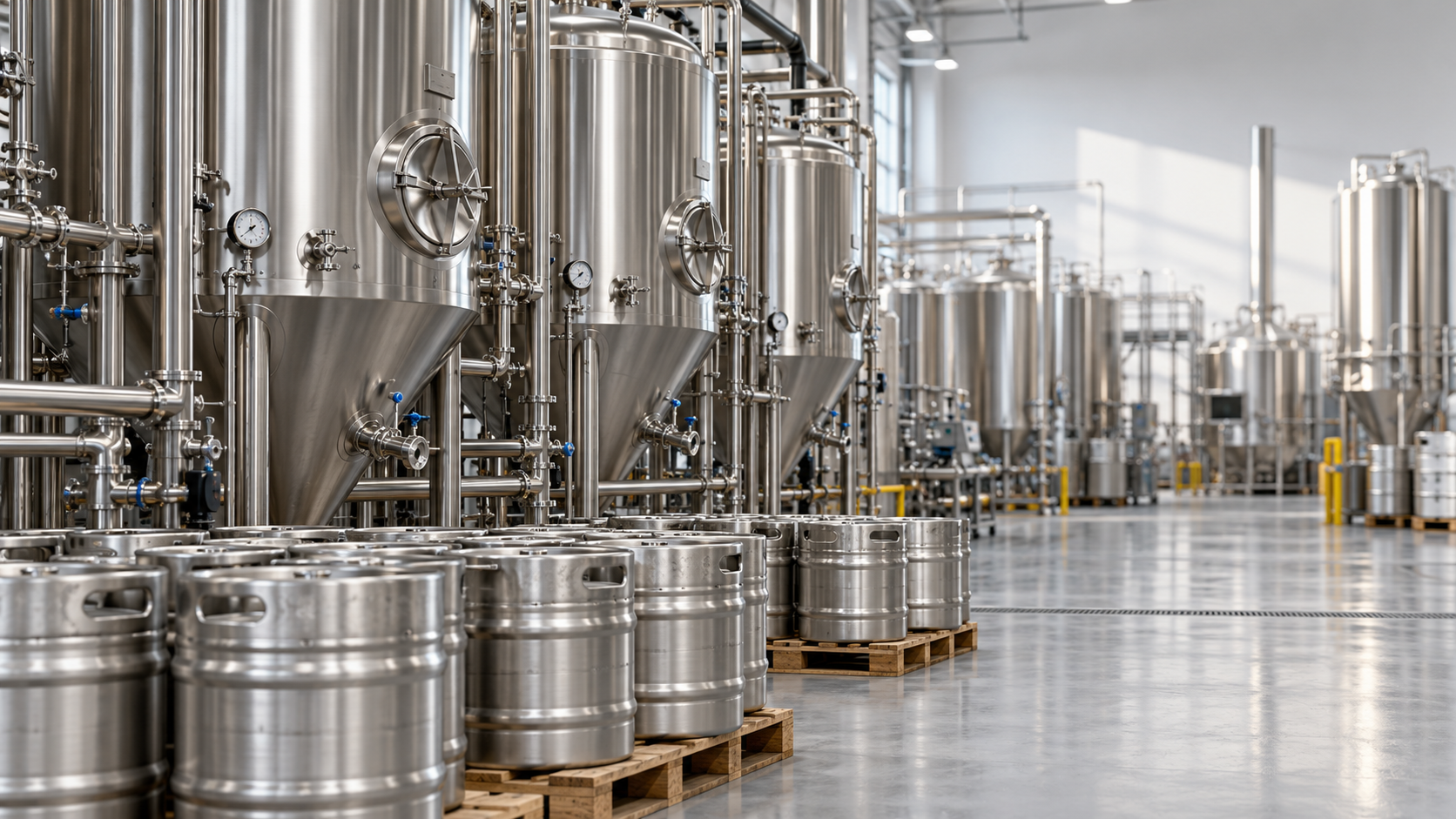
For most beer brands testing demand or entering new markets, contract brewing offers a practical starting point. Ownership becomes attractive when dependable volume supports the investment.
The decision extends beyond equipment prices. Working capital, production scheduling, quality assurance, packaging commitments, and distribution economics can change which model delivers better financial returns.
An owned beer factory provides direct operational authority but creates substantial fixed obligations. Contract brewing reduces initial infrastructure spending while introducing supplier dependencies and contractual constraints.
This guide explains how to compare both models, calculate a meaningful break-even point, and protect the product standards that customers and distribution partners expect.
Which Production Model Fits Your Business Today?
Start with demand visibility. Signed distribution agreements, repeat orders, and reliable sales forecasts provide stronger investment evidence than ambitious launch targets or broad market growth projections.
Contract brewing generally suits brands validating recipes, testing regional channels, or expanding without building technical teams. It also helps businesses preserve cash for customer acquisition.
Ownership deserves closer consideration when existing sales can support consistent production, differentiated processes require dedicated equipment, and management can operate a regulated manufacturing business effectively.
A brewery also needs enough cash to withstand slower sales, equipment downtime, and delayed customer payments. Forecast profitability alone does not establish that financial resilience.
Consider your source of competitive advantage. If distribution access, branding, or channel relationships drive growth, manufacturing ownership may contribute less value than strengthening those capabilities.
If proprietary fermentation, specialized processing, or rapid experimentation defines the product, direct production control may justify greater investment. Confirm that customers actually reward those differences.
What Does Owning a Beer Factory Really Cost?
The purchase price of brewing equipment rarely represents the full investment. Site preparation and operating infrastructure can materially increase the amount required before commercial production begins.
Budget for drainage, water treatment, refrigeration, electrical capacity, ventilation, wastewater management, laboratory equipment, and packaging. Local requirements and the condition of the premises determine scope.
Include installation, commissioning, permits, professional fees, initial ingredients, packaging stock, and startup losses. A contingency should reflect project uncertainty rather than an arbitrary universal percentage.
Fermentation capacity deserves particular attention. A brewhouse may produce wort quickly, while tank occupancy, cleaning cycles, and product mix limit how much finished beer ships.
Packaging can create another bottleneck. Owning a canning line adds maintenance, changeover losses, spare parts, and staffing requirements that equipment quotations may not fully explain.
Recurring obligations include production salaries, rent, insurance, maintenance, utilities, quality testing, and financing. Many remain payable when sales decline or the factory temporarily stops brewing.
Build a monthly cash forecast covering construction delays, inventory buildup, and customer payment terms. Peak funding requirements often matter more than the eventual annual profit.
Does Contract Brewing Actually Lower Your Total Cost?
Contract brewing usually lowers initial capital requirements, but its unit price includes the manufacturer's overhead and margin. Compare complete commercial terms before treating outsourcing as cheaper.
Request quotations against the same recipe, alcohol content, package format, production volume, testing requirements, and delivery location. Otherwise, apparent savings may reflect different product specifications.
Clarify whether prices include ingredients, cans or bottles, labels, cartons, testing, storage, and freight. Establish responsibility for applicable taxes and duties in each destination market.
Ask how the supplier bills production losses, packaging overruns, recipe trials, and changeovers. Small charges can become material when several products run in short batches.
Minimum order quantities create inventory exposure. A favorable production price can lose its advantage if slow sales produce expensive storage, discounting, or unsold aging stock.
Check whether minimums apply separately to brewing, packaging, and printed materials. You may need to purchase substantially more branded packaging than the first production run consumes.
Contract brewing also requires internal resources for forecasting, supplier management, specification approval, and quality oversight. Include those responsibilities when evaluating the true cost of outsourcing.
How Much Volume Makes Ownership Financially Sensible?
Use a break-even model based on equivalent finished beer delivered to the same handover point. Compare saleable output rather than theoretical equipment capacity or brewed volume.
The basic calculation divides additional annual ownership costs by the per-liter savings from internal production. Both inputs must use consistent accounting assumptions and comparable service scope.
The following figures are illustrative assumptions, not market quotations. Actual economics depend on location, financing, automation, recipe complexity, packaging format, utilization, and supplier terms negotiated.
At 750,000 liters annually, contract production totals $1,125,000 under these assumptions. Owned production totals $1,425,000, making ownership $300,000 more expensive before any excluded business costs.
At two million liters, owned production totals $2,800,000 against $3,000,000 for contracting. That $200,000 annual advantage must be assessed against investment risk and alternative uses of capital.
Keep common selling and distribution costs outside this comparison unless the production choice changes them. Avoid counting financing or capital recovery twice within ownership costs.
Then stress-test lower demand, higher ingredient prices, slower collections, and production interruptions. Ownership should remain fundable under a credible downside scenario, not only the base forecast.
Calculate upfront cash needs separately from annual economics. An attractive break-even volume does not guarantee an acceptable payback period or sufficient cash during the investment phase.
What Control Do You Gain, and What Can You Negotiate?
Ownership provides authority over production priorities, ingredient purchasing, process changes, and release decisions. Its practical value depends on capable staff, reliable equipment, and disciplined operating systems.
Contract brewing requires that authority to be translated into specifications and enforceable agreements. A clear contract can protect many priorities without transferring ownership of manufacturing assets.
Define ownership of existing recipes, newly developed formulations, trademarks, artwork, and production records. State whether the brand can transfer its recipe and documentation to another manufacturer.
For ODM projects, distinguish supplier formulations from customer-owned development. An exclusive product arrangement should specify territory, duration, permitted channels, and any conditions affecting continued exclusivity.
Protect commercially sensitive information through confidentiality terms and access controls. Address ingredient substitutions explicitly, including who approves alternatives and how resulting product changes are validated.
Agree on forecast windows, reserved capacity, lead times, and cancellation rules. Access to production during peak season can matter more than a small unit-price discount.
Include exit arrangements covering remaining packaging, finished inventory, outstanding payments, and technical handover. Contract protections should support continuity if service quality deteriorates or priorities change.
How Can You Protect Quality Without Owning Production?
Quality assurance starts with measurable acceptance criteria. Define relevant specifications for alcohol content, flavor, carbonation, microbiological condition, package integrity, and consistency across repeated commercial batches.
Request evidence of applicable food safety systems, traceability procedures, instrument calibration, and corrective-action practices. Certificates alone cannot establish that a supplier consistently executes your requirements.
Approve a commercial trial using the intended production and packaging equipment. A successful sample from a small development system does not guarantee equivalent factory performance.
For packaged beer, assess oxygen management, seam or closure checks, and stability under expected distribution conditions. Shelf-life claims should have evidence relevant to the actual product.
Agree who authorizes batch release and what happens after a failed result. Specify investigation procedures, replacement responsibilities, recall cooperation, and the availability of retained samples.
Specialty claims need additional scrutiny. Sugar-free, low-calorie, and functional positioning may require particular testing, labeling, or legal review depending on the market and intended claims.
An owned brewery must meet these same standards. Direct oversight creates value only when the business funds suitable expertise, testing, documentation, and consistent corrective action.
Which Model Supports Your Sales Channels and Growth Plans?
Supermarket listings may involve promotional peaks, service commitments, and demanding delivery windows. Evaluate whether either production model can supply those commitments without excessive finished inventory.
Restaurants and bars may require different keg formats, frequent replenishment, and responsive service. Production economics should reflect those requirements rather than assume every liter sells identically.
Export sales introduce documentation, labeling, freight, and destination requirements. Confirm which party handles each responsibility before comparing domestic factory prices with export-ready commercial supply quotations.
A contract brewer may support faster expansion where suitable capacity already exists. Verify available production slots and packaging supply instead of relying on nominal factory capacity.
A hybrid model can support gradual growth: retain pilot brewing or selected production internally while outsourcing larger runs, seasonal demand, or markets requiring different packaging capabilities.
Hybrid arrangements add coordination costs and potential flavor variation. Use common specifications, comparison tastings, traceability, and clear inventory planning to maintain a consistent customer experience.
What Should You Request Before Choosing a Brewing Partner?
Prepare one brief covering target markets, expected volumes, recipes, package formats, shelf life, launch timing, and quality requirements. Send the same brief to shortlisted suppliers.
Request itemized pricing, minimum orders, payment terms, available capacity, trial arrangements, and relevant quality documentation. Ask which assumptions could trigger price changes or delivery delays.
Jinpai Beer offers craft beer research, production, distribution, OEM/ODM services, wholesale supply, and customization. Its range includes lager, German wheat, fruit-flavored, and specialty beer products.
For a potential project, ask Jinpai Beer to confirm formulation feasibility, packaging choices, order quantities, testing scope, and destination requirements against your specific commercial brief.
Compare proposals on total cash exposure, product consistency, delivery capability, and contractual protections. A lower quote offers limited value if execution problems disrupt your customer relationships.
Make the Decision Around Proven Demand and Available Capital
Choose contract brewing when preserving capital, validating demand, and accessing established manufacturing capabilities outweigh the benefits of direct control. Negotiate quality, capacity, and ownership protections carefully.
Choose an owned beer factory when dependable sales, realistic utilization, operational expertise, and sufficient funding support the investment. Require a convincing downside case before committing capital.
The strongest next step is a comparable financial model supported by supplier quotations and verified demand. Let achievable volume and cash requirements determine your production strategy.