



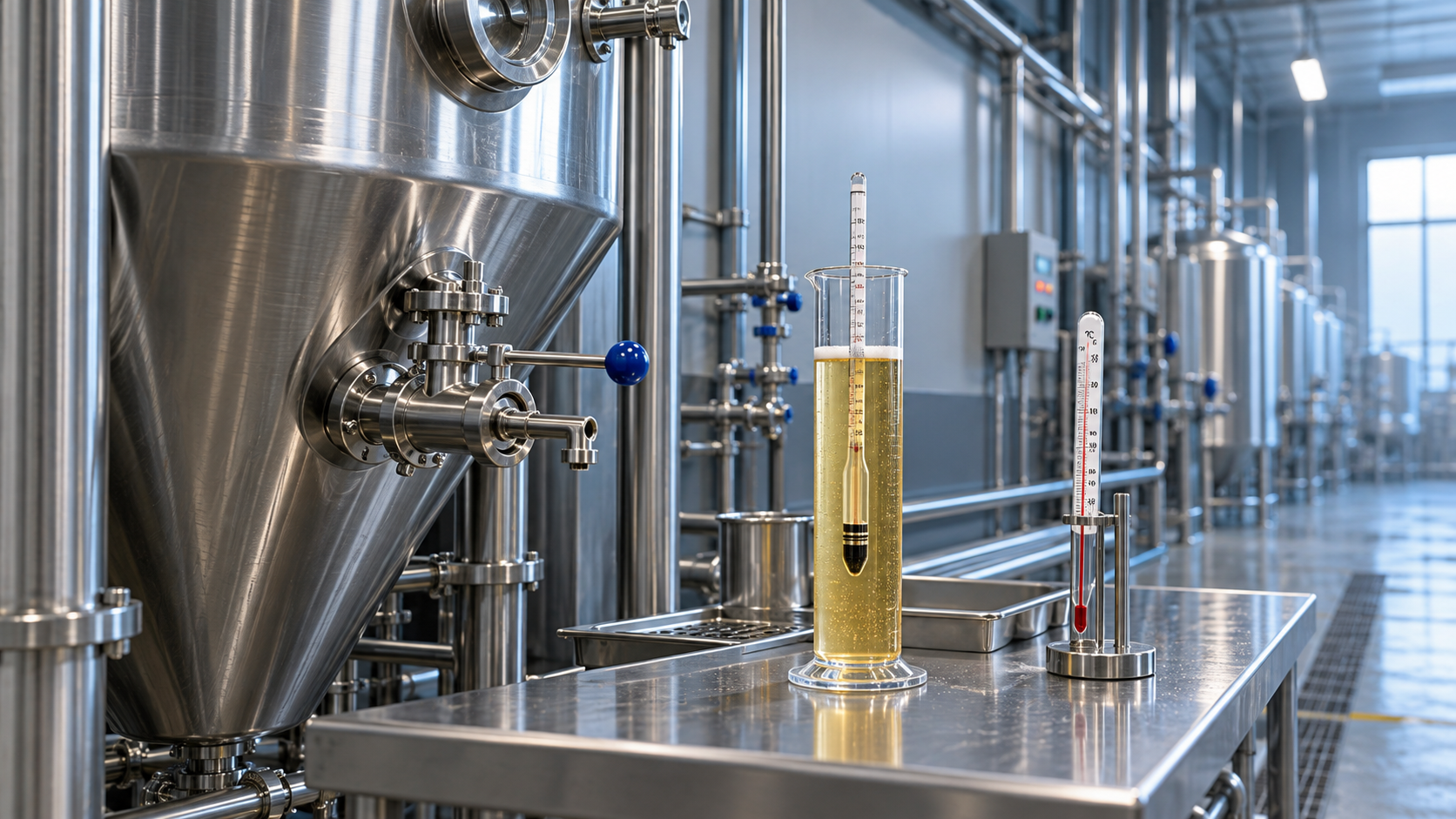
When beer gravity stops falling above its expected final gravity, confirm the measurement before changing the fermentation. A flat reading can reflect sampling error, a slow finish, or wort that has reached its fermentability limit. Once a genuine stall is established, compare the fermentation curve with yeast condition, pitching records, oxygen delivery at pitching, and actual beer temperature. Keep corrective work closed and sanitary: unnecessary transfers and late oxygen additions introduce fresh problems without resolving the original cause.
In a beer factory, the most useful starting point is the batch record. Original gravity, yeast strain, pitch quantity, temperature history, and recent gravity readings reveal whether fermentation struggled from the beginning or slowed after normal early activity. That distinction determines which intervention has a reasonable chance of working.
Establish whether fermentation has actually stalled
Take a representative sample through a cleaned and sanitized sampling point. Clear retained material from the valve according to the sampling procedure, then collect enough beer for the instrument. Remove dissolved carbon dioxide before taking a hydrometer reading, and bring the sample to the instrument’s calibration temperature or apply the appropriate correction. Bubbles attached to the hydrometer can lift it and distort the result.
A refractometer requires special attention after fermentation begins. Alcohol changes the relationship between refractive index and sugar concentration, so an uncorrected reading does not represent final gravity. Use a validated correction incorporating original gravity, or confirm the result with a suitable density measurement. Repeating the same unsuitable method only reproduces the error.
Compare successive readings over an interval appropriate to the strain, temperature, and fermentation stage. A single unchanged result does not establish a stall. Near the end of fermentation, gravity changes become smaller and easier to miss within instrument resolution. Airlock activity and visible foam are unreliable substitutes: escaping dissolved gas can continue after sugar consumption slows, while vessel leaks can hide ongoing fermentation.
Expected final gravity must come from a realistic fermentability target. A recipe estimate or yeast attenuation range is not proof that this particular wort should finish there. Mash conditions, extract composition, and specialty ingredients all influence the sugars remaining after normal fermentation.
Separate yeast failure from limited wort fermentability
A forced fermentation test helps answer the central question: is fermentable extract still available? Use a sanitary sample of the same wort, preferably retained before fermentation, and inoculate it with sufficient healthy yeast under controlled laboratory conditions that encourage complete fermentation. Follow a validated method and compare its stable endpoint with the production tank.
For troubleshooting the production strain, use that strain in the test. A more attenuative strain can consume sugars the production yeast cannot use, making the tank appear stalled when it has reached its normal limit. If only partially fermented beer is available, a laboratory restart test can still help, but alcohol exposure and sample handling affect interpretation.
If the wort has reached its fermentability limit, repeated yeast additions will not remove dextrins the strain cannot ferment. Adding enzymes or changing to a different yeast changes the process and potentially the beer’s body, flavor, and package stability. Treat those actions as controlled product changes.
Read the yeast history alongside the gravity curve
A long initial delay followed by weak attenuation points toward inadequate viable pitch, poor yeast condition, insufficient oxygen at pitching, or an unsuitable starting temperature. A healthy early decline followed by an abrupt stop puts greater emphasis on cooling events, premature flocculation, increasing alcohol stress, or changes in tank pressure. These patterns guide investigation; they do not establish a cause by themselves.
Pitch quantity and yeast condition are different measurements
Slurry volume alone does not establish how much yeast entered the tank. Cell concentration, the proportion of living cells, and the amount of non-yeast material all affect the delivered pitch. Calculate the viable cell addition from measured slurry properties and compare it with the brewery’s validated target for the strain, wort strength, and fermentation conditions.
Viability describes whether cells are alive under the test used. Vitality concerns their physiological ability to perform. Yeast can show acceptable viability yet ferment poorly after prolonged storage, repeated stressful fermentations, or depleted energy reserves. Review harvest timing, storage temperature, time before reuse, and the source batch’s performance. Generation number provides context but cannot replace those observations.
Strong wort increases the demands on yeast through osmotic stress at the start and alcohol stress later. A pitch that works reliably in a lower-gravity beer may perform poorly in a stronger batch. Likewise, temperature shock during pitching can delay activity even when the calculated viable cell count is adequate.
Look for premature settling and nutrient constraints
Highly flocculent yeast can leave suspension before attenuation is complete, particularly after cooling. Where the vessel design and operating procedure allow it, gentle rousing through an established closed method can return yeast to contact with the beer. Avoid improvised agitation, opening the tank, or injecting air. Rousing will not restore dead cells or make an unfermentable sugar usable.
For high-adjunct or otherwise unusual wort, review yeast nutrient availability. Total extract does not reveal whether usable nitrogen and other growth requirements are sufficient. Nutrient additions need a defined reason, suitable composition, and an approved dosing procedure. Adding nutrient late does not automatically reverse damage sustained earlier in fermentation.
Investigate oxygen at pitching without aerating finished beer
Yeast uses oxygen to synthesize membrane components needed for growth and stress tolerance. Insufficient oxygen at the start can limit healthy cell development, especially when repitched yeast has low reserves or the wort presents substantial stress. The relevant evidence is oxygen delivered into the wort at pitching, rather than the appearance of bubbles in a sight glass.
Review oxygen flow, wort flow, contact conditions, stone condition, and the location and timing of dissolved oxygen measurement. A gas supply indication does not prove effective transfer. Fouled stones, changing wort flow, and poor mixing can produce inconsistent results even when the gas regulator setting remains unchanged.
Measure dissolved oxygen using a calibrated instrument at a defined sampling point and process stage. Compare the result with a target validated for the strain and wort. No single oxygen target suits every fermentation. Yeast preparation also matters: some dry yeast products have pitching instructions that differ from those used for cropped liquid yeast.
Evidence of insufficient oxygen at pitching is not an instruction to oxygenate beer late. Once fermentation is established, oxygen exposure can damage flavor stability, and stressed yeast may not respond as intended. A late oxygen addition belongs only within a validated, stage-specific recovery procedure. The more appropriate response to a late stall is often to correct temperature or introduce properly prepared active yeast.
Verify beer temperature, cooling behavior, and pressure
Read actual beer temperature independently of the controller display when the fermentation curve changes unexpectedly. A controller can show its setpoint while the beer remains colder, and a probe fault can mislead both the display and the cooling system. Compare readings with a calibrated reference using an approved sanitary measurement method.
Examine the temperature trend around the point where gravity flattened. A cooling valve that remained open, a revised setpoint, or an early crash-cooling command can drive yeast out of suspension. Probe placement and thermal stratification also matter: one local reading may not represent the whole tank.
When the beer is below the strain’s working range, restore temperature gradually within the validated fermentation profile. Raising it above that range to force activity introduces flavor and yeast-stress concerns. If the beer is already warm enough and the yeast is severely compromised, more heat offers little benefit.
Pressure deserves attention when temperature appears normal. Increased dissolved carbon dioxide and elevated fermentation pressure can inhibit yeast performance, with sensitivity varying by strain and conditions. Review spunding timing, tank pressure history, and gas outlet operation. Any pressure adjustment must follow the vessel’s operating procedure; sudden depressurization can cause vigorous foaming and product loss.
Choose a recovery action tied to the evidence
Make the smallest justified intervention, record it, and allow enough time to observe a meaningful response. Changing temperature, rousing yeast, adding nutrients, and repitching simultaneously makes the outcome difficult to interpret and complicates future prevention.
- Restore a disrupted fermentation condition. Correct an unintended cooling event or pressure deviation within the established process limits, then follow gravity and temperature trends.
- If viable yeast has settled early and fermentable extract remains, use the brewery’s approved closed rousing method. Evaluate whether gravity resumes falling before repeating the intervention.
- Prepare a controlled yeast restart when the original population cannot finish. Select a compatible, healthy culture and establish active fermentation under a validated preparation procedure before introducing it to the stalled beer.
Restart yeast faces an environment containing alcohol, fewer nutrients, and a different sugar balance from fresh wort. Simply adding more stored slurry can repeat the failure. Preparation should account for the tank’s alcohol level, temperature, residual fermentable sugars, and strain compatibility. A staged acclimatization procedure can reduce the abrupt change in conditions.
Keep additions and transfers sanitary and minimize oxygen pickup. If flavor, aroma, microscopy, or fermentation behavior suggests contamination, investigate before blending or moving the batch through shared equipment. A gravity problem accompanied by unexpected acidity or other abnormal changes requires a different disposition from an otherwise clean, sluggish fermentation.
Confirm recovery before cooling or packaging
Renewed gas evolution alone does not demonstrate recovery. Confirm a downward gravity trend using the same reliable measurement method, then establish a stable endpoint consistent with the wort’s fermentability. Record the intervention and subsequent response so the next batch can address the original process weakness.
Attenuation also does not establish flavor readiness. Yeast still needs suitable conditions for maturation, including reduction of fermentation by-products such as diacetyl. Complete the brewery’s normal maturation and release checks before cooling or removing yeast.
Residual fermentable extract is especially significant before packaging. A beer that appears stable because its yeast is cold or inactive can resume fermentation after warming or after another yeast population enters the product. Release should therefore rest on demonstrated fermentation completion and the applicable stability controls, with any unresolved stall kept outside the normal packaging schedule.
Thank you very much for writing to us. Please leave your message and contact information, we will reply to you within 24 hours.