



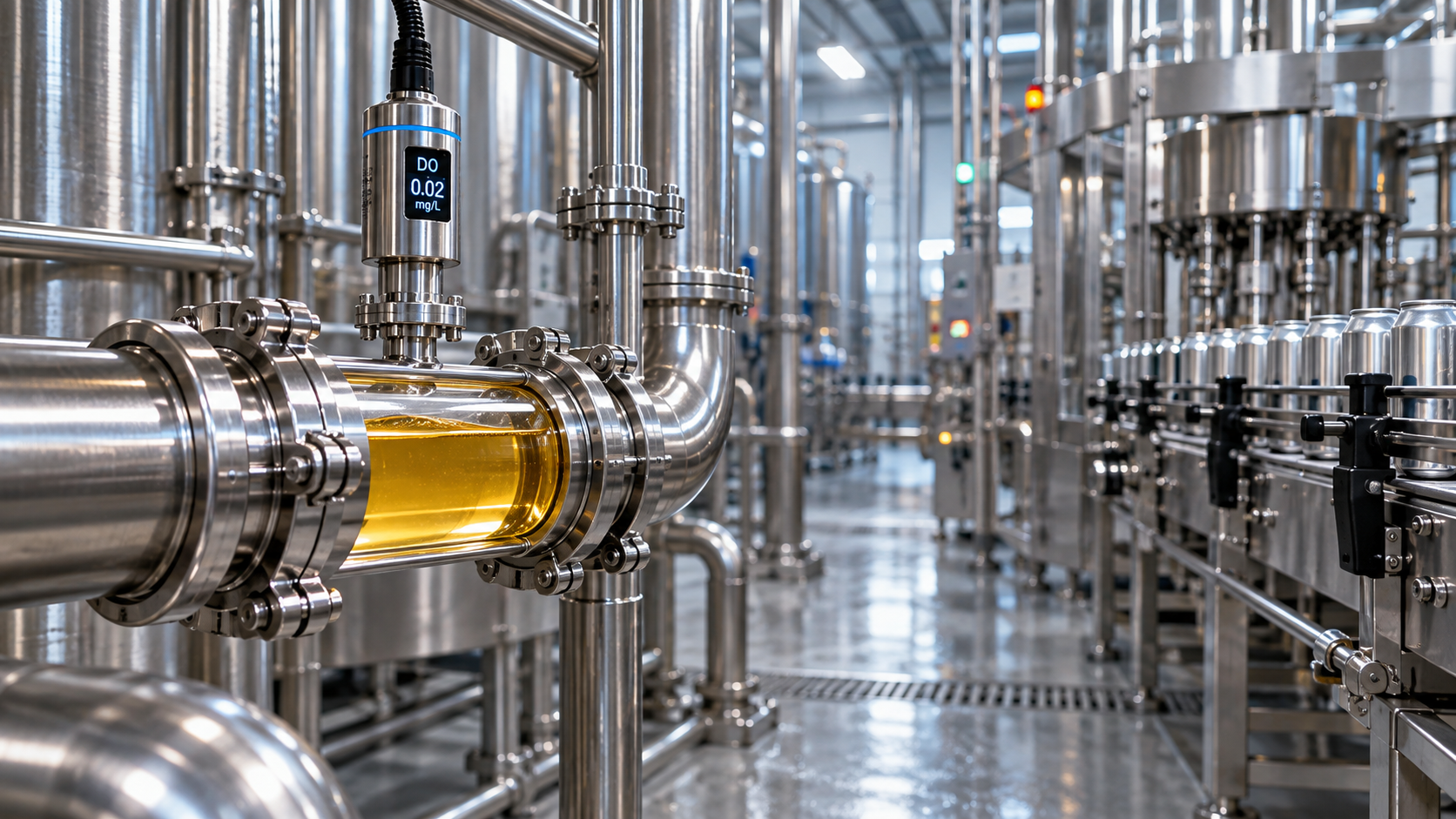
The most effective way to reduce oxygen during beer transfer and packaging is to measure pickup across individual operations, then correct the stage introducing it. A low dissolved oxygen reading in a bright beer tank does not prove that packaged beer is protected: transfer lines, filler bowls, empty containers and package headspace can each add oxygen after that measurement.
Control also requires distinguishing dissolved oxygen from total package oxygen. Beer can leave a filler with an acceptable liquid-phase reading while retaining enough oxygen in the headspace to compromise flavor stability. Reliable decisions therefore depend on validated sampling, controlled transfers and packaging checks that capture both sources.
Define the oxygen limit around the finished package
Oxygen exposure after fermentation can accelerate the loss of fresh hop character, alter malt expression and contribute to stale flavors. The sensory outcome depends on beer composition, previous oxygen exposure, storage temperature and distribution time. There is no single dissolved oxygen limit that guarantees the same shelf life for every beer.
Set the finished-package specification against the intended shelf life and distribution conditions, supported by sensory and stability testing. A delicate lager and a heavily hopped beer may show different deterioration patterns, but neither should be assumed tolerant of uncontrolled pickup.
At trace concentrations, beer dissolved oxygen is commonly reported in micrograms per liter, often described operationally as parts per billion. Instruments and records must use consistent units: confusing milligrams per liter with micrograms per liter creates a thousandfold reporting error.
Total package oxygen, or TPO, combines oxygen dissolved in the beer with oxygen in the package headspace. For comparison between packages, headspace oxygen must be converted to an equivalent quantity relative to beer volume using a validated method. A headspace percentage cannot simply be added to a dissolved oxygen concentration.
Once the final specification is established, allocate internal pickup limits to transfer, holding and filling. Leave operating margin rather than allowing every stage to consume the full allowance. These limits are process controls, not universal regulatory thresholds.
Confirm that the measurement is real
At low oxygen levels, the sampling system can introduce more oxygen than the process being investigated. An apparently poor result may come from an air-filled connector, a leaking sample fitting or inadequately flushed tubing rather than from the tank.
Use an instrument intended for trace oxygen measurement in carbonated beverages. Verify its measuring range, response characteristics, maintenance requirements and calibration procedure. Follow the manufacturer’s instructions for zero verification and calibration; do not assume that a successful check at atmospheric oxygen alone demonstrates accuracy near the production limit.
A dependable sampling arrangement should:
- Use short, suitable low-permeability tubing and leak-tight connections.
- Maintain sufficient pressure to prevent carbon dioxide breakout through the measuring cell.
- Provide the flow conditions required by the instrument.
- Flush the sample path until the reading stabilizes rather than for an arbitrary few seconds.
- Record sample temperature, sampling location, instrument identity and elapsed time after packaging.
Bubbles disturb measurement conditions and can make results unstable. A reading that changes substantially when tubing, flow or backpressure changes should trigger a sampling investigation before a production adjustment.
Packaged-beer measurements require a validated piercing and analysis procedure. If the method uses agitation to equilibrate headspace and liquid, apply the specified time, temperature and calculation consistently. An analyzer that reports dissolved oxygen alone is not automatically measuring TPO.
Measure packages promptly at a consistent interval after filling. Oxygen reacts with beer constituents, so a lower reading after storage does not necessarily indicate a better package. It can mean that oxygen has already been consumed in reactions associated with deterioration.
Locate pickup with a connected process profile
A single release result identifies an outcome, not a cause. Build a profile from the source vessel through the receiving tank and filler to the sealed package. Take samples close enough in time to represent the same production conditions, allowing for line residence time.
Sample startup, stable running, restart after a stop and the end of the run separately. Averaging them can conceal short oxygen spikes that affect a distinct group of packages. Where the equipment permits, connect results to filler-head identity, line speed and stop duration.
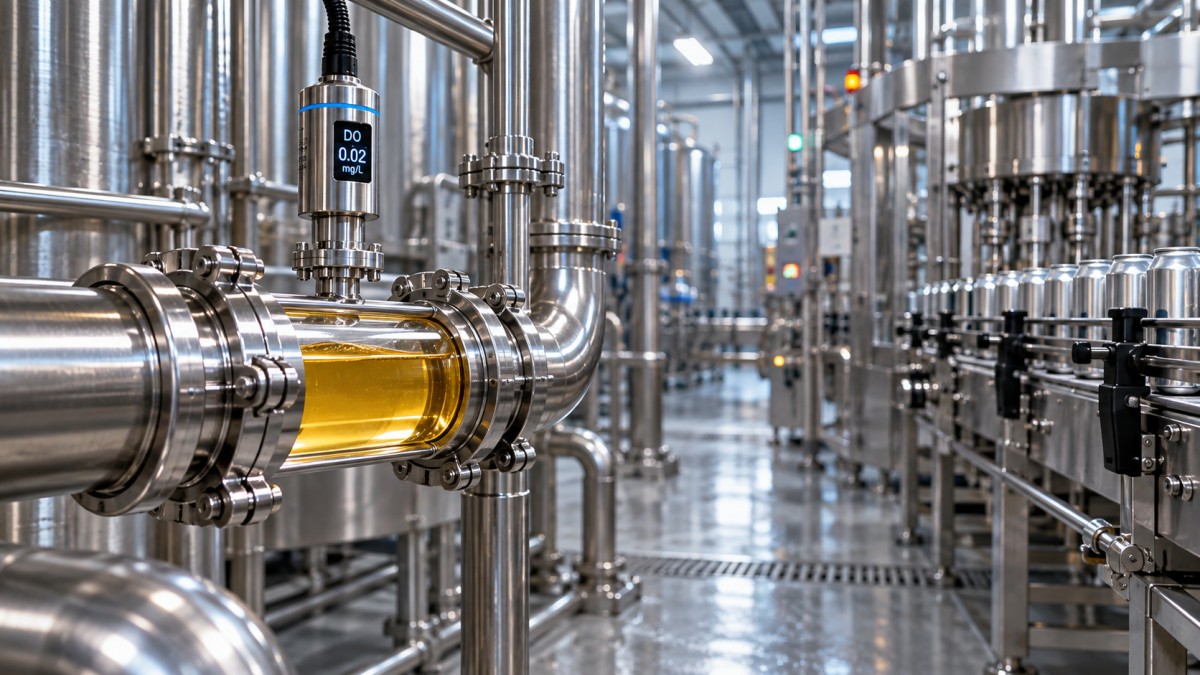
For investigation, calculate pickup as the downstream reading minus the corresponding upstream reading. Interpret small differences against instrument uncertainty, sampling repeatability and process variability. A difference smaller than the method can reliably resolve is not sound evidence for replacing equipment.
Remove air from the transfer path—not just the tank
Closed transfer protects beer only when the complete wetted path is prepared. A purged receiving tank still gains oxygen if beer pushes an air-filled hose, filter housing or valve cavity into it.
Establish a documented preparation sequence covering hoses, manifolds, pumps, filters, branches and receiving vessels. Identify sections that trap gas or retain rinse water. Where water is used for displacement, its dissolved oxygen matters; untreated water remaining in a line can become an oxygen source.
Purging should have a measurable endpoint. A fixed purge time or gas volume is dependable only after validation for the equipment geometry, pressure and flow conditions. Gas can bypass pockets, and mixing can make actual purging less efficient than an ideal displacement calculation suggests.
Verify the suitability of carbon dioxide or nitrogen at the point of use. A beverage-grade designation does not by itself establish that the residual oxygen concentration meets a particular process requirement. Review the gas specification and investigate downstream contamination, shared headers, maintenance work and pressure loss when results change unexpectedly.
During transfer, keep the liquid path flooded and operate within the pump’s inlet-pressure requirements. Restricted suction, damaged seals or unsuitable operating conditions can contribute to gas entrainment or air ingress where local pressure allows it. Cavitation is not proof of oxygen entry, but it signals that the transfer conditions need attention.
Introduce beer through a suitable low-level or bottom connection and avoid splashing into a gas-filled vessel. Turbulence alone does not create oxygen; it accelerates exchange when oxygen is present. The priorities are therefore removing oxygen from the surrounding gas and preventing contact with air, rather than simply reducing flow speed.
Check additions made after fermentation as well. Flavor preparations, dilution water and dosing assemblies can introduce oxygen even when the main transfer is controlled. Prepare these streams and their connections to the same oxygen-control standard as the beer path.
Control the period between container purge and closure
Packaging oxygen can remain high even when filler-inlet beer is consistently low. Empty containers contain air, filling exposes beer to a changing gas environment, and the interval before closing gives oxygen another opportunity to enter.
Container preparation must match the packaging format and equipment. Bottles may use evacuation and carbon dioxide flushing where the machine and container permit it. Can purging depends strongly on gas delivery, nozzle position, container movement and the time available before filling. Increasing gas flow without checking the flow pattern can waste gas without improving oxygen removal.
Validate purge performance at operating speed, including speed changes and restarts. A setting that performs adequately during slow commissioning may not provide the same protection during production. Check container positioning and blocked or damaged purge nozzles before treating oxygen variation as a gas-supply problem.
Maintain controlled filling pressure and temperature. Excessive carbon dioxide breakout can cause unstable fills, inconsistent headspace and product loss. Where the line uses controlled foam before closure, distinguish a repeatable fine foam cap from uncontrolled gushing. Foam can displace headspace air, but its appearance alone does not demonstrate low TPO.
Minimize and stabilize the time between filling and sealing. Examine packages following conveyor stops, interruptions in lid or crown supply and filler restarts. If these events create out-of-limit product, define an equipment-specific segregation or rejection rule rather than relying on an operator to recognize abnormal foam.
Fill volume also matters because it changes headspace volume. Compare oxygen results with actual fill and closure data. A higher TPO result may reflect more retained headspace gas rather than increased oxygen in the incoming beer.
Seam and closure integrity remain separate requirements. Low oxygen immediately after filling does not prove that a package will resist leakage or oxygen ingress during distribution. Maintain closure inspection and package-integrity controls alongside oxygen testing.
Turn abnormal results into targeted action
Use the pattern of results to decide where to intervene. Low source-vessel oxygen followed by a rise at the receiving vessel points toward transfer preparation or receiving conditions. Stable low filler-inlet oxygen with elevated TPO points toward container preparation, filling, headspace management or closing.
If only startup packages are affected, investigate residual air, initial gas stabilization and the startup rejection window. If results deteriorate after stops, examine pressure changes, filler operating state and restart sequencing. Repeated high results associated with one filling position justify a focused mechanical inspection.
Separate investigation thresholds from product disposition limits. A small but repeatable increase may warrant corrective maintenance before it threatens the finished-package specification. Product exceeding a release limit should be held under the established quality procedure while the affected interval and shelf-life implications are assessed.
Retesting must answer a defined question. Repeatedly testing stored packages until the oxygen reading falls is not evidence that the original exposure was harmless. Retained samples, sensory assessment and validated stability data are more useful for evaluating product impact.
Keep oxygen reduction compatible with sanitation and safety
In a beer factory, oxygen controls must remain subordinate to safe equipment operation and effective sanitation. Do not retain beer in an inadequately cleaned line, bypass a required cleaning stage or leave fittings partially assembled to simplify purging. Cleaning, rinsing, sanitation and oxygen removal need a compatible, validated sequence.
Carbon dioxide and nitrogen can create hazardous atmospheres. Purging requires suitable ventilation, gas-risk assessment and detection appropriate to the gas involved. Oxygen-deficiency monitoring alone does not address every carbon dioxide exposure hazard. Vessel entry requires a separate confined-space procedure; process purging does not make entry safe.
Pressurization and evacuation must remain within vessel and packaging-equipment ratings. Avoid improvised purge cycles that expose a tank to vacuum or pressure beyond its design limits, and preserve the operation of relief devices and interlocks.
A durable control plan ties oxygen results to operating conditions: purge endpoint, transfer pressure, filler state, package headspace and closure performance. The decisive improvement is not a single exceptionally low reading, but repeatable control during startup, normal production, interruptions and shutdown—the points where otherwise well-controlled beer can still acquire oxygen.
Thank you very much for writing to us. Please leave your message and contact information, we will reply to you within 24 hours.