



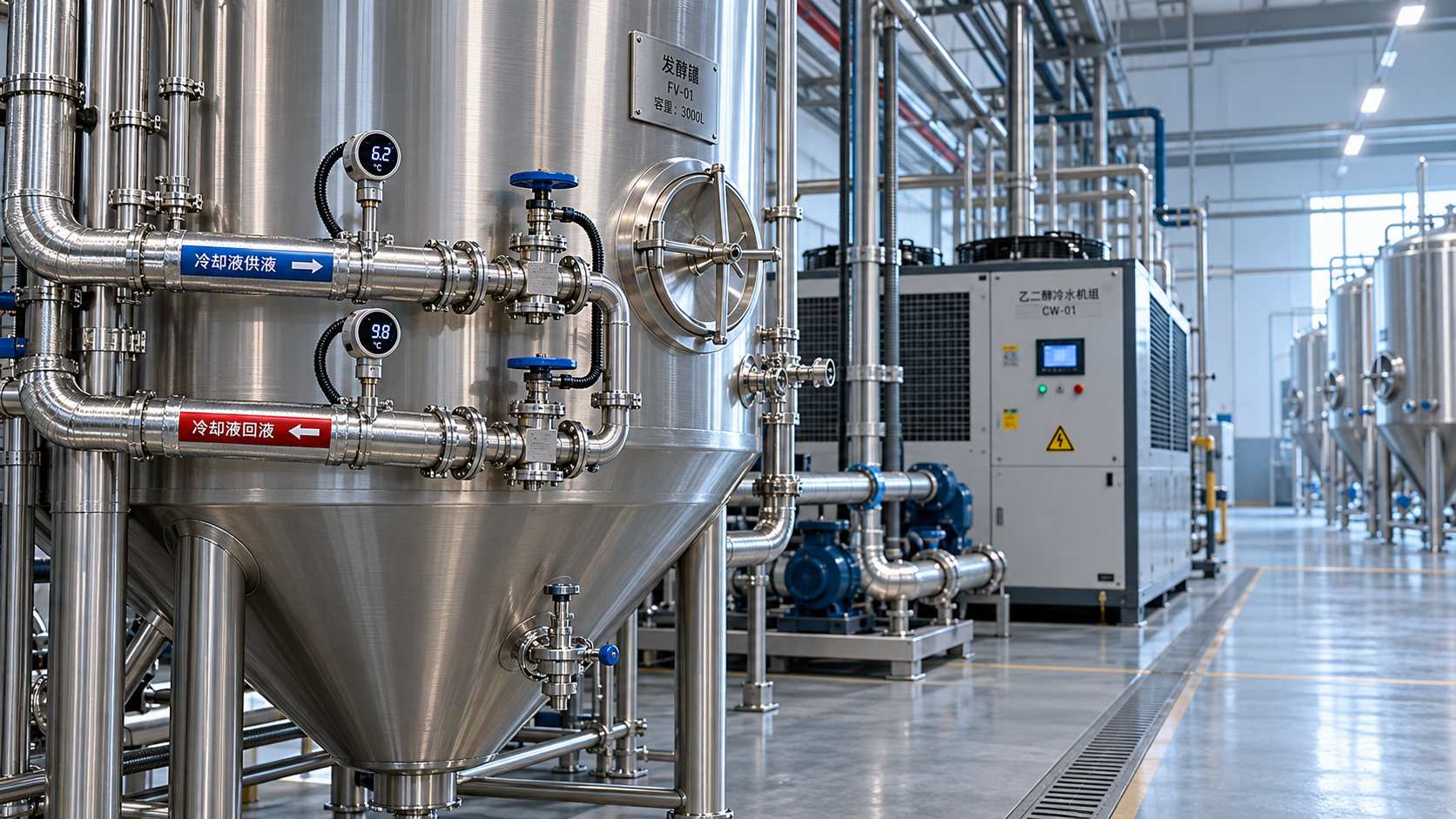
When fermentation tanks run too warm, first determine whether the cooling failure affects the whole cellar or only individual vessels. Warm glycol leaving the chiller points toward a refrigeration, heat-rejection, or capacity problem. Cold glycol at the main header but poor cooling at one tank points toward restricted circulation, a control fault, or inadequate heat transfer through that tank’s jacket.
In a Beer factory, this distinction prevents unnecessary chiller adjustments while fermentation temperature continues to drift. Excess heat can change yeast behavior and flavor development, so confirm the actual beer temperature, preserve alarm records, and notify production before changing operating conditions. Lowering the glycol setpoint without checking flow can worsen icing or leave the original fault unresolved.
Establish what is actually getting warm
Start with a short operating snapshot taken while the problem is present. Record the affected tank, fermentation stage, temperature trend, controller setpoint, cooling demand, glycol supply and return temperatures, and active alarms. Include other cooling loads, especially tanks being crashed or filled. Measurements taken after those loads stop may conceal the cause.
Check the displayed beer temperature against a calibrated reference using an approved sanitary measurement point. An external tank-wall reading is not equivalent to liquid temperature, particularly on an insulated vessel. Check sensor insertion, thermowell contact, wiring, and controller input configuration before treating a display discrepancy as refrigeration failure.
Use instruments suitable for the expected temperature range. For pipe measurements, use consistent contact methods and insulate probes from surrounding air. Infrared readings from shiny metal can mislead unless surface emissivity is addressed.
Follow the cooling path before changing settings
Trace the circuit from the chiller outlet through the supply header, tank valve, jacket, return branch, and back to the chiller. Confirm the actual arrangement against the piping diagram: some systems use separate primary and distribution pumps, buffer tanks, or mixing arrangements. A cold reservoir does not prove that cold fluid reaches the vessel.
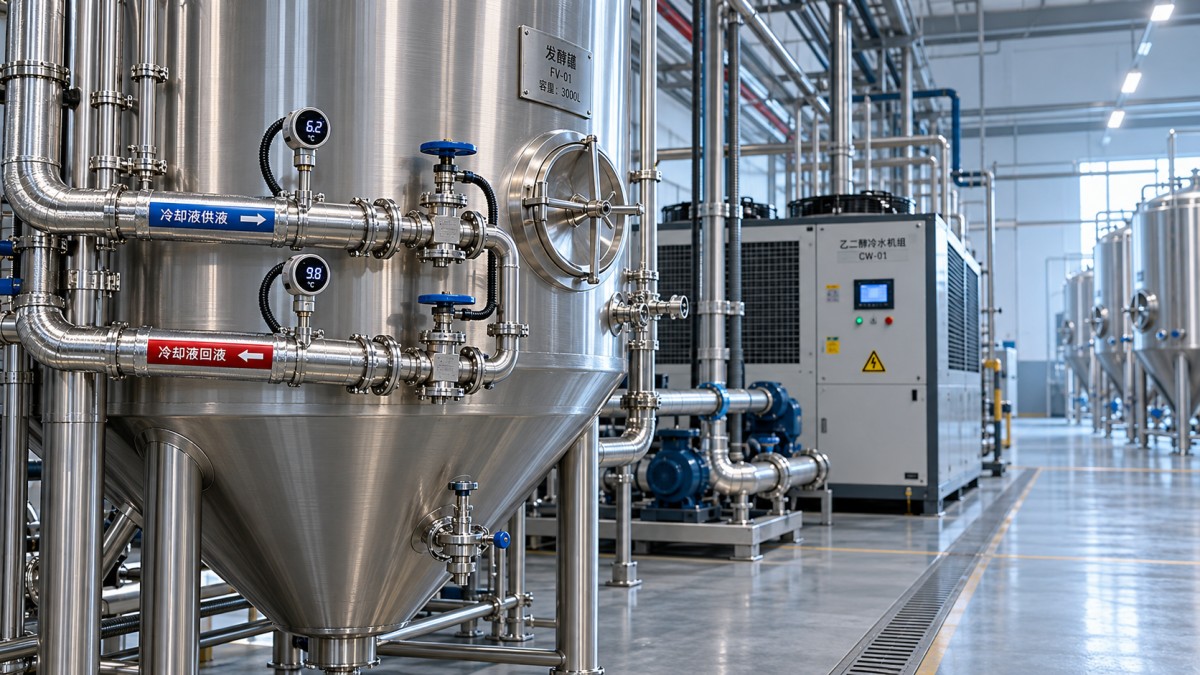
- Confirm a cooling request. Check that the tank controller is calling for cooling and that no schedule, interlock, or manual override blocks the output.
- Verify valve movement. An energized solenoid or controller indicator does not prove that the valve opens. Check the actuator, valve position, and temperature response downstream.
- Check the available flow path. Look for closed isolation valves, kinked hoses, obstructed strainers, incorrect check-valve orientation, and air trapped at high points.
- Compare branch conditions. Measure supply and return temperatures while cooling is commanded, then compare them with a working tank under similar conditions.
Inspect pump operation beyond simply listening for the motor. Verify rotation after electrical work, drive speed, reservoir level, suction conditions, and differential pressure against the pump curve. A running motor can coexist with poor circulation because of air ingress, cavitation, impeller damage, or an unsuitable operating point.
Apply lockout procedures before opening equipment. Isolate and depressurize fluid sections before removing strainers or instruments; never loosen a connection to “check for flow.” Follow the brewery’s carbon-dioxide precautions around fermentation areas.
Read temperature difference together with flow
A large glycol temperature rise across a jacket can indicate low flow: a small amount of fluid absorbs heat and returns much warmer. However, a large difference can also occur under a high heat load. It is not, by itself, proof of a blockage.
A small supply-to-return difference is equally ambiguous. The tank may need little cooling, fluid may be bypassing the jacket, or heat transfer may be poor. Compare temperature difference with measured flow, beer temperature, valve state, and fermentation activity. Touching two pipes and finding both cold is not enough.
Where reliable flow measurements are available, heat removal can be estimated from mass flow multiplied by the glycol mixture’s specific heat and temperature rise. Use properties for the actual concentration and temperature rather than water values. This helps distinguish insufficient circulation from insufficient refrigeration output.
Check glycol condition without guessing a target concentration
Excess glycol concentration increases viscosity and reduces heat-transfer performance compared with a properly selected mixture. At low temperatures, that viscosity penalty can reduce flow through jackets and strainers. Too little glycol creates a different risk: freezing in the evaporator or other cold sections, potentially restricting flow and damaging equipment.
Test a representative, well-mixed sample with an instrument appropriate to the glycol type. Interpret refractometer readings using the fluid supplier’s scale or conversion guidance; a generic Brix reading is not automatically a glycol percentage. Compare the result with the chiller manufacturer’s requirements and the fluid supplier’s freeze-protection data.
Select protection for the lowest expected fluid temperature, including evaporator conditions, not just the normal tank setpoint. Freeze protection and burst protection are different criteria. Do not dilute the circuit solely to improve pumping without checking the required protection and inhibitor concentration.
Also inspect for sediment, discoloration, contamination, and evidence of incompatible fluids being mixed. Follow the supplier’s testing guidance for inhibitor condition and pH. After correction, circulate thoroughly, retest, remove air through designated vents, and check for leaks that might have caused concentration changes.
When glycol leaves the chiller too warm
Check the chiller’s operating state before assuming it is undersized. Is the compressor running, waiting through an anti-short-cycle delay, unloaded, or locked out? Record alarm codes before resetting anything. Repeated resets can erase useful evidence and repeatedly expose equipment to the same fault.
Heat rejection and evaporator performance
On air-cooled equipment, inspect condenser cleanliness, fan operation, airflow direction, blocked clearances, and hot-air recirculation. High ambient temperature can reduce available capacity, especially when rejected heat cannot escape. Clean coils using the equipment manufacturer’s method; aggressive washing can damage fins or electrical components.
For water-cooled equipment, check condenser-water flow, entering temperature, strainers, and the associated heat-rejection equipment. Fouling on either side of a heat exchanger can impair performance. Use operating readings and service history to decide whether cleaning is justified rather than adding chemicals without identifying the deposit or checking material compatibility.
Low evaporator flow, local icing, and refrigeration faults can produce overlapping symptoms. Refrigerant pressure, superheat, subcooling, charge assessment, and sealed-circuit repairs belong with qualified refrigeration personnel. Low suction pressure alone does not establish low refrigerant charge, and refrigerant should not be added as a trial fix.
Separate overload from lost capacity
A chiller that runs continuously while supply temperature rises may be overloaded, but degraded condenser performance or a refrigeration fault can look the same. Confirm normal equipment operation before judging installed capacity.
Compare rated capacity at the actual glycol leaving temperature and ambient or condenser-water conditions. A nominal rating at warmer fluid conditions may not represent output during cold brewery operation. Review simultaneous fermentation heat, tank pull-down, wort cooling if connected, piping heat gain, and other users on the loop.
A buffer tank can soften short demand changes but cannot compensate indefinitely for inadequate refrigeration capacity. As a diagnostic measure, production may stagger discretionary crash-cooling loads and observe whether supply temperature recovers. Coordinate changes with production and quality personnel; do not interrupt essential fermentation control merely to improve chiller readings.
When the supply is cold but the tank stays warm
Focus on the local branch and controls. Check whether a valve opens fully or only briefly before the controller closes it. An incorrect sensor offset, unsuitable deadband, or control configuration can cause short cooling pulses even while the beer remains above its intended temperature.
Compare controller output with physical valve response. A failed relay, damaged actuator, loose connection, or loss of control power can leave the display showing demand without delivering glycol. Electrical testing should follow site procedures and be performed by personnel qualified for the equipment.
Next, confirm that the jacket circuits are connected and vented according to the tank manufacturer’s arrangement. Incorrect piping can trap air or distribute flow poorly between jacket zones. Respect jacket pressure limits and specified supply conditions; increasing pump pressure is not a substitute for correcting a restriction.
Product level also matters. A partially filled vessel may have less beer in contact with active jacket area. Product-side deposits, an unsuitable cooling-zone selection, or temperature stratification can further weaken apparent performance. Compare fill level and probe position with the tank’s intended operating range before changing refrigeration settings.
A useful clue is whether the fault follows the tank or the load. A vessel that struggles even when other tanks are satisfied deserves branch-level investigation. Several remote vessels losing cooling only when nearby branches open suggests hydraulic imbalance. Balance using design flows and measured conditions, not arbitrary valve throttling.
Prove recovery under the conditions that caused the fault
After corrective work, trend beer temperature, cooling demand, glycol supply and return temperatures, and relevant flow or pressure readings. Confirm that the beer moves toward its approved setpoint and remains stable without excessive cycling. A colder pipe immediately after a repair does not establish sustained recovery.
Repeat observations during a representative load overlap. Check that restoring one tank has not reduced flow to another, and confirm reservoir level after air removal. Inspect serviced joints for leaks and verify that isolation valves, guards, and automatic controls have been returned to their intended positions.
The service record should identify the verified cause, supporting measurements, corrective action, and operating conditions during validation. Keep previous setpoints and record every adjustment. When capacity remains uncertain, retain synchronized temperature and demand trends so the next engineering review can distinguish a short peak from a sustained cooling deficit.
Thank you very much for writing to us. Please leave your message and contact information, we will reply to you within 24 hours.