



Opening a US Brewery: Federal Permits, FDA Rules, and State Approvals
Opening a US brewery takes more than selecting tanks and scheduling construction. For project managers planning a beer factory, federal permitting, FDA requirements, and state and local approvals can directly affect facility design, commissioning, and launch timelines. Which approvals apply, and when should each process begin? The practical challenge is coordinating them: an acceptable production layout does not establish zoning compliance, and federal approval does not authorize taproom sales.
Treat regulatory approval as a design workstream, not paperwork to complete after installation. The safest starting point is a defined operating model, a site feasibility review, and an approval register showing who owns each application and what must happen before production or sales begin.
Define the operation before choosing the license path
A production brewery selling through distributors, a brewpub serving food, and a contract brewing operation can require different approvals. Before committing to a property, document who will own the equipment, purchase ingredients, control production, hold inventory, and sell the finished beer. Include intended distribution states and whether the site will offer tastings, takeaway sales, or restaurant service.
Those details matter particularly for OEM and private-label projects. In conventional contract brewing, the producing brewery generally handles production obligations under its qualification. An alternating proprietorship is different: separate brewing businesses share premises or equipment under arrangements subject to TTB requirements. A branding agreement alone does not establish which party is legally operating the brewery.
Also define the product range early. Conventional lager, wheat beer, fruit beer, reduced-calorie products, and beverages containing specialty ingredients do not necessarily follow identical formula or labeling pathways. “Beer” for federal excise-tax purposes and “malt beverage” under federal labeling law are not interchangeable definitions.
The TTB Brewer’s Notice is the federal production gate
The Alcohol and Tobacco Tax and Trade Bureau administers federal brewery qualification. A domestic commercial brewery generally needs an approved Brewer’s Notice before beginning brewing operations. The central regulations are in 27 CFR Part 25. Applications are commonly submitted through TTB’s Permits Online system.
Expect to provide business and ownership information, evidence of authority to occupy the property, and descriptions or diagrams of the brewery premises. TTB may request additional documentation depending on the entity and operating arrangement. A brewer’s bond may be required unless the business qualifies for an exemption; verify eligibility rather than including or excluding a bond by assumption.
For engineering teams, the premises drawing deserves attention. Production, storage, shared areas, and public-facing spaces need to match the proposed operation. A late decision to add a warehouse room, move a boundary, or accommodate another producer may require regulatory review rather than merely an updated construction drawing.
Use one controlled layout across the TTB application, state licensing package, and construction documents. The drawings may need different information, but room names, addresses, boundaries, and operating assumptions should agree. Otherwise, an ordinary design revision can become several rounds of agency questions.
Do not treat mechanical completion as permission to brew. Water testing, controls verification, and equipment checks should be separated from activities involving beer production. Confirm the authorized commissioning scope before scheduling a trial batch; calling it a test run does not remove regulatory obligations.
FDA registration is separate from TTB approval
A brewery that manufactures, processes, packs, or holds food for US consumption generally must register with FDA unless an exemption applies. Beer is food for this purpose. Registration is not a product approval, a sanitation certificate, or a substitute for the Brewer’s Notice.
FDA food facility registration generally must be completed before operations begin and renewed during October through December of each even-numbered year. Registration also requires an FDA-recognized unique facility identifier, currently the DUNS number. Confirm the facility’s registration status and applicable exemptions through FDA’s food facility registration guidance, particularly where retail or restaurant activities complicate the business model.
The alcoholic-beverage exemption is not a blanket food-safety exemption
Under 21 CFR 117.5(i), qualifying alcoholic-beverage facilities have exemptions from specified preventive-controls and supply-chain program requirements. Eligibility depends on the conditions in the regulation. It does not mean every brewery is exempt from all of Part 117, nor does it automatically cover every nonalcoholic product made at the same site.
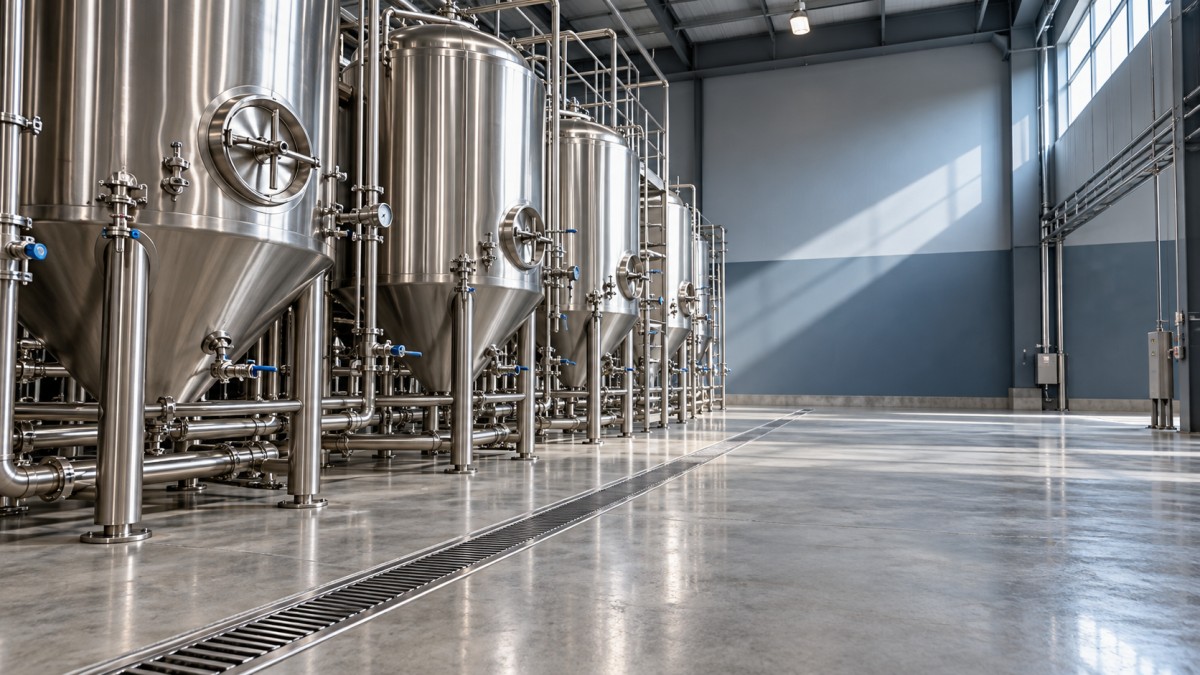
Applicable current good manufacturing practice requirements still matter. In design reviews, examine cleanable surfaces, drainage, potable water, pest exclusion, chemical storage, employee hygiene, and protection of packaging materials. These are easier to resolve before trench drains are poured and utility routes are fixed.
Consider a brewery adding a nonalcoholic beverage line. Its regulatory position and food-safety hazards may differ from those of its conventional beer range. Do not extend an alcoholic-beverage exemption to that line without checking the conditions. Product stability, process controls, and storage requirements also need their own assessment.
Check site constraints before the equipment order becomes irreversible
A property advertised as industrial is not necessarily approved for brewing, public tastings, or alcohol sales. Obtain a written zoning determination where available. Confirm whether the proposed use is permitted outright, requires a conditional-use process, or faces restrictions involving parking, operating hours, neighboring uses, or public access.
Wastewater can be the less visible constraint. Brewery discharge varies with production, cleaning practices, and solids management. Ask the sewer authority about industrial discharge authorization, sampling, pH limits, organic loading, temperature, and potential surcharges. There is no single nationwide brewery discharge limit that can safely replace local requirements.
Send utilities a realistic operating profile, including cleaning peaks—not just average beer output. A sewer connection that appears adequate on a property plan may not accept the proposed discharge without pretreatment or operating controls.
Building and fire reviews may address occupancy classification, structural loading, exits, ventilation, boilers, refrigeration, compressed gases, and carbon dioxide storage. Requirements depend on the adopted codes, equipment, and quantities involved. CO2 detection and ventilation should be evaluated with the responsible authorities and engineers, not copied from another brewery’s layout.
Keep public occupancy separate from production authorization in the schedule. A brewery may have installed equipment but still lack the inspections or certificate needed to open its taproom.
State approvals determine how the brewery can sell
State alcohol agencies establish their own license categories and privileges. Manufacturing, self-distribution, taproom service, takeaway sales, and brewpub operations may require different licenses or endorsements. Federal approval does not override state restrictions on ownership, distribution, or retail activity.
Ask the state agency which applications can run alongside TTB review and which approvals must be supplied before issuance. Depending on the jurisdiction, the process may involve local consent, public notice, ownership disclosures, background checks, or premises inspections. Avoid promising a launch date based only on a federal application estimate.
Selling outside the home state adds another layer. Destination states may require supplier registration, brand registration, reporting, or distribution arrangements. Online availability does not establish permission to ship directly to consumers. For a brewery planning supermarket, restaurant, and bar channels, validate the route to market before signing distribution commitments.
Resolve formulas and labels before printing packaging
Facility approval does not settle product compliance. Some beers require TTB formula approval because of their ingredients or production methods, while others qualify for exemptions. Fruit, flavorings, extracts, and specialty processing deserve an early review. Where required, formula approval should precede the related label approval application.
For products subject to Federal Alcohol Administration Act malt-beverage labeling rules, a Certificate of Label Approval, or COLA, is generally required for interstate commerce. Intrastate-only products may follow a certificate-of-exemption pathway, subject to applicable conditions. Some products classified as beer for tax purposes fall outside that malt-beverage definition and instead face FDA labeling requirements.
This distinction is relevant to product developers such as Jinpai Beer, whose portfolio includes classic lager, German wheat beer, fruit-flavored beer, reduced-calorie options, and specialty products. For an OEM/ODM project entering the US market, existing overseas packaging is a starting document—not evidence of US compliance. The actual recipe, alcohol content, claims, and manufacturing arrangement determine the review needed.
Claims such as “sugar-free,” “low-calorie,” or functional benefits need particular scrutiny. Applicable rules differ by product jurisdiction, and health-related language can create additional issues. Have claims reviewed before committing to printed cans or long-lead labels.
Build the launch schedule around release conditions
A useful approval register records more than submission dates. For each item, identify the authority, responsible owner, prerequisite documents, inspection needs, and activity it releases. The critical gates normally include:
- Site commitment: acceptable zoning, utility capacity, wastewater pathway, and workable licensing assumptions.
- Design release: coordinated premises boundaries, process layout, drainage, fire protection, and public-access arrangements.
- Production release: approved federal and state authority, applicable FDA registration, and required facility inspections.
- Sales release: product and label compliance, relevant retail or distribution privileges, and destination-market requirements.
After opening, assign ownership of excise-tax filings, production records, license renewals, FDA registration renewal, and change notifications. A new owner, added premises, or altered operating arrangement may trigger further submissions.
Before fixing the first commercial brew date, hold a release review against actual approvals—not application receipts. Any unresolved item should have a named owner and a clear restriction on what the team may do. That distinction keeps an almost-ready brewery from producing beer it is not yet authorized to make or sell.
Thank you very much for writing to us. Please leave your message and contact information, we will reply to you within 24 hours.