



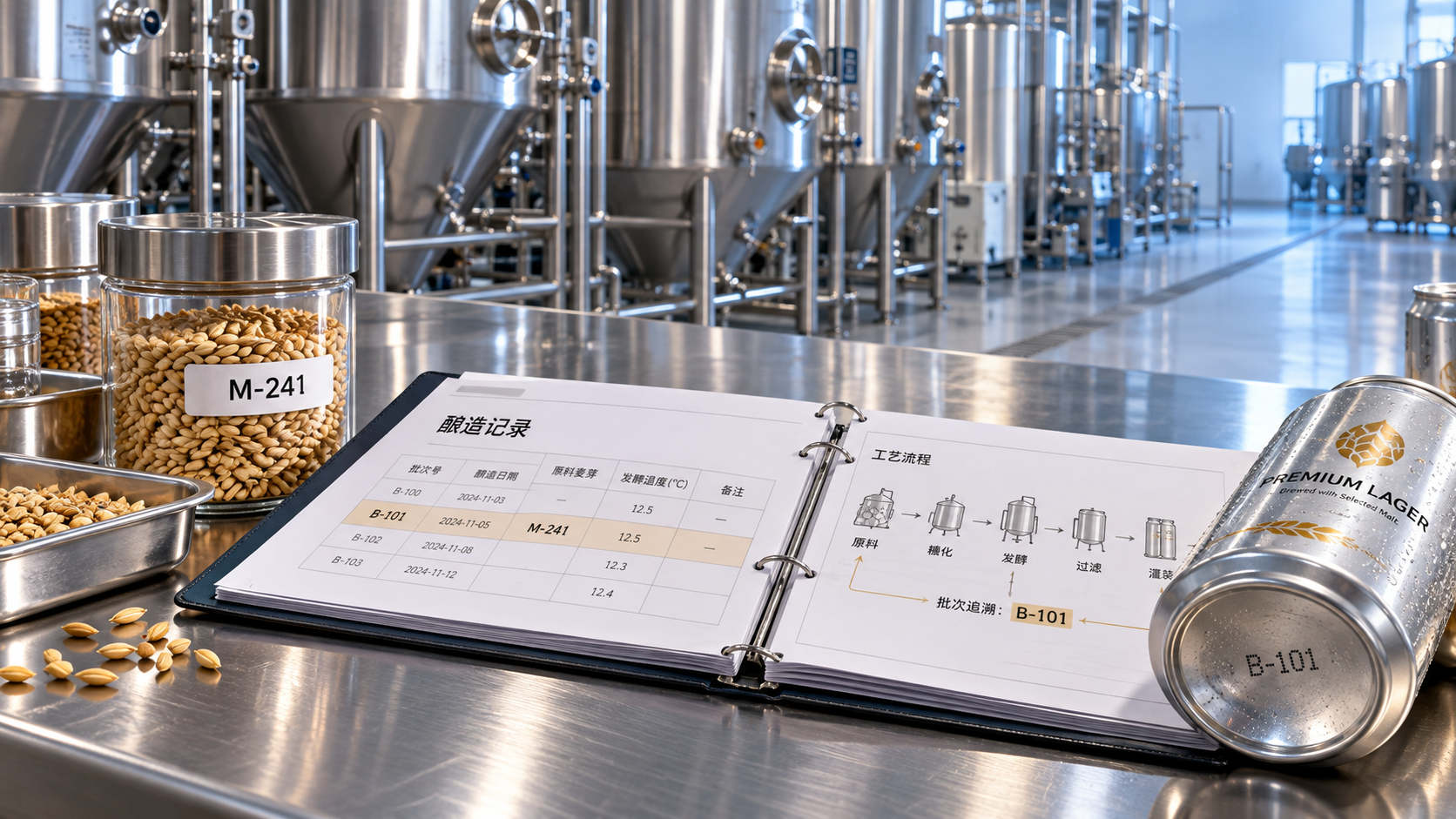
A supplier flags a potentially affected malt lot just as a distributor asks whether its latest delivery can remain on sale. The quality team has receiving records, brewing logs and shipment documents—but can anyone connect them quickly enough to make a defensible decision?
Brewery traceability means linking ingredient lots to brewing batches, fermentation vessels, packaged beer and customer shipments. In a beer factory handling several recipes or OEM/ODM orders, a missing transfer record can turn a narrow investigation into a much wider product hold. The practical goal is straightforward: identify what went into each finished lot, where that beer went, and which records support the decision to release, hold or recall it.
Build a batch genealogy, not just a document archive
A folder full of supplier certificates does not establish traceability. Neither does a production system that records only the recipe and brewing date. Useful traceability depends on relationships between records: a particular quantity from an identified ingredient lot was consumed in a particular production event, then transferred, blended or packaged.
Those relationships must work in both directions:
- Backward tracing: From a bottle, can or keg code, identify its packaging run, source beer, ingredient lots and relevant processing records.
- Forward tracing: From a suspect ingredient lot, identify every production batch, finished lot, stock location and shipment potentially affected.
These are different tasks. A team may easily find the malt used in one lager batch yet struggle to find every other batch that consumed the same malt lot. Test both directions before assuming the system is reliable.
Also distinguish the physical vessel from the beer it contains. “FV-06” identifies equipment, not a unique batch. The same fermentation vessel may hold many batches over time, while one beer batch may move through several vessels before packaging.
The minimum links a beer factory needs to capture
Use identifiers that remain unique within the record-retention period. They do not need to contain every production detail; they need to be readable, consistently applied and connected to the right records. Retain supplier lot identifiers even when assigning internal receiving codes.
Recipe quantities are not substitutes for actual consumption. If an operator finishes one hop lot and opens another during a brew, both lots belong in the batch record. The same rule applies to partial bags, substitute ingredients and additions made after fermentation.
Water requires a slightly different approach. Link the batch to its water source, treatment status and relevant monitoring period rather than forcing a continuously supplied utility into an artificial supplier-lot model.
Follow one ingredient through the real production flow
Consider an illustrative malt lot, M-241, issued to brewing batches B-101 and B-102. B-101 ferments separately. B-102 is later blended with B-103 in a bright beer tank, creating blend BL-08. That blend supplies two packaging runs: one for cans and another for kegs.
A forward trace of M-241 must therefore reach B-101 and every finished lot descended from BL-08. Looking only for “M-241” in packaging records will fail because packaging staff may never handle—or even see—the original ingredient identifier.
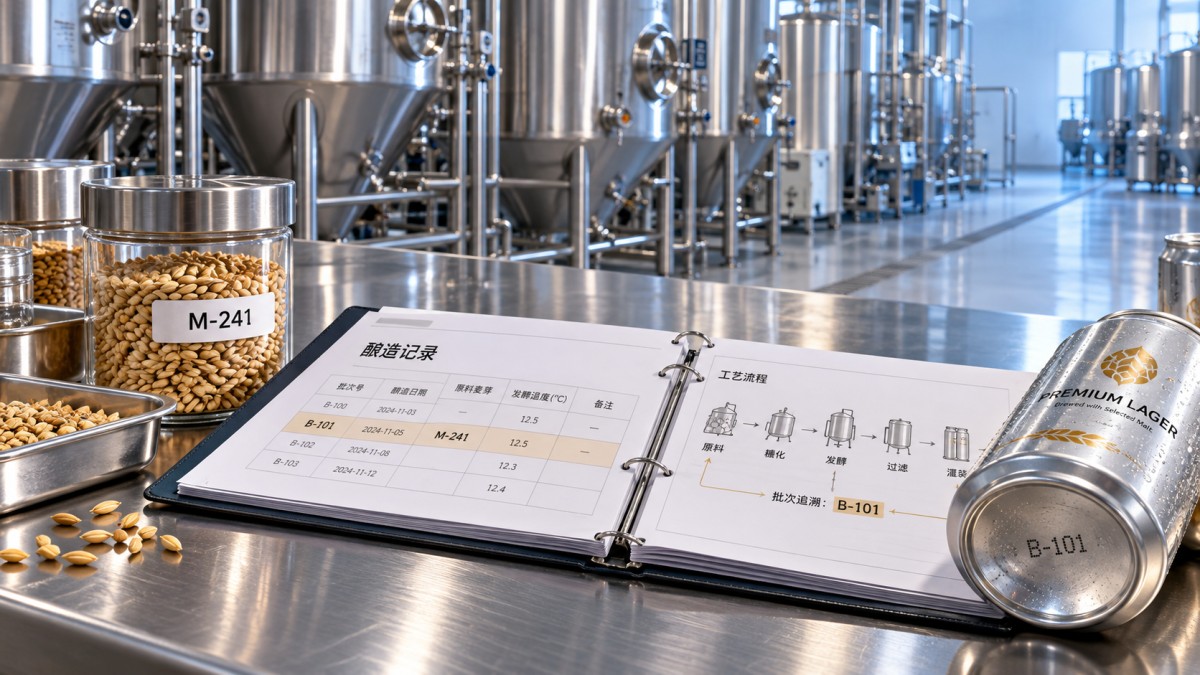
The connection must pass through the intermediate events. Record the source, destination, quantity, date, time and responsible operator for each transfer. Where quantities are estimated from tank instruments, document the measurement method and expected uncertainty.
This matters particularly when the production pattern changes:
- One batch, multiple destinations: Beer split between tanks or packaging formats must retain the same upstream ancestry.
- Multiple batches, one destination: A blend needs all parent batch IDs, not just the largest contributor.
- Partial tank packaging: Remaining beer must stay identifiable after the first packaging run closes.
- Additional beer entering a tank: Define how a top-up creates or updates the traceable batch and affects subsequent finished lots.
Physical mixing determines exposure. If affected beer enters a blend, the entire blend may require assessment; a small contribution does not automatically justify excluding the resulting product.
Close the gaps that commonly survive routine audits
Repitched yeast has its own family tree
A yeast strain name is not a traceability identifier. Record the original culture or supplier lot, propagation events, harvest source, collection date, storage conditions where relevant, and each receiving batch. Generation numbers support control, but they do not replace unique harvest identifiers.
If a yeast-related concern emerges, the investigation may need to follow successive harvests into later brews. Define that scope with the food safety team rather than stopping at the first batch that received the original culture.
Post-fermentation additions need equal visibility
Fruit preparations, flavorings, sweeteners and specialty ingredients can enter production after the main brewing record has closed. Capture their lots and actual quantities at the addition point, with links to the receiving beer and the applicable recipe version.
For a portfolio covering classic lager, German wheat, fruit-flavored beer, sugar-free low-calorie beer and functional specialty beers, the traceability model must accommodate different process routes. Ingredient specifications and allergen information should remain accessible, while any nutritional or functional claims require their own supporting controls. Traceability alone does not substantiate those claims.
Packaging can create an independent recall scope
Affected cans, bottles, closures, labels or kegs may cross several beer batches. Record packaging material lots against the runs that used them, including changes made mid-run. For returnable kegs, maintain container identification and relevant filling and cleaning records.
Printed codes deserve verification too. At startup, changeovers and defined intervals, check that the code is correct, legible and linked to the intended production record. A perfectly documented batch is difficult to trace from the market if its package code is unreadable.
Use reconciliation to expose missing links
Traceability should make quantitative sense. For each ingredient lot, compare receipt quantities with recorded consumption, remaining inventory, returns and documented losses. For beer, reconcile transfers and packaged output with expected process losses and measurement variation.
Do not demand artificial precision. Fermentation losses, sampling, sediment removal and packaging rejects are real. Instead, establish justified tolerances for each process and investigate unexplained differences. An unusually large variance may reveal an unrecorded addition, a wrong lot selection or a transfer assigned to the wrong tank.
Packaging reconciliation needs consistent units. Convert cases, individual cans and kegs into comparable quantities when checking output. During a recall exercise, separately reconcile finished units produced against stock held, quantities shipped, returns and documented destruction.
An unexplained balance is a reason to investigate, not a reason to invent a correcting entry. Preserve the original record and document any correction, its reason, author and approval.
Choose controls operators can use under production pressure
A smaller brewery can maintain effective traceability with controlled paper forms and well-managed spreadsheets. A larger beer factory may benefit from integrated inventory, production and warehouse software. Neither approach succeeds if recording a lot change is inconvenient or responsibilities are unclear.
Prioritize the controls that prevent predictable errors:
- Confirm the ingredient identity and released status before issue.
- Scan or record the lot at the point of use, not from memory after the shift.
- Require source and destination confirmation for transfers and blends.
- Prevent packaging runs from closing with missing source-batch information.
- Use controlled access, backups and an audit trail for electronic records.
- Provide a downtime procedure and reconcile temporary records after recovery.
Barcode scanning reduces transcription, but it cannot correct a label attached to the wrong pallet. Periodic physical checks remain necessary. Likewise, software should distinguish blocked, released and rejected stock so that traceability records support actual inventory control.
Assign responsibility at each handoff. Warehouse staff own receipt identification; production records consumption and movement; packaging verifies finished codes; quality oversees exceptions and disposition. Shared responsibility works only when individual actions are explicit.
Run the recall exercise before the urgent call arrives
Select a real finished lot and trace backward. Then select an ingredient or packaging lot and trace forward without preparing a special dataset. Include an ordinary shipment to a distributor, because the difficult questions often begin after goods leave the warehouse.
- Define the trigger. Identify the suspect lot, defect or process deviation and the available evidence.
- Contain potentially affected stock. Apply physical and system holds while the scope is assessed.
- Build the affected-product list. Include blends, split batches, later additions and relevant packaging runs.
- Reconcile quantities and destinations. Separate stock on site, stock in transit and delivered quantities.
- Check communication readiness. Confirm current contacts, decision authority and notification procedures.
- Record gaps and corrective actions. Repeat the failed portions after improvements.
Set internal completion targets based on risk, customer expectations and applicable market requirements. Measure retrieval time, completeness, unexplained quantities and contact accuracy—not just whether someone eventually produced a report.
A traceability match identifies potentially affected product; it does not by itself determine the health risk or legal recall obligation. Quality and safety personnel must assess the hazard, available test results and distribution circumstances, following applicable notification requirements.
Make OEM/ODM handoffs as traceable as production
Contract manufacturing adds another identity layer: the same source beer may be packaged under different brands, customer specifications or market labels. Keep the relationship between internal batch IDs, customer product codes, approved artwork versions and finished lot codes explicit.
Jinpai Beer’s mix of craft beer production, OEM/ODM services and wholesale supply makes these handoffs relevant to discussions with distributors and brand partners. A practical agreement should define which records accompany shipments, who retains detailed production records, how investigations are coordinated and who contacts downstream customers.
For international distribution, confirm destination-specific coding, documentation and retention requirements rather than assuming one format fits every market. Retention periods should reflect applicable obligations, product shelf life and a justified investigation margin.
The strongest traceability system is not the one with the most fields. It is the one that lets a quality manager take a package from the warehouse, identify its complete production ancestry, and locate every related shipment without relying on someone’s memory. Build those links into daily work, challenge them through realistic exercises, and recall decisions become more focused, better supported and less disruptive.
Thank you very much for writing to us. Please leave your message and contact information, we will reply to you within 24 hours.