



Zero-Carb Beer Low Calorie: What to Check Before Choosing a Product Line
For buyers evaluating a zero-carb beer low calorie portfolio, product claims alone are not enough.
You need to check taste stability, ingredient transparency, brewing capability, packaging options and supplier customization before making a line decision.
This guide covers the points that matter most when comparing a zero-carb beer low calorie product line for long-term market fit.
Why Zero-Carb Beer Low Calorie Is Getting More Attention
Consumer demand is shifting toward lighter drinking options with clearer nutrition claims.
That change is visible across retail, bars, restaurants and online marketplaces.
A zero-carb beer low calorie range can help brands enter health-aware segments without leaving the beer category.
More importantly, it gives distributors and private-label buyers a chance to widen their offer mix.
Still, market interest alone is not a reason to approve a product line.
In practice, the success of zero-carb beer low calorie products depends on repeat purchase, not first-trial curiosity.
That is why line selection should focus on drinkability, consistency and commercial flexibility.
Start With the Product Claim, but Do Not Stop There
The phrase zero-carb beer low calorie sounds simple, but the actual product definition can vary by market.
Before comparing suppliers, confirm how carbohydrate and calorie values are measured and declared.
Ask whether the nutrition panel follows destination-market labeling rules.
Also verify whether the product claim refers to per serving, per 100 milliliters or another standard basis.
This matters because a zero-carb beer low calorie item can look compliant in one region and problematic in another.
Key questions to ask
- What test method supports the carbohydrate claim?
- How many calories are declared, and under which unit?
- Can the supplier provide batch-level lab reports?
- Are label claims adjustable for different export markets?
A supplier that answers these clearly is usually easier to work with later.
Taste Stability Is the First Real Filter
Many buyers focus on claims first and flavor second.
That order often leads to weak sell-through.
A zero-carb beer low calorie product must still taste like beer people want to buy again.
Low-carb and low-calorie positioning can sometimes create a thin body or a short finish.
That is not always a problem, but it must fit the target channel.
For supermarkets, easy-drinking balance may be enough.
For bars and restaurants, flavor memory matters more because reorder decisions happen faster.
What to evaluate in tasting
- Aroma clarity and freshness
- Mouthfeel, body and carbonation balance
- Aftertaste length and bitterness control
- Flavor consistency across multiple batches
Request retained samples from different production dates when possible.
That gives a more useful view than a single fresh sample.
Check Brewing Capability and Production Control
A strong zero-carb beer low calorie line needs more than a good formula.
It also needs process control that keeps the formula stable at scale.
This is where brewing capability becomes a commercial issue, not just a technical one.
If the supplier cannot reproduce the same profile consistently, channel expansion becomes risky.
Ask about fermentation control, filtration standards, quality inspection and shelf-life validation.
You should also confirm production capacity for both launch volumes and future growth.
Useful supplier checkpoints
- Can they scale the same zero-carb beer low calorie recipe without changing taste?
- Do they have internal and third-party quality verification?
- What are the lead times for repeat orders?
- How do they manage raw material variation?
Reliable answers reduce launch risk and improve planning accuracy.
Review Ingredient Transparency and Compliance Readiness
Ingredient transparency affects both trust and speed to market.
When evaluating a zero-carb beer low calorie line, ask for a full ingredient and process explanation.
The goal is not to collect paperwork for its own sake.
The goal is to avoid delays when a retailer, importer or regulator requests proof.
This becomes even more important for export projects and private-label programs.
Check whether the supplier can support destination-specific documentation, label adaptation and claim review.
Match Packaging to Channel Strategy
Packaging choice shapes cost, shelf impact and channel suitability.
A zero-carb beer low calorie product for convenience retail may need different packaging than one for hospitality.
That sounds obvious, but many product lines still use one pack format for every route.
In real business terms, that can limit margin and reduce market response.
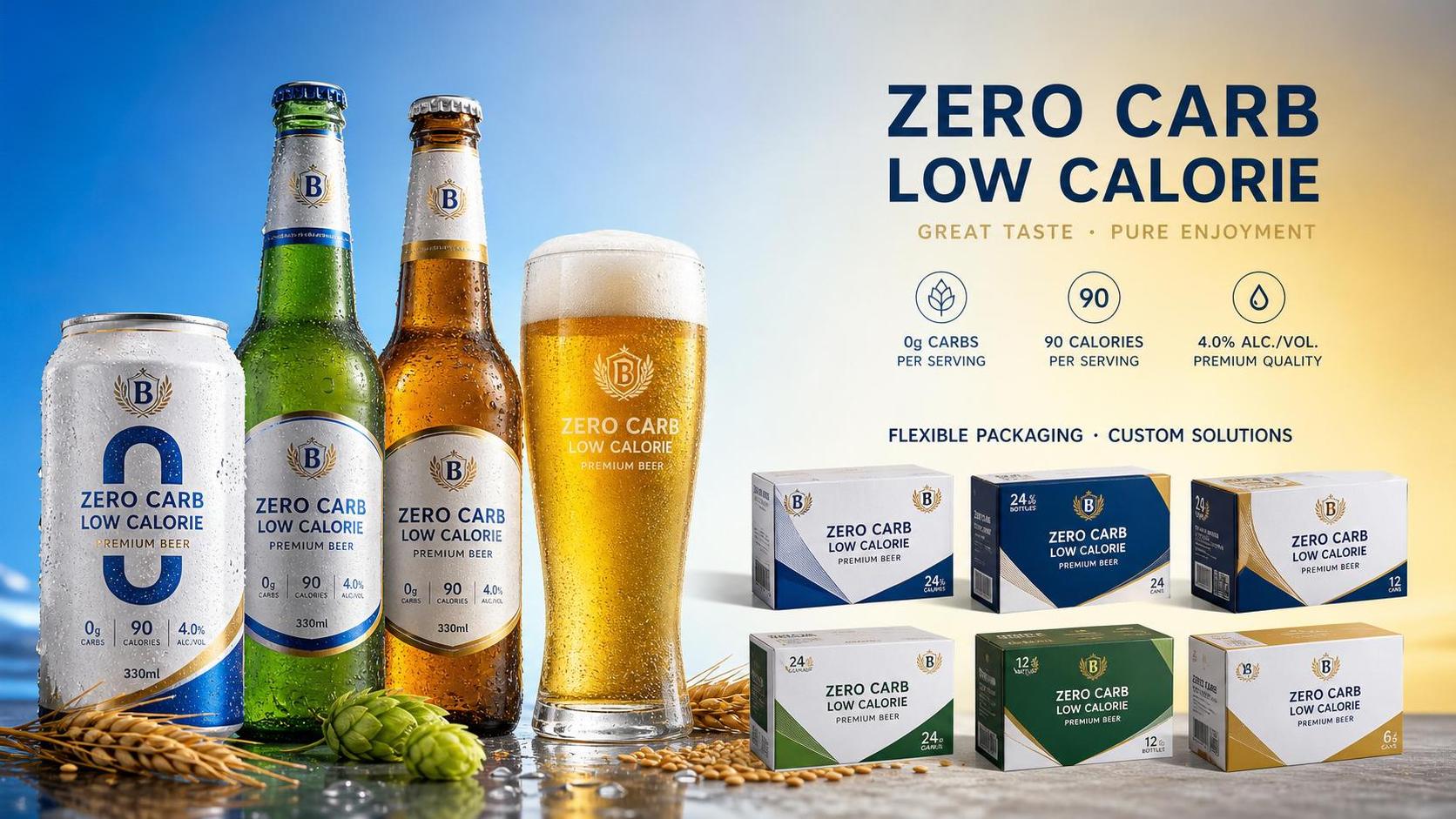
Review can, bottle and outer-case options early in the selection process.
Also ask whether design customization is available for OEM or ODM programs.
Packaging factors worth checking
- Available sizes for cans and bottles
- Carton strength for export shipping
- Private-label artwork support
- Low minimum order flexibility for market testing
The best zero-carb beer low calorie line is not just the best liquid.
It is the one that works smoothly through your target channel.
Evaluate Customization and Portfolio Fit
A single SKU rarely carries long-term growth on its own.
That is why portfolio fit matters when reviewing a zero-carb beer low calorie supplier.
You may launch one item first, then expand into adjacent styles later.
A supplier with broader brewing capability can support that path more efficiently.
Jinpai Beer, for example, develops and produces craft beer across classic lager, German wheat, sugar-free low-calorie beer, fruit-flavored beer and functional specialty beer.
That broader range is useful when a zero-carb beer low calorie launch needs follow-up products for different channels.
OEM, ODM and wholesale support also matter because market requirements rarely stay fixed.
The more clearly a supplier handles customization, the easier line management becomes later.
A Practical Selection Framework
To make comparison easier, score each zero-carb beer low calorie option against the same decision points.
- Confirm claim validity and nutrition documentation.
- Run tasting across multiple batches.
- Check capacity, lead time and quality systems.
- Review packaging formats and label flexibility.
- Assess OEM, ODM and expansion potential.
This framework keeps the review grounded in business outcomes.
It also helps prevent decisions based only on price or a single sample.
Final Takeaway
Choosing a zero-carb beer low calorie line is really about balancing product appeal with execution reliability.
The right choice should taste stable, meet claim requirements, fit your channels and leave room for brand growth.
When suppliers can support brewing consistency, packaging flexibility and customization, the line becomes easier to scale.
For teams comparing partners, the smartest next step is a structured sample review backed by documentation, packaging checks and a clear launch plan.
That approach gives your zero-carb beer low calorie decision a stronger commercial foundation from day one.
Thank you very much for writing to us. Please leave your message and contact information, we will reply to you within 24 hours.