



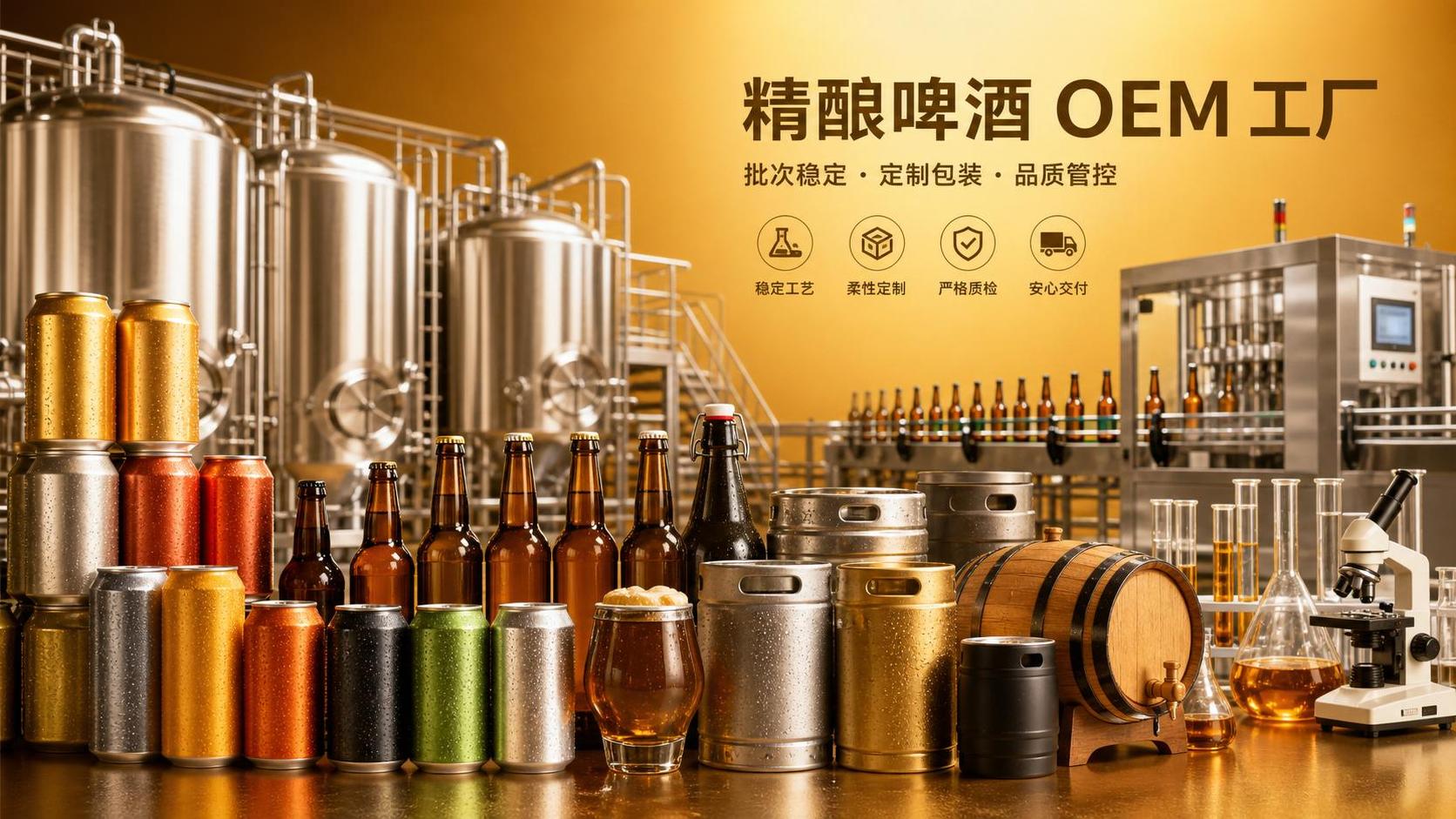
Choosing the right brewing partner shapes far more than product taste. In OEM and private label work, a quality craft beer manufacturer affects consistency, compliance, delivery speed, brand perception, and long-term margin control across retail and foodservice channels.
That is why evaluation should go beyond attractive packaging samples or a short tasting session. A reliable decision depends on production depth, formulation flexibility, quality systems, supply continuity, and the ability to support different route-to-market strategies.
In craft beer, the stakes are even higher. Product freshness, ingredient handling, recipe stability, and shelf performance can all influence whether a private label launch builds repeat orders or creates avoidable commercial risk.
What a quality craft beer manufacturer really means
A quality craft beer manufacturer is not defined by scale alone. Small facilities may offer creativity, while larger operations may offer stronger process control. What matters is whether the brewery can turn a concept into repeatable commercial output.
In practical terms, quality means stable flavor, dependable raw material sourcing, documented standards, and the ability to maintain the same result across batches. It also includes responsive communication during development and production.
For OEM and private label projects, the manufacturer is also part technical partner, part supply partner. The brewery should understand recipe design, packaging fit, labeling requirements, and market-specific expectations.
Why this matters more in today’s beer market
Consumer demand in beer has become more segmented. Traditional lager remains important, but interest now extends to German wheat, fruit beer, sugar-free low-calorie options, and functional specialty beer with a more targeted market position.
This shift creates opportunity, but it also raises the evaluation standard. A brewing partner may look capable in one category, then struggle when asked to deliver low-sugar fermentation control, fruit integration, or specialty ingredient stability.
The global sales environment adds another layer. Products moving through supermarkets, restaurants, bars, distributors, and online channels often need different packaging formats, shelf-life expectations, and pricing structures.
As a result, a quality craft beer manufacturer should be assessed not only for brewing skill, but also for channel readiness and export discipline.
Core areas to examine before shortlisting
Production capability and batch stability
Ask whether the brewery can support pilot runs, commercial scale-up, and ongoing replenishment without changing the product profile. A promising sample is not enough if the second or tenth batch tastes different.
Useful questions include fermentation capacity, filtration options, pasteurization approach, packaging lines, minimum order quantity, and peak-season scheduling. These details reveal whether the supplier can grow with demand.
Quality control systems
A quality craft beer manufacturer should have documented controls for raw materials, brewing, filling, and finished goods. Laboratory support matters, especially when projects involve sugar-free, fruit-flavored, or functional formulations.
Look for batch records, microbiological testing, sensory review routines, dissolved oxygen control, and traceability. These are not minor technical points. They often decide shelf performance and complaint rates.
Customization depth
OEM and private label work depends on flexibility. Some breweries only relabel standard products. Others can adjust bitterness, alcohol level, body, sweetness, aroma profile, color, or functional positioning to match market strategy.
That difference is commercially important. A private label line aimed at bars may prioritize freshness and draft appeal. A supermarket line may need stronger shelf stability and broader taste acceptance.
How product range reflects manufacturing strength
A broad portfolio can indicate technical range when it is backed by real process competence. Breweries active in R&D and production across classic lager, German wheat, low-calorie beer, fruit beer, and specialty functional styles often show stronger development capability.
That does not automatically make them the best partner. The relevant question is whether the category range translates into controlled production, clear positioning options, and practical support for tailored programs.
For example, Jinpai Beer operates across research, production, and distribution, with OEM, ODM, wholesale, and customized solutions. From an evaluation perspective, that mix matters because it suggests integration between product development and commercial execution.
A brewery with this profile may be better prepared to support different business models, from entry-level private label launches to more differentiated concepts for restaurant groups, bar chains, and multi-channel distributors.
Signs of a dependable OEM and private label partner
During evaluation, some indicators are more revealing than sales language. The table below highlights useful checkpoints.
If a quality craft beer manufacturer can answer these points clearly, the risk profile usually becomes easier to assess.
Where evaluation often goes wrong
One common mistake is choosing on flavor alone. Taste matters, but commercial beer programs fail more often because of unstable supply, packaging issues, poor shelf behavior, or weak coordination during rollout.
Another mistake is ignoring channel fit. A product that performs well in bars may not translate smoothly to retail shelves. Carbonation retention, visual design, case configuration, and shelf-life demands are different.
Some evaluations also overlook communication discipline. Delayed responses during sampling often become larger problems during production. In OEM work, process visibility is almost as important as product capability.
- Do not rely on one successful sample without repeat verification.
- Do not treat generic relabeling as true customization.
- Do not assume export availability means every market requirement is covered.
- Do not ignore MOQ, lead time, and packaging change limits.
A practical way to compare manufacturers
A structured comparison saves time and reduces subjective judgment. Start with business needs, then test whether each brewery can support them under realistic operating conditions.
Step one: define the project clearly
Clarify product style, target market, packaging format, expected volume, launch timing, and compliance destination. A quality craft beer manufacturer can only be evaluated accurately against a defined brief.
Step two: test both product and process
Request samples, but also ask for production workflow, technical parameters, and quality records. This shows whether the sample result is reproducible at scale.
Step three: review commercial resilience
Check pricing logic, reorder conditions, packaging procurement, and shipping coordination. Even a strong brewery becomes a weak partner if it cannot support stable replenishment.
Step four: assess long-term fit
The best choice is often the manufacturer that can support future line extensions. That may include seasonal releases, healthier profiles, or differentiated beer styles for specific retail and hospitality channels.
What to look for in the next conversation
When narrowing options, focus the next discussion on evidence rather than broad claims. Ask how the brewery manages formulation adjustments, quality exceptions, packaging changes, and growth in order volume.
A quality craft beer manufacturer should be able to connect brewing capability with business reality. That includes product range, OEM or ODM flexibility, wholesale support, and practical experience across online and offline channels.
The most useful next step is to build a comparison sheet around your target style, volume, channel, and timeline. Once those variables are clear, the right partner becomes easier to identify, and the project moves forward with fewer surprises.
Thank you very much for writing to us. Please leave your message and contact information, we will reply to you within 24 hours.