



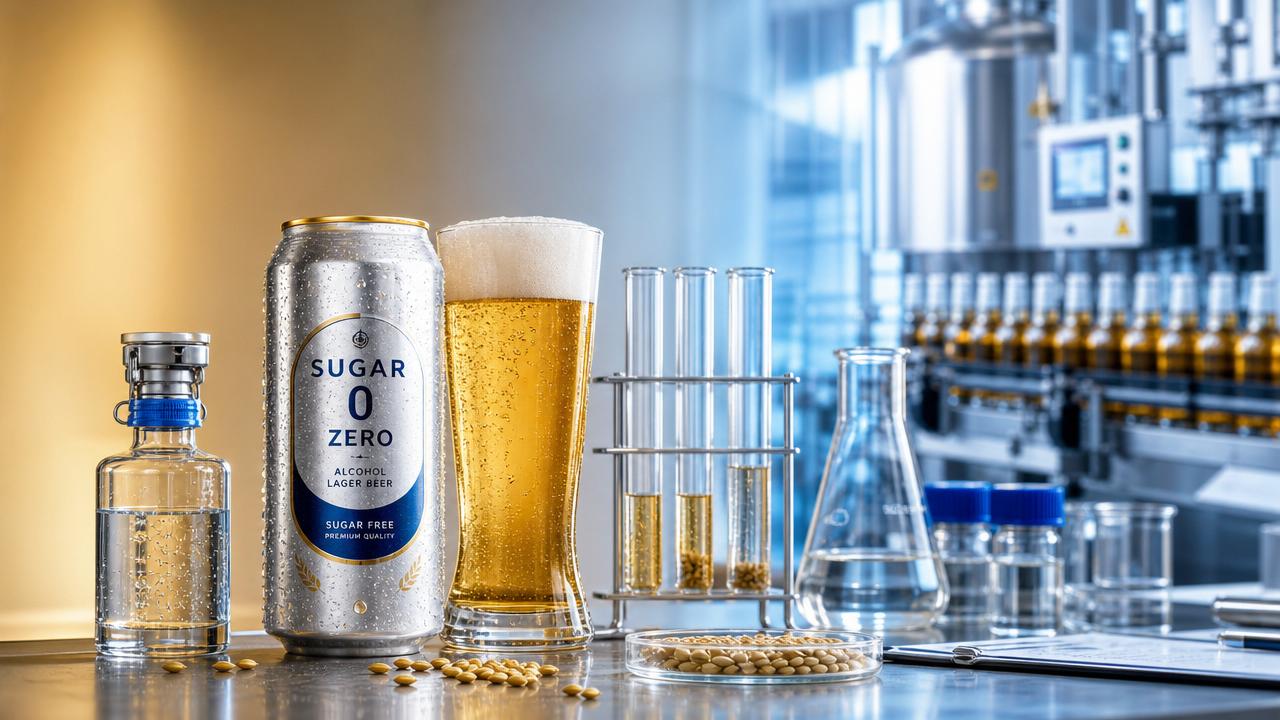
Why do some sugar-free beers from China fail to match their label claims? For quality control and safety managers, this issue goes beyond compliance to ingredient verification, production consistency and export risk. As a sugar-free beer supplier China market buyers often evaluate, manufacturers must prove label accuracy through reliable formulation, testing and process control. This article examines the main causes behind claim failures and what professionals should check before approval.
Why label-claim scrutiny is rising in the sugar-free beer market
A clear shift is taking place in the beer and beverage sector. Buyers are no longer satisfied with attractive front-label language such as “sugar-free,” “low-calorie,” or “better-for-you.” Importers, retailers, and food safety teams now ask a harder question: can the product consistently prove the claim under different test methods, shelf-life conditions, and market regulations? This shift is especially important when sourcing from a sugar-free beer supplier China buyers want to qualify for export, retail placement, or private-label programs.
Several trends are driving this change. First, health-positioned alcoholic beverages are growing as consumers seek reduced sugar, lower calories, and lighter drinking experiences. Second, regulatory enforcement is becoming more practical and data-based, with customs, distributors, and platforms asking for ingredient specifications, nutrition facts support, and laboratory reports. Third, cross-border trade has made label interpretation more complex. A formula that appears compliant in one market may face challenge in another because “sugar-free” thresholds, analytical methods, and declaration formats differ.
For quality control and safety managers, this means the issue is no longer limited to final packaging review. The real risk sits deeper in recipe design, fermentation behavior, residual carbohydrate testing, sweetener management, and claim translation. A capable sugar-free beer supplier China procurement teams can trust is therefore not simply a low-cost producer. It is a manufacturer that can connect formulation science, production discipline, and documentation control into one verifiable system.
The market signal: “sugar-free” is becoming a verification claim, not a marketing phrase
One of the biggest changes in recent years is that “sugar-free” has moved from soft marketing language to a hard verification claim. In the past, some products used the term loosely to communicate a lower-sugar image. Today, brand owners and B2B buyers expect precise support. This is particularly relevant in beer because fermentation naturally changes sugar levels over time, and product stability can influence final results. A batch may be compliant at one stage but drift near a threshold under different storage or sampling conditions.
This creates a practical challenge for any sugar-free beer supplier China export customers are assessing. Beer is not a static matrix. Residual sugars, alcohol content, carbonation, flavor additions, and non-nutritive sweeteners can all affect both testing outcomes and label interpretation. If a supplier relies on broad assumptions rather than batch-level validation, claim failure becomes much more likely.
Why some sugar-free beer from China fails label claims
Claim failures usually do not come from one dramatic mistake. More often, they result from several small control weaknesses across development, production, testing, and labeling. For a sugar-free beer supplier China beverage buyers evaluate, the following risk points are the most common.
1. Formula design does not match the legal meaning of “sugar-free” in the target market
A beer may be designed to reduce sugar significantly, yet still fail a strict sugar-free threshold in the destination country. This often happens when teams assume “very low sugar” and “sugar-free” mean the same thing. They do not. Some markets define the claim by grams per 100 ml, some by serving basis, and some require additional conditions on energy or carbohydrate communication. If R&D only targets domestic expectations, export labels may overstate the product.
2. Fermentation variability changes residual sugar outcomes
Beer production contains natural process variability. Yeast performance, malt composition, mash profile, fermentation temperature, attenuation, filtration, and filling conditions can all influence the remaining sugar level. In sugar-free beer, the tolerance window is much narrower than in standard beer. A small shift in raw material or fermentation control can move a batch from compliant to borderline. A sugar-free beer supplier China factories can depend on should therefore monitor not only final alcohol and taste, but also the consistency of sugar depletion through the entire process.
3. Flavor additions create hidden claim risk
Fruit-flavored beer and specialty beer are popular growth categories, but they can complicate sugar-free positioning. Flavor bases, concentrates, extracts, and processing aids may introduce sugars or affect the analytical profile. Even when added in small quantities, they can alter the final claim calculation. This is a frequent problem when a base lager is compliant but a flavored variant is not reviewed with the same rigor.
4. Laboratory methods are not aligned with claim requirements
Testing is another major weak point. Different labs may use different methods, detection limits, or sample preparation procedures. In low-sugar products, method sensitivity matters. If the manufacturer, third-party laboratory, and buyer use different approaches, conflicting results can appear even when the product itself has not changed. For quality teams sourcing from a sugar-free beer supplier China exporters recommend, it is essential to confirm which sugar components are measured, what method is used, and whether the result supports the exact label wording.
5. Translation and artwork approval mistakes
Some failures happen after production rather than before it. A compliant product can still create non-compliance if the English export label, online listing, distributor brochure, or shelf tag uses stronger language than approved. Phrases such as “zero sugar,” “sugar-free,” and “no added sugar” are not interchangeable. If internal approval stops at packaging design and does not include bilingual technical review, the risk increases.
What is driving the rise in claim failures now
The increase in claim disputes is not random. It reflects broader industry changes that are reshaping quality expectations in the beverage sector.
- Product innovation is moving faster, so launch timelines are shorter and validation is sometimes compressed.
- Private-label and OEM projects have increased, creating more versions of the same beer with different artworks and destination rules.
- Health claims influence buying decisions more strongly, making inaccurate labels commercially and legally more visible.
- Digital retail and social content spread claim language quickly, so off-label wording becomes harder to control.
- International buyers are using supplier audits and pre-shipment checks more actively than before.
These drivers mean a sugar-free beer supplier China partners shortlist today must be assessed with a wider lens than basic beverage manufacturing capability. Technical compliance has become part of brand protection and channel access.
Who feels the impact most across the supply chain
The effects of inaccurate sugar-free claims do not stop at the factory. Different functions absorb different types of risk, and that is why cross-functional review is increasingly important.
What professionals should check before approving a supplier
When evaluating a sugar-free beer supplier China market participants are considering, approval should focus on evidence, not claims alone. The following areas deserve close attention.
Validate the formulation logic
Ask how the product reaches the sugar-free target. Is the result based on fermentation efficiency, carbohydrate reduction strategy, ingredient substitution, or sweetener use? Request technical explanation, not just a specification sheet. A supplier that understands its own mechanism is more likely to keep the claim stable across production cycles.
Review the analytical framework
Confirm the exact test method used for sugars, the laboratory qualification, sample retention practice, and the acceptable internal release limit. Strong suppliers set internal action levels tighter than the legal threshold to absorb process variation. That is a good sign of preventive control.
Check variant management
Do not assume the same documentation applies to classic lager, fruit beer, and specialty beer variants. Each formula and flavor system should be reviewed separately. For an OEM project, even a small recipe adjustment can change claim validity.
Audit label governance
Look at how the supplier controls claims across cartons, cans, technical data sheets, e-commerce text, and distributor materials. Mature manufacturers treat labeling as a governed process, not only a design task.
The next direction: tighter integration of production data, testing, and export labeling
Looking ahead, the most reliable sugar-free beer supplier China buyers will favor is likely to be one that integrates three capabilities. First is process precision: better control of fermentation, ingredient dosing, and batch variation. Second is analytical credibility: consistent use of suitable methods, calibrated labs, and market-relevant reporting. Third is regulatory translation: the ability to convert technical results into compliant claims for each destination.
This direction matters because sugar-free beer sits at the intersection of brewing and functional positioning. As the category grows, the winning suppliers will not be those who use the strongest claim language, but those who can prove what the label says under real commercial conditions. That is where long-term cooperation becomes more secure for importers, brand owners, supermarkets, restaurants, and specialty retail channels.
Practical judgment signals for quality and safety managers
Before final approval, professionals should ask a few decisive questions. Can the supplier show repeated batch results rather than one favorable test? Does the sugar-free beer supplier China exporter provide target-market claim review support? Are flavor variants controlled separately? Is there an internal escalation rule when results approach the claim limit? Are online and offline labels checked under one approval workflow? The answers to these questions often reveal more than a sales presentation.
For businesses sourcing health-positioned beer, the safest path is to treat sugar-free claims as a managed compliance project from formulation to shelf. If companies want to judge how these trends affect their own portfolio, they should focus on four points: the legal threshold in each target market, the stability of residual sugar during production, the suitability of test methods, and the discipline of label control across every commercial channel.
Jinpai Beer supports this direction through craft beer R&D, diversified production capability, and OEM/ODM cooperation for classic lager, German wheat, sugar-free low-calorie beer, fruit-flavored beer, and functional specialty beer. For buyers seeking a sugar-free beer supplier China market projects can rely on, the real priority is not only product variety, but whether the supplier can align innovation with claim accuracy, export readiness, and consistent quality assurance.
Thank you very much for writing to us. Please leave your message and contact information, we will reply to you within 24 hours.