



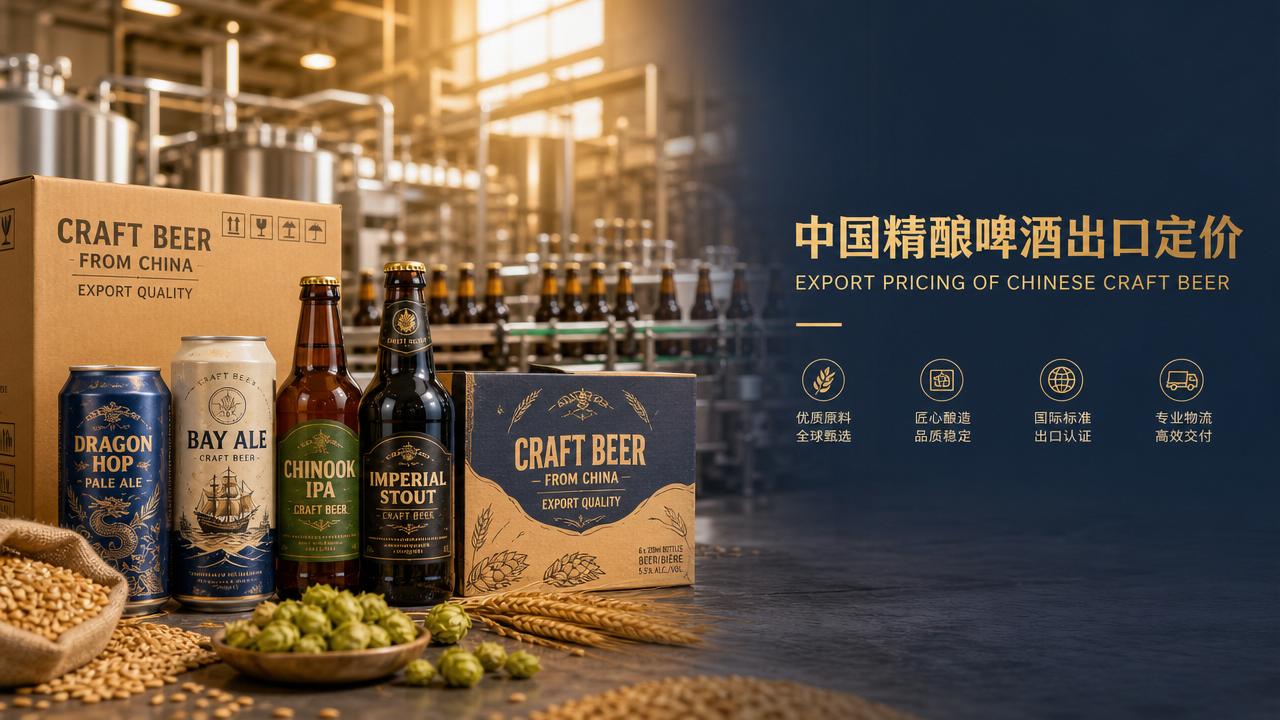
Why do Chinese craft beer factory export prices differ so widely? For financial decision-makers, the answer goes far beyond unit cost. From recipe complexity and packaging standards to OEM/ODM customization, order volume and compliance requirements, each factor can significantly affect the final quote. Understanding the logic behind Chinese craft beer factory export pricing helps buyers control budgets, compare suppliers more accurately and make lower-risk purchasing decisions.
In the beer and beverage sector, a price gap of 15% to 40% between two export quotations is not unusual. What looks like the same craft beer on paper may involve very different raw material ratios, production processes, packaging systems, documentation workloads, and post-sale support levels.
For procurement teams and finance approvers, the key question is not simply which supplier offers the lowest FOB price. The better question is which Chinese craft beer factory export proposal delivers the most controllable total cost, the most stable supply, and the lowest compliance risk over 6 to 24 months.
What Actually Drives Chinese Craft Beer Factory Export Pricing
The largest pricing differences usually come from five layers: liquid formulation, production complexity, packaging configuration, order scale, and destination market requirements. In many export projects, packaging and compliance together can account for 20% to 35% of the final landed cost, not just the beer itself.
1. Recipe Composition and Brewing Process
A classic lager, a German wheat beer, a sugar-free low-calorie beer, and a fruit-flavored beer do not carry the same cost structure. Malt usage, hop type, yeast strain, fruit concentrate, sweetener alternatives, and filtration needs all affect factory pricing.
For example, a standard lager may use a more straightforward process with a shorter fermentation and conditioning schedule, while functional specialty beers or fruit beers may require extra blending, stability testing, or flavor adjustment in 2 to 3 additional production stages.
Cost-sensitive formulation variables
- Malt ratio and imported ingredient content
- Alcohol level, typically ranging from 2.5% to 8% ABV
- Fruit pulp or extract inclusion rate
- Sugar-free or low-calorie formulation requirements
- Shelf-life target, often 6 to 12 months for export formats
2. Packaging Format Changes the Quote More Than Many Buyers Expect
In Chinese craft beer factory export business, packaging can sharply change the quotation. A 330ml can, 500ml can, 330ml glass bottle, and 5L keg do not use the same filling line efficiency, carton structure, breakage protection, or freight cube.
If the destination market requires bilingual labels, anti-moisture cartons, tray wrapping, barcode placement, or retail-ready shelf boxes, the cost may rise at multiple points rather than in one visible packaging line item.
The table below shows how common export variables influence pricing logic in practical sourcing discussions.
For finance teams, this means a lower ex-factory beer price may still produce a higher total import cost if packaging inefficiency, relabeling, or breakage is built into the transaction. Chinese craft beer factory export evaluation should therefore be based on full landed cost, not quote headline alone.
3. MOQ and Production Efficiency
Minimum order quantity has a direct impact on average cost. A run of 3,000 to 5,000 liters often carries a much higher unit cost than a run of 20,000 to 50,000 liters because setup time, tank scheduling, label preparation, and cleaning procedures are spread over fewer saleable units.
This is especially relevant in OEM/ODM craft beer projects. If a buyer requests multiple SKUs in one container, such as 4 flavors in 330ml cans, the flexibility may improve market testing but reduce manufacturing efficiency and increase per-SKU packaging loss.
How Finance Decision-Makers Should Compare Export Quotes
A good quote comparison model should include at least 6 checkpoints: liquid specification, packaging specification, MOQ, incoterm, compliance scope, and delivery schedule. Without these details aligned, a side-by-side supplier comparison can be misleading even if both offer the same beer style.
Build a Like-for-Like Comparison Framework
Many buyers compare supplier A and supplier B using only price per can or price per carton. That approach misses hidden cost drivers. For a reliable Chinese craft beer factory export review, each supplier should be assessed on the same commercial and technical assumptions.
Core quote comparison checklist
- Beer type, ABV, and ingredient profile
- Net content such as 330ml, 500ml, or keg volume
- Primary and secondary packaging specification
- MOQ per SKU and MOQ per order
- Lead time, often 20 to 45 days after design confirmation
- Export documents and market-specific labeling support
The next table offers a practical structure for financial approvals when reviewing a Chinese craft beer factory export proposal.
A disciplined review process helps finance teams reject false savings. A quote that is 8% lower but omits pallet wrapping, design revision, or export paperwork can quickly become the more expensive option after shipping and customs handling begin.
Watch the Difference Between Unit Price and Total Cost of Ownership
A Chinese craft beer factory export purchase should be reviewed over the full cycle: pre-production sampling, commercial order, shipment, import clearance, shelf readiness, and replenishment. This approach is especially useful for restaurants, bars, supermarkets, and retail chains managing multiple channels.
Finance approvers should calculate at least four cost layers: product cost, packaging cost, logistics cost, and risk-adjusted compliance cost. Even a 2% breakage rate or a 10-day customs delay can erase the benefit of a low purchase quote.
Why OEM/ODM Requirements Create Major Price Gaps
Private label and custom development are major reasons Chinese craft beer factory export prices vary. Buyers often ask for brand-specific flavor profiles, packaging graphics, carton language versions, and channel-oriented sizing. Each request adds cost in a different way.
OEM Is Not Just Label Replacement
In practical beverage export projects, OEM can involve artwork adaptation, packaging material sourcing, small-batch trial production, sample approval, and revised carton markings. ODM projects can go further by adjusting recipe direction, sweetness level, calorie profile, or flavor balance for target markets.
For example, a supermarket private label may need stable taste consistency, shelf-friendly outer cartons, and clear nutritional display. A bar channel product may prioritize stronger visual identity and differentiated styles such as German wheat or fruit-flavored beer in smaller launch volumes.
Typical customization cost drivers
- Custom can or bottle artwork file preparation
- Label translation and legal text adaptation
- Flavor matching in 1 to 3 sampling rounds
- Mixed SKU production planning
- Special carton strength for long-distance export routes
When Customization Improves Financial Efficiency
Not every added cost is negative. In some cases, customization lowers the total commercial risk. A sugar-free low-calorie beer tailored for a health-conscious retail segment may carry a higher factory price, but it may also improve sell-through and reduce markdown pressure.
Likewise, a well-designed fruit beer range in 3 or 4 flavors can support channel testing across bars and convenience stores. If the supplier can coordinate OEM/ODM development with wholesale supply and stable production scheduling, the buyer gains better budget predictability over repeated orders.
Compliance, Logistics, and Delivery Terms Often Explain the Hidden Gap
A Chinese craft beer factory export quotation may look competitive until destination requirements are added. Alcohol beverages are not ordinary consumer goods. Label declarations, ingredient display, language rules, shelf-life markings, and customs document accuracy all influence cost and timing.
Export Documentation and Destination Readiness
If one supplier includes export document coordination and another does not, the price difference is understandable. Buyers should verify whether the quotation covers standard commercial paperwork, shipping marks, carton labeling checks, and destination-specific format requirements.
In many beverage projects, correcting packaging after production is far more expensive than confirming details 7 to 10 days earlier during artwork approval. A disciplined pre-shipment review lowers the chance of rework, customs queries, and delayed market launch.
Freight Efficiency Can Offset a Higher Factory Price
For finance teams, freight cube matters. A can-based format may deliver better loading efficiency than heavier glass formats, while glass can still be preferred for brand image in certain channels. The right option depends on route distance, breakage tolerance, and retail positioning.
When comparing offers, ask how many cartons fit into a shipment plan, whether palletization is included, and what protective materials are used. A 5% to 12% improvement in container utilization can materially change total landed cost for recurring imports.
Risk control questions before approval
- Are all label claims aligned with the final formula?
- Is shelf-life coding format confirmed for the target market?
- Does the supplier provide a realistic lead time buffer of 5 to 7 days?
- Are packaging strength and outer carton specs suitable for sea shipment?
- Is the quote based on the correct incoterm and destination assumption?
How to Select the Right Supplier for Long-Term Cost Control
The best Chinese craft beer factory export partner is rarely the supplier with the absolute lowest opening quote. For financial approvers, the stronger choice is the one that combines product range, customization capability, packaging discipline, and repeat-order stability.
Look for Breadth Plus Operational Fit
A supplier that can support classic lager, German wheat, sugar-free low-calorie beer, fruit-flavored beer, and functional specialty beers gives buyers more flexibility without restarting the sourcing process for every new SKU. That matters when channels evolve over 2 to 4 seasonal cycles.
Operational fit also matters. If the factory can handle OEM/ODM services, wholesale supply, and customized solutions under one workflow, internal coordination becomes easier for distributors, supermarket groups, bars, and restaurant supply programs.
A Practical 4-Point Approval Model
Before approving a new supplier, finance teams can use a simple 4-point model: price transparency, production suitability, compliance readiness, and reorder stability. If one area is weak, the lowest quote may not support long-term profitability.
- Price transparency: clear split between liquid, packaging, and service items
- Production suitability: capable of required beer styles and order sizes
- Compliance readiness: disciplined labeling and export coordination
- Reorder stability: reliable lead time and repeat consistency
Chinese craft beer factory export prices vary because buyers are not always purchasing the same product, service depth, or risk profile. Once finance decision-makers compare quotations on a like-for-like basis, the gap becomes easier to explain and easier to manage.
For companies sourcing craft beer internationally, the real objective is not the lowest unit price but the best balance of formula fit, packaging efficiency, compliance security, and commercial continuity. That is especially true for private label, multi-SKU, and channel-specific beverage programs.
Jinpai Beer supports global buyers with craft beer R&D, production, distribution, OEM/ODM cooperation, wholesale supply, and customized solutions across classic lager, German wheat, sugar-free low-calorie beer, fruit-flavored beer, and specialty functional ranges. If you need a more accurate Chinese craft beer factory export quotation, contact us now to discuss your target market, packaging plan, and order structure, and get a tailored sourcing solution.
Thank you very much for writing to us. Please leave your message and contact information, we will reply to you within 24 hours.