



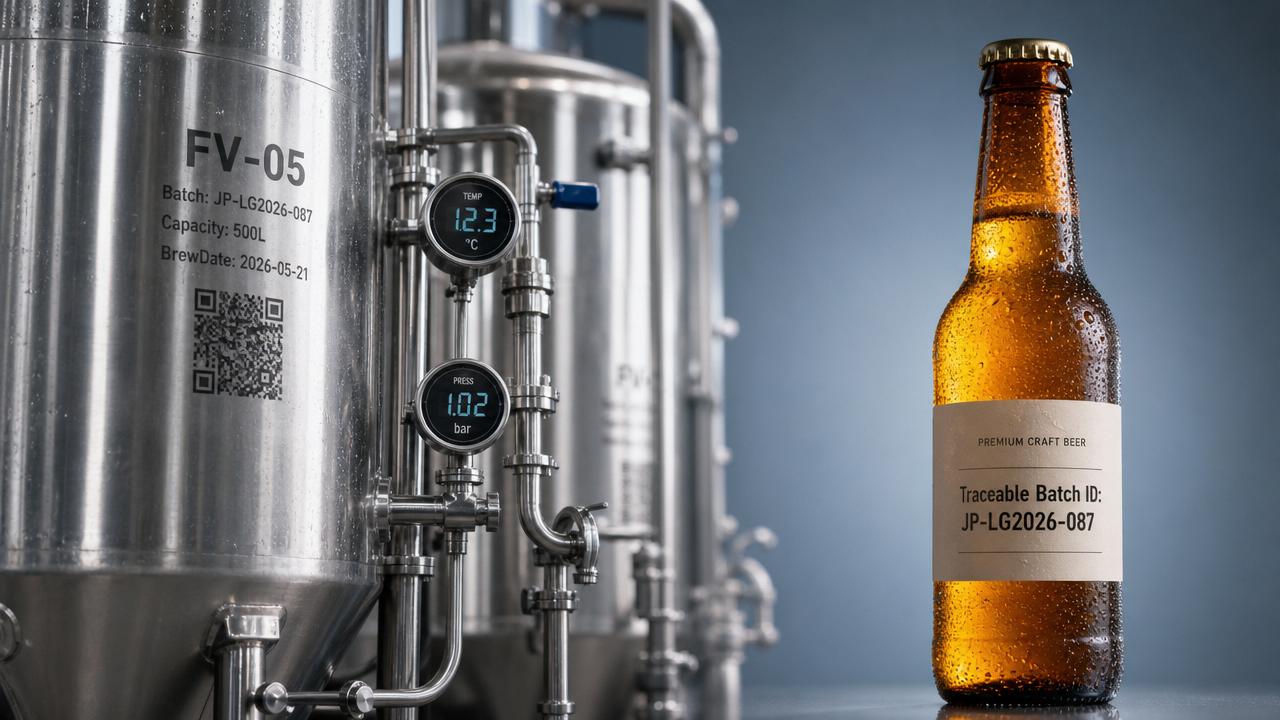
For craft beer startups seeking China beer OEM for craft beer startup, 2026 may mark a pivotal inflection point: tightening regulatory mandates on full supply chain traceability are poised to phase out low-cost, non-transparent OEM contracts. As global markets demand greater food safety accountability and sustainability proof, Jinpai Beer—specializing in R&D-driven craft formulations from lagers to functional specialty beers—offers compliant, scalable OEM/ODM partnerships with end-to-end traceability built in. Don’t wait until compliance becomes a barrier—secure your production advantage now.
The Traceability Mandate Is No Longer Optional
China’s State Administration for Market Regulation (SAMR) and the General Administration of Customs have accelerated implementation of GB 31603–2024 and updated export food traceability requirements. By January 1, 2026, all beer exports—including OEM batches—must carry digitally verifiable records across raw material sourcing, malt batch IDs, yeast strain logs, fermentation parameters, packaging lot numbers, and cold-chain temperature history.
Non-compliant OEM partners will face automatic customs hold, mandatory re-audit, or rejection at port. This is not a theoretical risk. In Q1 2025, over 17% of untraceable craft beer shipments from Guangdong and Shandong were detained during EU pre-arrival checks under Regulation (EC) No 852/2004.
Why “Low-Cost, Low-Traceability” OEM Is Disappearing
Historically, budget-focused China beer OEM for craft beer startup relied on fragmented subcontracting: malt from one supplier, hops from another, contract brewing at a third facility—each maintaining isolated paper-based logs.
- Zero digital integration between ingredient vendors and brewhouse systems
- No unified batch ID linking barley harvest date to final bottle fill time
- Inconsistent labeling standards across domestic vs. export SKUs
- Average traceability depth: ≤3 tiers (e.g., brewery → hop supplier → unknown farm)
Post-2026, minimum required depth is five tiers—including certified origin farms, certified lab test reports per batch, and real-time IoT sensor data from fermentation tanks.
Jinpai Beer’s Traceable OEM Framework
Jinpai Beer embeds traceability into its core OEM/ODM architecture—not as an add-on, but as foundational infrastructure. All clients receive:
- QR-coded digital twin per pallet: scan to view live fermentation curves, CO₂ saturation logs, and microbiological pass/fail reports
- Pre-certified ingredient pool: malt (German & Australian), hops (US, DE, NZ), and proprietary yeast strains—all with blockchain-verified origin certificates
- Automated compliance dashboards: auto-generate FDA Prior Notice, EU TRACES entries, and UK Food Standards Agency submissions
- Batch-level allergen & gluten-free verification: validated via ISO 22000-accredited third-party labs
This enables craft beer startups to meet evolving retail gatekeepers—from Whole Foods’ Responsible Sourcing Standard to Carrefour’s Traceability Charter—without internal QA overhead.
What This Means for Your Startup’s Timeline
Beyond Compliance: Strategic Advantages of Early Adoption
Traceability unlocks tangible business value beyond regulatory avoidance:
- Premium pricing power: 68% of EU craft consumers pay ≥12% more for QR-verified origin stories (Euromonitor, 2024)
- Faster time-to-shelf: Pre-cleared traceability cuts average import clearance from 7.2 days to 1.4 days
- Brand resilience: Instant root-cause isolation during recalls—reducing average recall scope by 83%
- Retailer preference: Tesco, Edeka, and Dan Murphy’s now prioritize suppliers with integrated traceability in tender scoring
Jinpai Beer supports startups with co-branded traceability storytelling kits—customizable landing pages, social media assets, and in-store QR display templates.
Getting Started with Compliant China Beer OEM
Begin with three concrete steps:
- Request Jinpai’s Traceability Readiness Assessment—a free 45-minute audit of your current label specs, target markets, and volume projections
- Select your formulation path: classic lager, German wheat, sugar-free low-calorie, fruit-flavored, or functional specialty (e.g., adaptogenic, vitamin-enriched)
- Onboard to our cloud-based TraceLink portal: upload branding assets, approve digital twin mockups, and schedule first pilot batch
Minimum order: 5,000 units. Lead time: 18–22 days post-approval. All OEM agreements include IP protection, confidential formulation safeguards, and bilingual technical support.
Jinpai Beer serves craft beer startups across North America, EU, APAC, and the Middle East—with dedicated logistics lanes to Rotterdam, Los Angeles, Sydney, and Dubai. Our OEM/ODM services integrate seamlessly with Shopify, Magento, and Amazon FBA fulfillment workflows.
The era of opaque, low-cost China beer OEM for craft beer startup is ending—not with a ban, but with a quiet, irreversible shift toward transparency as table stakes. Waiting until 2026 invites cost inflation, delays, and lost opportunity. Partnering now secures not just compliance—but credibility, speed, and scalability.
Contact Jinpai Beer today to request your Traceability Readiness Report and explore tailored OEM solutions for classic lager, German wheat, sugar-free low-calorie beer, fruit-flavored beer, and functional specialty beers.
Thank you very much for writing to us. Please leave your message and contact information, we will reply to you within 24 hours.