



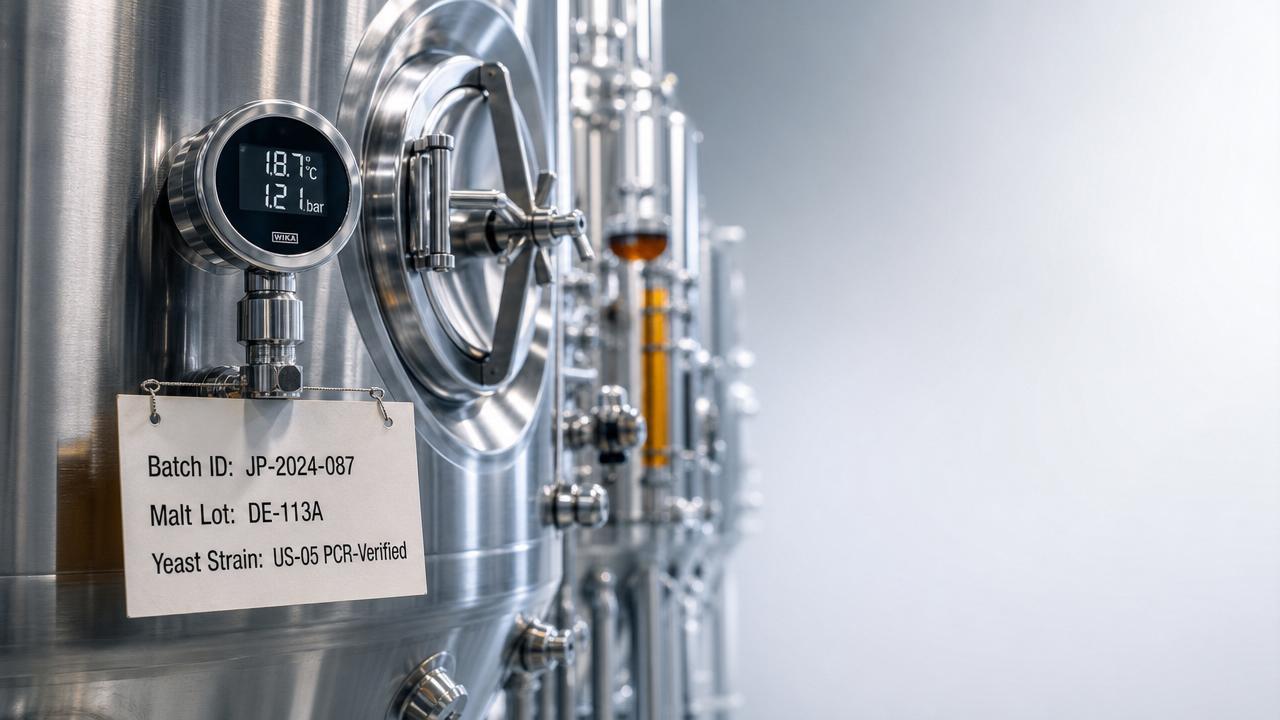
For craft beer startups exploring China beer OEM for craft beer startup partnerships, quality inconsistencies can derail launches before they begin. Three recurring gaps—material traceability, fermentation process control, and label/compliance alignment—often surface too late, risking recalls, brand damage, or shelf rejection. As a certified craft beer OEM with ISO 22000 and HACCP compliance, Jinpai Beer helps startups detect and resolve these issues at the pilot-batch stage—not during mass production. This article breaks down each gap with actionable checkpoints for QA and food safety teams.
Material Traceability Gaps in Early-Stage OEM Engagement
Many startups assume raw material sourcing is standardized across Chinese breweries. In reality, malt, hops, yeast, and adjuncts often lack batch-level documentation—especially in pilot runs.
Without full traceability, identifying contamination sources or flavor drift becomes guesswork. A single hop lot variance can shift IBU by ±15%, altering recipe fidelity irreversibly.
- Require full COA (Certificate of Analysis) for every malt lot—including protein content, diastatic power, and moisture level
- Verify yeast strain identity via third-party PCR testing—not just supplier-provided strain codes
- Confirm hop storage conditions (temperature, oxygen exposure, light shielding) with photo evidence from the warehouse
- Insist on dual-lot sampling: one retained by the OEM, one sent to your lab for parallel analysis
Jinpai Beer assigns unique batch IDs to all inputs and logs them in an auditable digital ledger—accessible to clients upon request. This supports rapid root-cause analysis if off-flavors emerge post-fermentation.
Fermentation Process Control Variability
Fermentation defines character. Yet many China beer OEM for craft beer startup arrangements treat it as a “black box”—relying on generic temperature profiles rather than strain-specific kinetics.
Yeast health, pitching rate, oxygenation timing, and pressure management directly impact ester/phenol balance, attenuation, and haze stability.
- Reject OEMs that pitch yeast without prior viability testing (≥95% viable cells required)
- Require real-time logging of fermenter temperature, pressure, and dissolved oxygen—reviewable per batch
- Validate final gravity readings against predicted attenuation curves (±0.5°P tolerance)
- Test for diacetyl rest completion using GC-MS or enzymatic assay—not sensory-only clearance
At Jinpai Beer, every fermentation cycle includes automated data capture synced to cloud dashboards. Startups receive live alerts for deviations exceeding preset thresholds—enabling intervention before flavor compromise occurs.
Labeling and Regulatory Alignment Failures
Misaligned labeling is the #1 cause of port-of-entry rejections for imported craft beer. It’s not just about font size—it’s ingredient hierarchy, allergen declarations, alcohol-by-volume rounding rules, and country-of-origin phrasing.
For example, EU Regulation (EU) No 1169/2011 mandates “gluten-free” claims only if ≤20 ppm gluten—verified by ELISA testing. A China-based OEM may print “low-gluten” without verification, triggering non-compliance.
- Cross-check label drafts against target-market regulations—not just Chinese GB standards
- Require bilingual ingredient lists where legally mandated (e.g., Canada: English + French)
- Confirm ABV display format matches local norms (e.g., “4.8% vol.” vs. “4.8% alc./vol.”)
- Verify QR code links point to live, multilingual compliance documentation—not placeholder PDFs
Jinpai Beer maintains an updated regulatory matrix covering 32 export markets. Before printing, labels undergo dual review: internal QA + external legal counsel specializing in beverage import law.
Why Pilot-Batch Validation Is Non-Negotiable
Startups often skip pilot batches to accelerate time-to-market. That shortcut sacrifices visibility into critical process behaviors.
A 500L pilot run reveals what spreadsheets cannot: yeast flocculation consistency, filtration efficiency, carbonation stability, and label adhesion under humidity cycling.
At Jinpai Beer, every pilot engagement includes:
- Full analytical panel: microbiology (yeast/bacteria), sensory (trained panel), and chemical (IBU, SRM, ABV, residual sugar)
- Side-by-side comparison against your reference sample or commercial benchmark
- Process deviation report with root-cause annotations and corrective action timeline
- Optional third-party audit support (SGS, Bureau Veritas) for pre-shipment certification
This prevents scaling flawed processes—and transforms OEM collaboration from transactional to developmental.
Actionable Next Steps for Startups
Begin with documentation—not negotiation. Request these three items before signing any MOU:
- Completed HACCP plan with CCPs mapped to your specific beer type (e.g., fruit sour vs. dry-hopped lager)
- Traceability flowchart showing input → brewhouse → fermentation → packaging data linkage
- Regulatory compliance dossier for your top 3 target markets (including label mockups and test reports)
Then schedule a virtual process walkthrough. Observe how operators log temperatures, handle yeast transfers, and manage label stock. Watch—not just listen.
Jinpai Beer offers no-cost pilot-batch consultations for qualified craft beer startups evaluating China beer OEM for craft beer startup options. We align technical rigor with startup agility—so quality isn’t compromised for speed.
Ready to validate your first batch? Contact Jinpai Beer’s OEM Solutions Team to initiate a compliance-first pilot engagement—with full transparency, zero gatekeeping, and actionable insights before volume production begins.
Thank you very much for writing to us. Please leave your message and contact information, we will reply to you within 24 hours.