



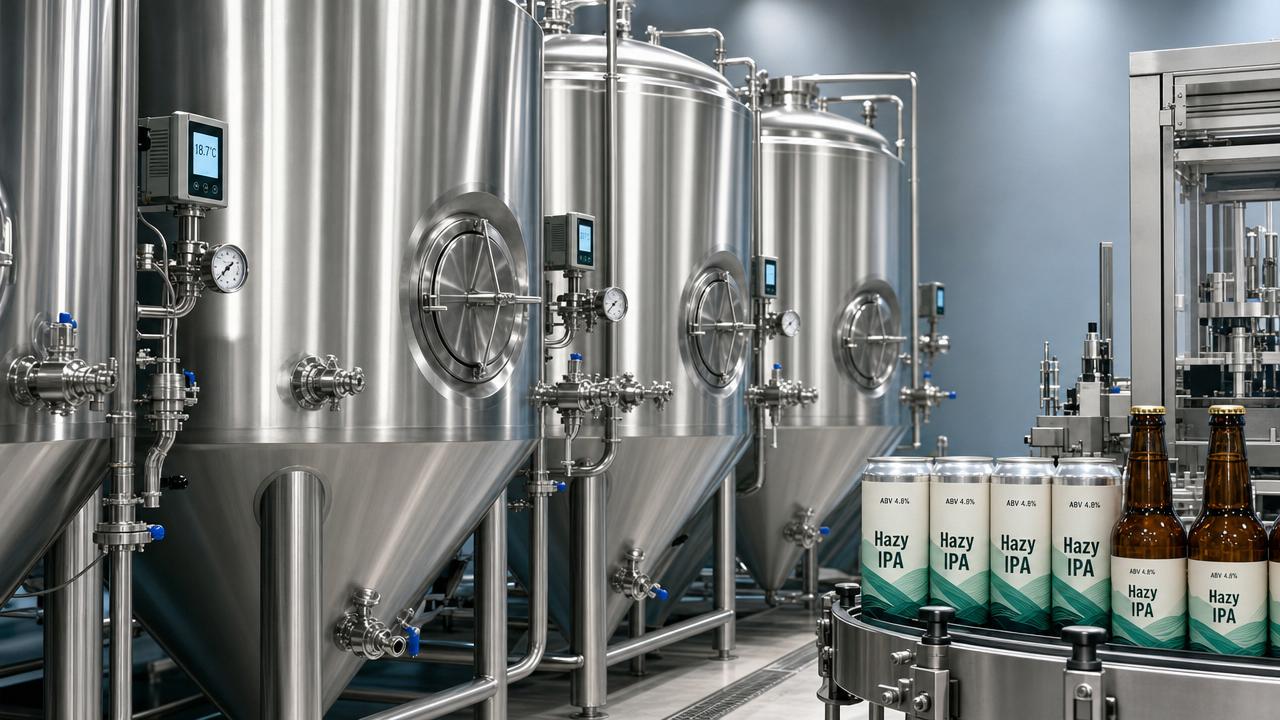
For craft beer startups evaluating technical feasibility and scalability, partnering with a reliable China beer OEM for craft beer startup is critical—especially when navigating small-batch fermentation from recipe validation to shelf-ready packaging. At Jinpai Beer, our end-to-end OEM process integrates lab-scale trials, pilot-brewing calibration, quality-controlled fermentation, and compliant labeling—all tailored to your brand’s specs and market requirements. This step-by-step deep dive reveals how we bridge innovation and industrial precision without compromising authenticity or regulatory readiness.
Small-Batch Fermentation Is No Longer Just a Lab Experiment
The global craft beer landscape has shifted. Startups no longer treat 10L test batches as endpoints—they’re stepping stones to scalable production. Demand for limited-edition fruit sours, functional brews, and sugar-free lagers now drives volume expectations beyond traditional garage brewing capacity.
This transition exposes a critical gap: many early-stage brands lack access to fermentation infrastructure that balances microbiological control, repeatability, and compliance—without requiring multi-million-dollar CAPEX.
Why China Beer OEM for Craft Beer Startup Is Gaining Strategic Momentum
Three structural factors are accelerating adoption of professional China beer OEM for craft beer startup services:
- Cost-efficient access to ISO 22000-certified brewhouses with CIP/SIP automation and real-time DO/pH/temperature logging
- Rapid iteration cycles: From recipe submission to first 500-unit batch in under 28 days
- Regulatory agility: Pre-vetted label templates, allergen declarations, and country-specific alcohol content formatting (e.g., EU ABV rounding, US TTB-compliant ingredient statements)
Unlike generic contract brewers, specialized China beer OEM for craft beer startup partners like Jinpai Beer embed sensory scientists, yeast propagation specialists, and packaging engineers into each project—not just production managers.
How Jinpai Beer Translates Your Recipe Into Shelf-Ready Reality
Our OEM workflow is segmented into four non-negotiable phases—each designed to de-risk scale-up while preserving flavor integrity.
Phase 1: Recipe Audit & Lab-Scale Validation
We begin with raw material profiling (malt extract potential, hop oil composition, adjunct fermentability) and conduct 5L fermentations using your target yeast strain.
Key deliverables: Fermentation curve modeling, predicted attenuation, ester/phenol profile mapping, and off-flavor risk assessment.
Phase 2: Pilot-Batch Calibration (50–200L)
Here, we replicate thermal profiles, oxygenation levels, and dry-hop contact times at near-commercial scale.
Adjustments are made iteratively—never assumed. For example, a mango-passionfruit hazy IPA may require lower whirlpool hopping temperatures to preserve volatile thiols.
Phase 3: Controlled Fermentation & Maturation
All batches run in jacketed, stainless-steel conical fermenters with automated glycol cooling and pressure control.
We maintain strict lot traceability: Every tank log includes harvest date, yeast generation count, and final gravity verification before cold crashing.
Phase 4: Packaging, Compliance & Logistics Handoff
Bottling, canning, or kegging occurs in a dust-controlled environment. We support custom can designs, shrink-sleeve labels, and tamper-evident closures.
Documentation includes full COA (Certificate of Analysis), TTB Form 5100.31 (if required), and EU health certificate drafts—ready for your local customs agent.
What Changes When You Shift From DIY to Professional OEM
Moving from homebrew-scale to commercial OEM isn’t just about volume—it redefines quality ownership, timeline reliability, and brand consistency.
Five Non-Negotiables for Startup Success With China Beer OEM
- Require batch-level COAs—not just “passed QC” stamps
- Verify yeast banking capability (cryo or slant storage) for repeatable strain sourcing
- Confirm packaging line flexibility: Can they handle 330mL slim cans *and* 500mL swing-top bottles on the same shift?
- Assess logistics integration: Do they coordinate FOB, CFR, or DDP shipping with bonded warehousing options?
- Review IP protection terms: Recipe confidentiality, trademark usage rights, and co-packing exclusivity clauses
Your Next Step Starts With One Sample Batch
Jinpai Beer invites craft beer startups to initiate collaboration with a no-commitment 100L pilot batch. You provide the recipe, target ABV, and desired packaging format. We handle everything else—including free digital label proofing and sensory feedback report.
No minimum order. No long-term lock-in. Just actionable data to validate scalability before scaling.
Whether you’re launching a low-calorie German wheat in Berlin or a botanical-infused lager in Toronto, a trusted China beer OEM for craft beer startup isn’t an outsourcing decision—it’s your first strategic manufacturing partner.
Contact Jinpai Beer today to schedule your recipe intake call—and turn fermentation theory into shelf-ready reality.
Thank you very much for writing to us. Please leave your message and contact information, we will reply to you within 24 hours.