



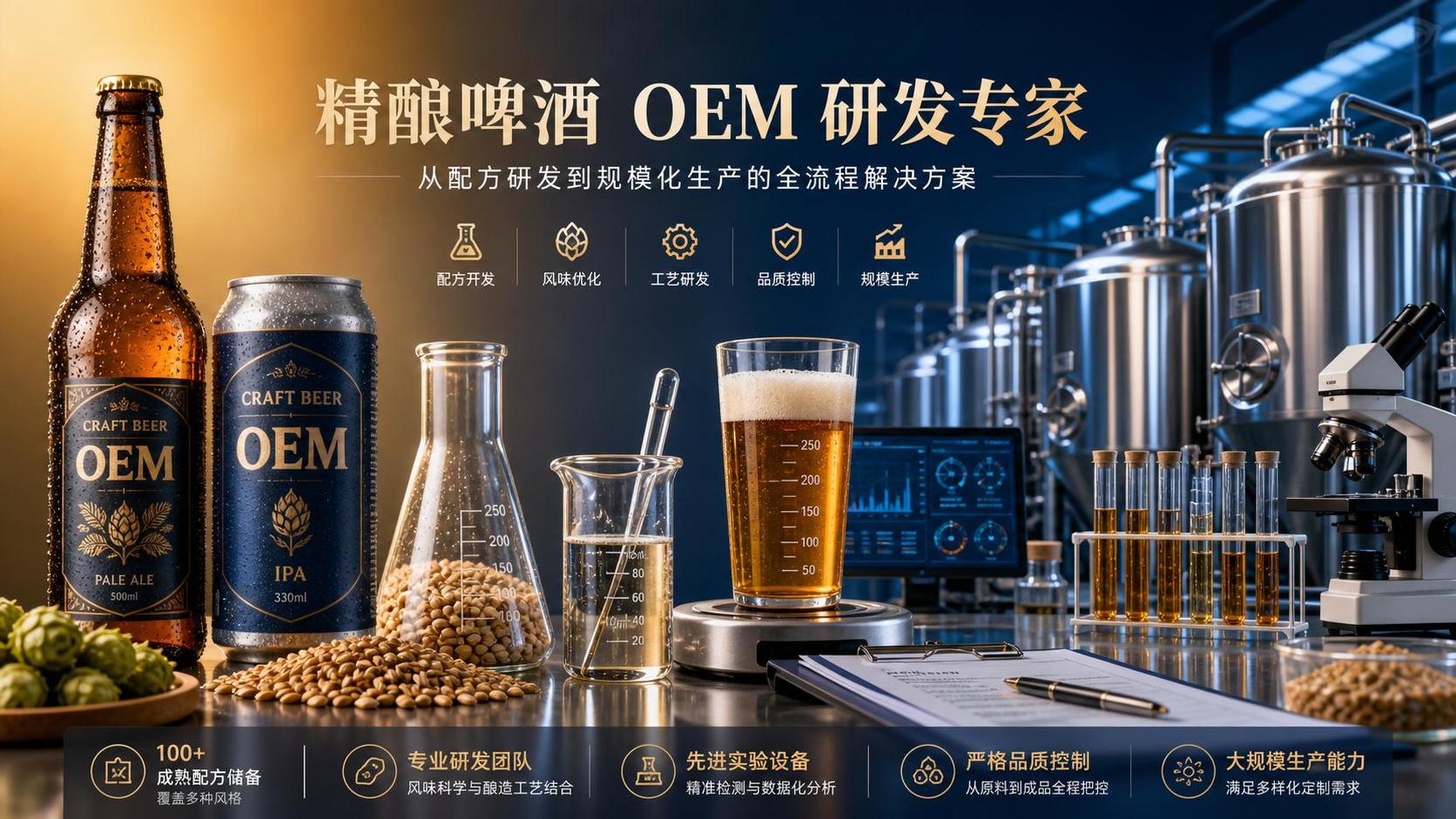
When selecting a brewing partner, many buyers ask: Do China beer OEM factories offer R&D support? The short answer is yes, but the depth and usefulness of that support vary greatly. If your goal is only to source a standard private-label lager, basic manufacturing may be enough. But if you want to launch a distinctive craft beer, improve margins through formula optimization, respond quickly to trends, or build a product line with long-term brand value, R&D capability becomes a major decision factor.
In the beer and beverage industry, strong R&D is not a luxury feature. It influences how well an OEM partner can translate your concept into a stable, scalable and market-ready product. It affects flavor development, ingredient selection, shelf-life performance, regulatory adaptation, packaging compatibility and production consistency. In other words, R&D is closely tied to both commercial success and operational reliability.
For importers, brand owners, distributors and retail buyers, this means evaluating a China beer OEM should go beyond production capacity and price. A factory may offer attractive minimum order quantities and competitive quotations, yet still struggle when you need a sugar-free beer with a clean finish, a fruit beer with stable aroma retention, or a functional beer that balances taste with active ingredients. That is where R&D strength becomes visible.
Why R&D matters more than many buyers expect
Many buyers initially compare OEM factories based on unit cost, lead time and packaging options. Those factors are important, but they do not explain whether the supplier can help you create a product that sells well and can be reproduced consistently. R&D capability fills that gap by turning a product idea into a commercially viable formula.
In beer OEM projects, product development rarely stops at choosing a beer style. Even a classic lager may require adjustments in malt profile, bitterness level, alcohol content, mouthfeel or carbonation to fit a target market. A capable R&D team can make these adjustments systematically rather than relying on trial and error during production.
This is especially important in categories where consumer expectations are changing quickly. Low-calorie beer, sugar-free beer, fruit-flavored beer and functional specialty beer all require more technical support than standard formulations. The challenge is not only making the product once. The real challenge is making it taste right, remain stable and stay compliant in repeated production runs.
For that reason, asking whether China beer OEM factories offer R&D support is really asking a deeper question: can this manufacturer help me reduce product risk while improving my chances of market success? That is the real business value behind R&D.
What buyers usually want to know before choosing a China beer OEM
Most serious buyers are not simply looking for a brewing plant. They want a partner that can support brand building, shorten development cycles and lower the risk of failed launches. Their concerns are practical, not theoretical.
One common concern is whether the factory can develop a beer that matches a clear market position. A buyer may want a German wheat beer for restaurant channels, a crisp low-calorie line for supermarkets, or a fruit beer for younger retail consumers. In each case, the formula must fit the target customer, not just the production line.
Another concern is consistency. Buyers often worry that a sample may taste excellent, while mass production performs differently. This is where process validation, pilot testing and quality-linked R&D become important. A factory with solid development capability is more likely to control this transition well.
Speed is also a major issue. Beverage trends move quickly, and seasonal opportunities can be lost if product development takes too long. Buyers want to know whether the OEM can accelerate sampling, adjust formulas efficiently and solve technical issues without delaying launch timelines.
Finally, many global buyers need support with localization. Taste preferences, labeling rules, alcohol expectations and ingredient restrictions differ by country. A strong R&D-backed OEM can adapt products to different markets instead of forcing one standard formula into every channel.
Do China beer OEM factories offer R&D support in practice?
Yes, many established China beer OEM factories do offer R&D support, but the scope can range from very basic to highly strategic. Some suppliers only provide simple flavor adjustments on existing base formulas. Others can participate in concept design, formula innovation, ingredient testing, stability studies and market-oriented customization.
At the basic level, R&D support may include modifying alcohol percentage, bitterness, color or sweetness. This may be enough for buyers who need a conventional product under a private label. However, this type of support does not necessarily indicate deep technical capability.
At a stronger level, the OEM can co-develop differentiated products based on your target price, target audience and sales channel. That may include building a low-sugar beer with balanced drinkability, developing a fruit beer with improved aroma retention, or formulating a functional beer with specific positioning and stable taste.
The most capable suppliers connect R&D with production, quality control and commercial execution. They do not treat product development as an isolated lab exercise. Instead, they consider whether ingredients are scalable, whether packaging will affect shelf life, whether the formula remains stable during logistics, and whether the final product can be produced efficiently at your planned volume.
That is why buyers should not ask only, “Do China beer OEM factories offer R&D support?” They should also ask, “What kind of R&D support, at what stage, and with what proven outcomes?”
How R&D capability affects product innovation and differentiation
In a crowded beer market, many products compete on shelf appearance but fail to create repeat purchase. Real differentiation often comes from the liquid itself. R&D capability helps brands create a product profile that supports both first-time trial and long-term customer retention.
For example, in craft beer segments, consumers expect more than standard flavor. They may look for fuller aroma, cleaner fermentation character, a smoother mouthfeel or more original ingredient combinations. Without an experienced R&D team, these expectations are difficult to meet consistently.
In healthier beer segments, technical challenges are even more obvious. Sugar-free or low-calorie beer must still taste balanced. If the formula sacrifices body or creates off-notes, the product may fail even if the positioning is attractive. R&D helps bridge the gap between concept appeal and actual drinkability.
Fruit-flavored and functional beers also require careful development. Fruit components can affect aroma stability, sweetness perception and fermentation balance. Functional ingredients may introduce bitterness, haze or compatibility issues. A capable OEM partner can solve these problems before they become costly market complaints.
For brand owners, this means R&D is not just a technical department. It is a tool for creating unique value propositions that are difficult for competitors to copy quickly.
Why R&D also protects consistency, compliance and supply reliability
Some buyers think of R&D mainly as innovation support, but its value is equally strong in risk control. In beer manufacturing, a formula that tastes good in development is only the starting point. It must also remain stable through sourcing, brewing, filling, transport and storage.
R&D teams help evaluate ingredient interactions, process tolerances and packaging suitability. This reduces the chances of problems such as flavor drift, sediment instability, carbonation inconsistency or shelf-life deterioration. When exporting to multiple markets, these risks can become even more costly.
Compliance is another area where R&D matters. Different countries may have different expectations regarding additives, nutrition claims, labeling language or alcohol declarations. A technically competent OEM can help adapt formulations and documentation more efficiently, reducing the risk of rework or market-entry delays.
Supply reliability is also linked to development capability. If one ingredient becomes unavailable or too expensive, a strong R&D team can evaluate substitute options without damaging product quality. That flexibility is extremely valuable for buyers who need long-term product continuity.
In this sense, R&D capability supports not only growth, but also resilience. It helps brands maintain quality and supply performance under real-world commercial conditions.
How to judge whether an OEM’s R&D is truly strong
Not every factory that mentions R&D has the same level of competence. Buyers should evaluate evidence, not marketing language. The best approach is to look for clear signs that the supplier can connect product development with scalable production and business goals.
Start by asking what kinds of products the factory has already developed. If the supplier can only show standard lagers, their ability to support innovative craft, functional or health-positioned beer may be limited. A broader product portfolio usually suggests stronger formulation experience.
Next, ask about the development process. A reliable OEM should be able to explain how ideas move from briefing to sample creation, internal testing, customer feedback, pilot production and mass manufacturing. A structured process is often more valuable than vague claims about creativity.
It is also useful to ask whether the factory can tailor products based on channel and consumer profile. A beer developed for bar service may require different sensory priorities than one built for supermarket retail. R&D that understands commercial context is more practical than R&D focused only on laboratory outcomes.
Another good sign is responsiveness during sampling. If the supplier can interpret your feedback accurately and deliver targeted refinements rather than random changes, that usually indicates a mature technical team. Precision in iteration often reflects depth of expertise.
Finally, check whether R&D is integrated with quality control and manufacturing. If the development team works separately from production realities, you may receive promising samples that are difficult to reproduce at scale. Strong OEMs close that gap early.
Questions buyers should ask before signing with a beer OEM
To make a better decision, buyers should ask specific questions that reveal how the factory works. Generic discussions about quality and experience are not enough. The goal is to understand whether the OEM can support your product strategy in practical terms.
Ask what product categories they have developed in recent years, especially in segments relevant to your brand. If you are entering low-calorie, sugar-free, fruit or functional beer, request examples of similar work and what technical issues were solved during development.
Ask how they manage sample revisions. You need to know how feedback is recorded, how formulation changes are tested and how quickly improved samples can be delivered. A smooth iteration process can save weeks or even months in launch preparation.
Ask how they ensure consistency between approved samples and commercial batches. This question often reveals whether the factory truly understands scale-up control or relies too heavily on manual adjustments. Consistency is one of the most important indicators of professional capability.
Ask what support is available for market adaptation. If you sell in different regions, the OEM should be able to discuss taste localization, label support, packaging formats and possible formula adjustments related to regulations or consumer preferences.
These questions help move the conversation from sales promises to operational reality. That is where a smart sourcing decision is made.
When R&D capability matters most
R&D is always valuable, but in some situations it becomes critical. The first is when your brand relies on differentiation. If you are competing in a crowded market, a generic OEM product is unlikely to build long-term brand strength. You need development support that creates a distinctive profile.
It also matters greatly when you are entering newer or technically demanding segments. Functional beer, low-calorie beer, sugar-free beer and fruit-based styles all require more formulation skill and more testing than conventional products. In these segments, weak R&D can quickly lead to poor repeat sales.
Another key scenario is multi-market expansion. If your brand serves more than one country or channel type, product flexibility becomes important. You may need different sweetness levels, alcohol strengths or packaging formats. A capable R&D team makes these adaptations easier and faster.
R&D is also essential when time to market matters. If you want to capture a trend quickly, the OEM must be able to move from concept to validated sample without confusion or repeated technical setbacks. Good development systems reduce costly delays.
Even for buyers focused on private-label efficiency, R&D can still create value by improving cost-performance, sensory balance and line extension potential over time.
What a capable partner can bring beyond manufacturing
A strong China beer OEM does more than brew to order. The right partner can contribute insight into consumer trends, style evolution, ingredient direction and packaging-market fit. This is especially useful for overseas buyers who need both manufacturing support and category understanding.
For example, an experienced supplier may help you identify where classic lager remains the best commercial entry product, where German wheat offers stronger premium appeal, or where fruit-flavored and functional beers create better differentiation for younger consumers. These recommendations can improve portfolio decisions, not just recipe design.
At Jinpai Beer, the value of R&D lies in combining craft beer expertise with practical OEM and ODM execution. A product range that includes classic lager, German wheat, sugar-free low-calorie beer, fruit-flavored beer and functional specialty beer reflects the ability to serve different channels and market needs with customized solutions.
For distributors, agents, supermarkets, bars and restaurant buyers, this means the conversation can move beyond simple contract production. It becomes a discussion about how to create the right beer product for the right market, with the right balance of taste, positioning and scalability.
That is the kind of partnership many buyers are actually looking for when they begin searching whether China beer OEM factories offer R&D support.
Conclusion
When choosing a China beer OEM, R&D capability is highly important because it directly influences product uniqueness, flavor consistency, development speed and long-term commercial reliability. Not every project requires the same level of technical involvement, but for brands that want customization, innovation or multi-market adaptability, strong R&D support is a decisive advantage.
The best approach is to evaluate an OEM not only by price and capacity, but by how well it can turn your product concept into a scalable, compliant and market-ready beer. If a factory can support formulation, sampling, refinement, consistency and adaptation with confidence, it is far more likely to help your brand succeed.
So, do China beer OEM factories offer R&D support? Many do. But the real question is whether that support is deep enough to create business value. For serious buyers, that is one of the most important factors in choosing the right brewing partner.
Thank you very much for writing to us. Please leave your message and contact information, we will reply to you within 24 hours.