



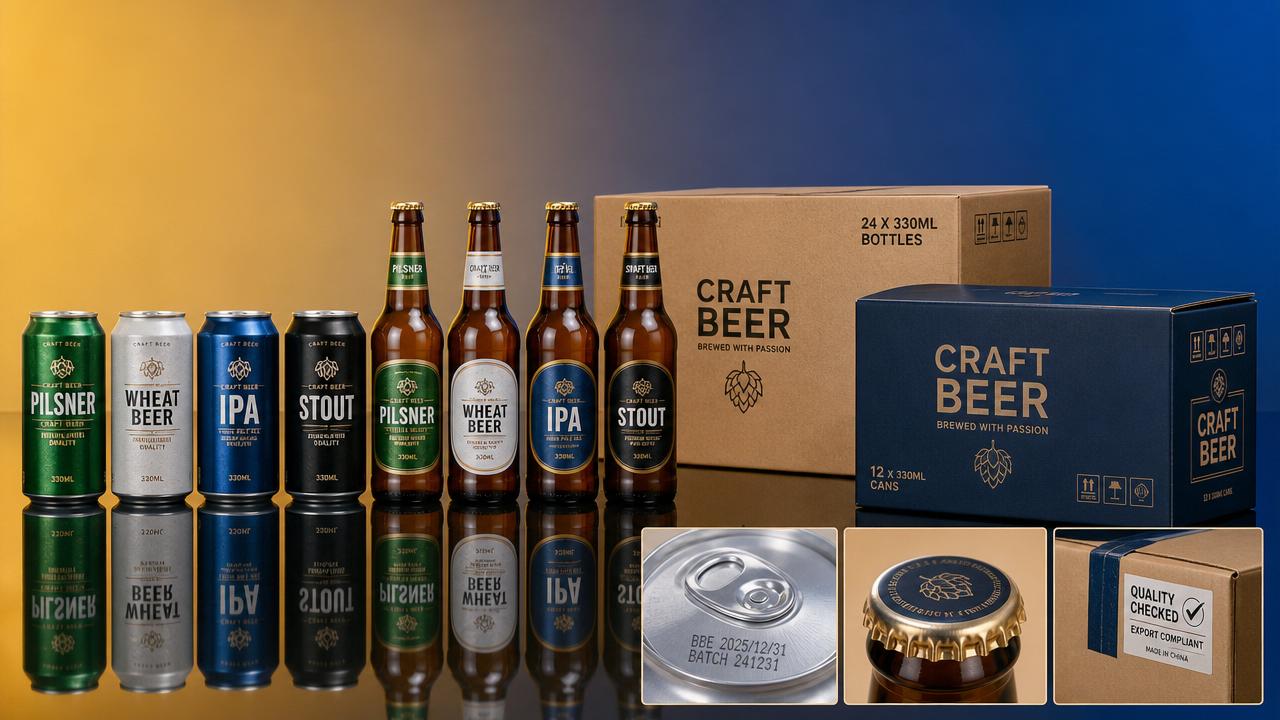
Choosing a beer supplier in China is not mainly about finding the lowest quote. For importers, distributors, and private label brand owners, the differences that matter most are consistency, customization, compliance, and the supplier’s ability to support long-term growth.
If you are looking for a reliable Chinese beer factory for private label projects, the right comparison standard is simple: can this supplier help you launch a product that sells well, stays stable from batch to batch, and clears export requirements without creating costly delays?
Many buyers begin by comparing unit prices, minimum order quantities, or packaging options. Those factors matter, but they do not tell the full story. A cheaper supplier can become more expensive if flavor drifts, lead times slip, labels fail compliance checks, or communication breaks down during production.
That is why the core search intent behind this topic is practical evaluation. Buyers want to know which supplier differences truly affect product quality, brand reputation, market fit, and long-term profitability. They are not just searching for beer. They are searching for a dependable manufacturing partner.
Why Price Alone Is a Poor Way to Compare Beer Suppliers
Price is visible, easy to compare, and often the first filter in supplier discussions. However, in beverage sourcing, headline pricing rarely reflects the full cost of ownership. Freight damage, reformulation, slow response times, unstable quality, and repackaging issues can quickly erase any initial savings.
For example, two suppliers may offer similar beer styles at similar alcohol levels, yet one uses tighter process controls, more stable raw material sourcing, and stronger packaging standards. The invoice may look slightly higher, but the delivered value is far better once shelf performance and customer satisfaction are considered.
For private label buyers, price should be evaluated alongside repeatability, market positioning, and operational reliability. A supplier that can consistently produce your chosen flavor profile and packaging format is usually more valuable than one that wins only on the first quotation.
Product Consistency Is What Protects Your Brand
When you sell under your own label, every quality issue becomes your problem in the eyes of retailers and consumers. That is why product consistency is one of the most important differences between suppliers, especially for businesses building a long-term brand rather than testing a one-time shipment.
Consistency means more than the beer tasting good in a sample. It means the next production batch should match the approved profile in aroma, bitterness, color, carbonation, mouthfeel, and alcohol content. It also means cans or bottles should arrive with stable filling, secure sealing, and acceptable shelf life.
A capable supplier should have documented production standards, clear batch records, and internal quality checkpoints from brewing to packaging. Ask how they control fermentation, how they verify final specifications, and what happens if a batch falls outside target ranges.
For a Chinese beer factory for private label cooperation, consistency is often the dividing line between a factory that can support scaling and one that is only suitable for small, low-risk orders. If your market depends on repeat purchase, stable flavor is not optional.
Customization Capability Determines Whether Your Product Can Stand Out
Many buyers are not looking for an off-the-shelf beer with a new label. They want a product that fits a defined audience, channel, or price segment. This is where supplier customization capability becomes a major point of comparison.
Customization can include recipe adjustment, sweetness level, bitterness balance, alcohol strength, packaging size, label design support, and category innovation. In today’s market, this may also include sugar-free low-calorie beer, fruit-flavored beer, functional specialty beer, or styles designed for younger consumers and social drinking occasions.
A strong supplier should be able to explain what level of OEM or ODM service is realistic. Some factories can only relabel standard stock formulas, while others can support deeper development based on your target market, local consumer preferences, and pricing goals.
This difference matters because product differentiation is often the only way a new beer brand can avoid direct price competition. If a supplier cannot support tailored development, your private label may look generic even if the packaging is attractive.
Quality Control and Food Safety Matter More Than Marketing Claims
Professional websites and polished catalogs are helpful, but they do not replace real quality systems. When comparing suppliers, buyers should look past promotional language and focus on how quality is actually managed.
Important questions include whether the factory has relevant certifications, whether raw materials are inspected, how microbial risks are controlled, how packaging integrity is checked, and whether test reports are available for export orders. You should also understand their process for handling complaints and non-conforming products.
Food safety is especially important for importers working with supermarkets, chain retailers, and regulated markets. A weak quality system does not just risk returns. It can damage distributor relationships, trigger customs issues, and create legal exposure in your destination country.
A dependable supplier should be comfortable discussing testing, shelf life validation, storage requirements, and traceability. If answers stay vague or overly sales-oriented, that is often a sign the operational foundation is weaker than the presentation suggests.
Export Experience Reduces Risk Across the Entire Supply Chain
Not every brewery that can produce good beer can manage international business smoothly. Export experience is one of the most underestimated differences when buyers compare Chinese suppliers.
An export-ready supplier understands labeling requirements, documentation accuracy, packaging protection for long-distance shipping, production scheduling around vessel timelines, and communication expectations for overseas buyers. This experience helps reduce avoidable delays and compliance mistakes.
For private label projects, export capability also includes coordination across formula approval, design confirmation, carton marking, palletization, and shipment preparation. A supplier with limited export practice may produce acceptable beer but still create costly friction during delivery.
In practical terms, experienced exporters tend to provide clearer lead times, faster document turnaround, and better anticipation of problems. That reliability is often more valuable than a small unit price advantage, especially when your launch schedule is tied to seasonal promotions or distributor commitments.
Packaging Flexibility Affects Both Sales and Operations
Beer buyers often focus on the liquid, but packaging plays a major role in market success. The right supplier should offer formats that match your sales channel, brand positioning, and logistics model.
Depending on your business, this may mean cans for convenience retail, glass bottles for restaurant presentation, or mixed packaging strategies for different countries. Packaging size, carton durability, labeling precision, and visual consistency all influence customer perception and handling efficiency.
For distributors and wholesalers, packaging flexibility can also improve inventory planning. A supplier that offers different pack sizes, seasonal designs, or market-specific labeling gives you more room to adapt without changing production partners.
When evaluating a Chinese beer factory for private label, ask not only what formats are available, but how reliably those formats are supplied. A wide packaging menu means little if procurement coordination or print quality is unstable.
Communication Speed and Project Management Often Predict Future Problems
One of the clearest signals of supplier quality appears before production even starts. How a supplier communicates during sampling, quotation, and artwork confirmation often reflects how they will handle your account later.
Strong suppliers answer specific questions clearly, explain limitations honestly, confirm timelines in writing, and follow a structured process. Weak suppliers may respond slowly, avoid technical details, or say yes to everything without clarifying what is feasible.
This matters because private label beer projects involve many moving parts: formula confirmation, packaging approval, compliance review, production planning, payment scheduling, and logistics coordination. If communication is unclear, small misunderstandings can become expensive production errors.
For overseas buyers, responsiveness is not just a service issue. It is a business control issue. A supplier that communicates well helps you make faster decisions and reduces hidden risk throughout the order cycle.
Minimum Order Quantity Should Match Your Market Strategy
MOQ is another area where buyers often compare numbers without enough context. A lower MOQ can be useful for testing a market, but it is not always the best option if it leads to weaker pricing, limited customization, or less stable scheduling.
What matters is whether the supplier’s MOQ structure fits your business stage. New brand owners may need trial flexibility, while established importers may prioritize volume efficiency and dedicated production planning. The right supplier should be able to discuss these tradeoffs transparently.
In some cases, a slightly higher MOQ is acceptable if it unlocks better formula customization, more professional packaging, or stronger value per unit. The goal is not simply to buy less. The goal is to launch with a product structure that makes commercial sense.
How to Evaluate a Supplier Beyond the Sample Stage
Samples are important, but they only show a limited moment. A good sample does not guarantee stable mass production, export readiness, or efficient cooperation. Buyers should evaluate the supplier as a system, not just as a tasting experience.
A stronger assessment method includes reviewing product range, checking documentation capability, confirming customization depth, discussing quality control procedures, and understanding the timeline from development to shipment. If possible, factory audits or video walkthroughs can also add useful insight.
You should also ask scenario-based questions. What if label rules change before shipment? What if a batch needs adjustment? What if you need a repeat order in peak season? A mature supplier usually has practical answers based on operating experience, not vague assurances.
This approach is especially useful when selecting a Chinese beer factory for private label cooperation, because long-term success depends on repeatable execution more than first impressions.
What the Best Supplier Usually Looks Like
The best supplier is not always the cheapest, biggest, or most aggressive in sales. In many cases, the best fit is the factory that combines stable brewing quality, relevant product development capability, export familiarity, and realistic cooperation terms.
For example, a supplier with experience across classic lager, German wheat, sugar-free low-calorie beer, fruit-flavored beer, and functional specialty beer can often support a broader market strategy. That range can help distributors and brand owners respond to different consumer segments without rebuilding the supply chain.
It also helps if the supplier can support OEM, ODM, wholesale supply, and customized channel solutions for supermarkets, bars, restaurants, and retail networks. This kind of operational flexibility is valuable because your needs may expand after the first successful launch.
In other words, the most meaningful supplier differences are the ones that affect repeat sales, channel compatibility, and long-term scalability. Those are the areas where real business value is created.
Final Thoughts: Compare for Business Fit, Not Just for Cost
When comparing beer suppliers in China, the differences that actually matter are not superficial. They are the factors that influence whether your product can succeed consistently in the real market: stable quality, useful customization, strong quality control, export competence, reliable communication, and practical packaging support.
If you are sourcing from a Chinese beer factory for private label business, treat supplier selection as a strategic decision rather than a purchasing shortcut. The right partner does more than manufacture beer. They help you reduce risk, strengthen your brand, and create a product line that fits your customers and channels.
That is the standard worth using. Not who offers the lowest quote today, but who can support a better product and smoother growth tomorrow.
Thank you very much for writing to us. Please leave your message and contact information, we will reply to you within 24 hours.