



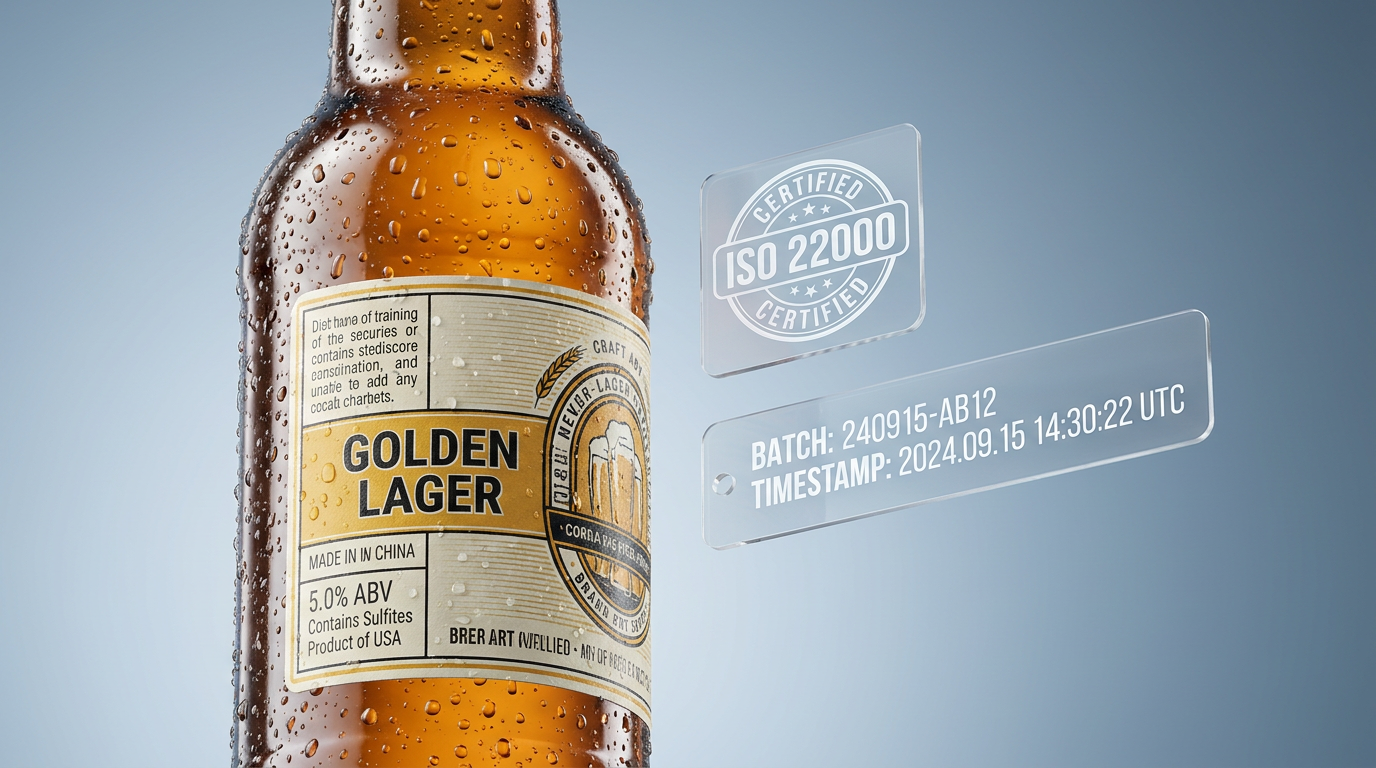
Before signing a Beer OEM contract, procurement professionals must rigorously audit three critical areas: labeling compliance with local alcohol regulations, end-to-end batch traceability for quality control and recalls, and clear excise tax liability allocation to avoid unexpected financial exposure. At Jinpai Beer — a craft beer OEM/ODM partner specializing in lagers, wheat beers, low-calorie, fruit-infused, and functional brews — we embed these safeguards into every agreement. This article breaks down what to verify, why it matters, and how proactive clause review protects your brand, budget, and market access.
Why labeling compliance isn’t just about fonts and logos
Alcohol labeling is highly regulated — and enforcement varies sharply by jurisdiction. In the EU, mandatory elements include alcohol by volume (ABV), allergen declarations (e.g., gluten content in wheat beer), origin statements, and health warnings. In the U.S., TTB requires formula approval, net contents, government health warning statement, and responsible party identification. In Japan or South Korea, bilingual labeling and specific calorie disclosures are enforced. A single misstep — such as omitting “contains sulfites” on a fruit-flavored beer or misstating ABV tolerance — can trigger product rejection at customs, shelf removal, or fines up to 3% of local annual revenue.
Procurement teams often assume the OEM handles all labeling — but unless explicitly stated in the Beer OEM contract, legal responsibility remains with the brand owner. Jinpai Beer pre-validates label drafts against target-market regulatory databases and provides certified translations and print-ready artwork compliant with ISO 22000-aligned packaging workflows.
How batch traceability impacts recall speed, cost, and reputation
When a contamination event or quality deviation occurs, time-to-isolation is measured in hours — not days. Without granular batch traceability, a recall may escalate from one production run to all SKUs shipped in the past 90 days. For craft beer OEM partners, this means tracing raw materials (malt lot codes, yeast strain IDs, hop harvest dates), fermentation logs, filtration timestamps, fill-line identifiers, and pallet-level shipping manifests.
- Raw material traceability: Verified supplier certificates for malt, hops, adjuncts (e.g., fruit purees, functional ingredients)
- Process-level logging: Fermentation temperature curves, dissolved oxygen levels, pH shifts per tank
- Packaging linkage: Fill-line ID + time stamp mapped to individual case/barcode + pallet ID
- Digital accessibility: Cloud-hosted traceability dashboard with exportable audit trails (PDF/CSV)
Jinpai Beer assigns unique 12-digit batch IDs at wort boil initiation and maintains full digital traceability across our ISO 22000-certified production lines — covering classic lager, German wheat, sugar-free low-calorie variants, fruit-infused releases, and functional specialty beers. Trace reports are delivered within 2 business hours of request.
Where excise liability clauses go wrong — and how to fix them
Excise duty is typically assessed at the point of removal from bonded warehouse — but who bears liability when duty rates change mid-contract, or when goods are held in transit across jurisdictions? Ambiguous Beer OEM contracts often leave brand owners exposed to retroactive assessments, storage surcharges, or classification disputes (e.g., whether a functional beer with added vitamins qualifies as “alcoholic beverage” or “dietary supplement” under local law).
This table reflects real negotiation outcomes across 12 markets where Jinpai Beer supports OEM clients — from EU’s Excise Movement and Control System (EMCS) to Canada’s CRA beer classification framework. We align contractual language with local administrative practice, not just statutory text.
What procurement teams should verify before signing
- Label artwork has received formal pre-approval from the OEM’s internal regulatory team — not just “reviewed”
- Batch ID format is standardized, machine-readable, and appears on both primary label and shipping manifest
- Traceability system allows filtering by ingredient lot, production date, and destination market — with no data silos
- Excise clause specifies which party initiates duty filing, which bears audit costs, and how classification disputes are resolved
- OEM provides documented evidence of prior successful customs clearance in your target country (e.g., TTB COLA, EU EORI, MHLW import license)
Why Jinpai Beer builds compliance into every Beer OEM engagement
We don’t treat labeling, traceability, or excise clauses as legal afterthoughts — they’re engineered into our OEM service model. From R&D formulation (e.g., gluten-reduced wheat beer meeting Codex Alimentarius thresholds), through pilot-batch validation, to full-scale production, every step generates auditable records. Our clients — global distributors, bar chains, supermarket private labels, and functional-beverage startups — rely on us to de-risk market entry without sacrificing speed or innovation.
Ready to review your next Beer OEM contract with embedded compliance? Contact Jinpai Beer for a free clause audit checklist, sample traceability report, or jurisdiction-specific labeling guidance — tailored to your target market, product type (e.g., low-calorie lager, hibiscus sour, adaptogen-infused IPA), and distribution channel (online DTC, wholesale, HORECA). Let’s align your contract with what regulators expect — and your customers trust.
Thank you very much for writing to us. Please leave your message and contact information, we will reply to you within 24 hours.