



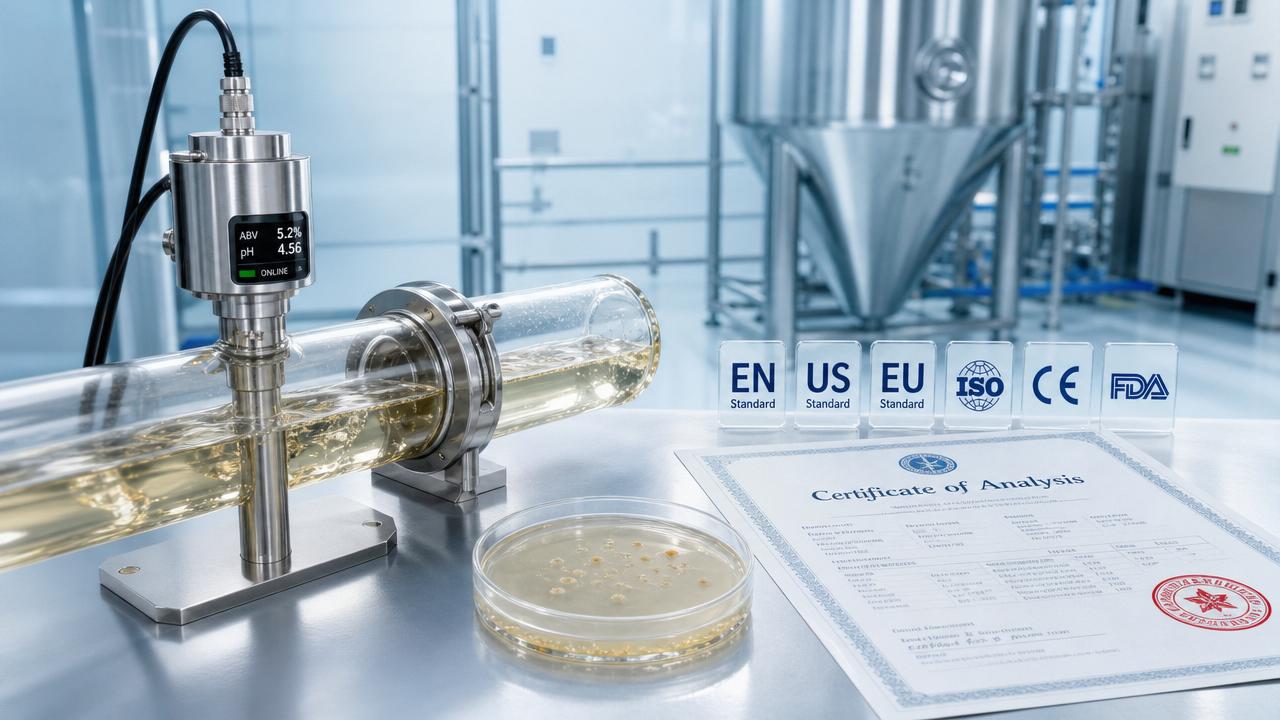
When sourcing a Chinese beer factory OEM service, rigorous quality control checkpoints are non-negotiable—especially for food safety managers and QA professionals overseeing global supply chains. At Jinpai Beer, every batch undergoes strict in-process checks: raw material verification, microbiological testing pre-fermentation, real-time ABV and pH monitoring, sterile filtration validation, and shelf-life stability trials. Unlike generic contract brewers, we align our HACCP-certified protocols with your brand’s compliance requirements (e.g., FDA, EU EFSA, or ANVISA). This guide details the 5 most mission-critical QC checkpoints—and why skipping even one risks recalls, reputational damage, or market access failure.
Which QC checkpoints determine batch release for a Chinese beer factory OEM service?
Not all checkpoints carry equal weight. Five stand out as decisive gates—each tied directly to regulatory acceptance, sensory consistency, and shelf-life predictability.
1. Raw Material Traceability & Specification Compliance
Barley, hops, yeast strains, and adjuncts must meet origin-specific standards—not just general “food-grade” labels.
Jinpai Beer requires COA (Certificate of Analysis) for every lot, plus third-party heavy-metal and pesticide-residue screening on incoming malt and hops.
Non-compliant inputs trigger automatic quarantine—not rework. This prevents downstream flavor drift or haze formation.
2. Pre-Fermentation Microbiological Baseline
Yeast health and wort sterility before pitching dictate fermentation fidelity.
We perform aerobic plate counts, wild yeast detection (Brettanomyces), and lactic acid bacteria (LAB) assays within 2 hours of wort cooling.
Any deviation halts fermentation until root cause is verified—no “acceptable risk” allowances.
3. Real-Time Fermentation Parameter Validation
ABV, pH, gravity, and temperature are logged every 15 minutes—not sampled hourly.
Our automated SCADA system flags deviations >±0.2% ABV or >±0.15 pH units in real time.
This ensures reproducibility across batches—even for German wheat or low-calorie variants where ester balance is critical.
4. Post-Filtration Sterility Assurance
Cold filtration alone doesn’t guarantee biostability. We validate membrane integrity via bubble-point testing pre- and post-run.
Each filtered batch undergoes mandatory 7-day incubation at 30°C, followed by plating on MRS and YPD agar.
Zero colony growth is required before packaging. No exceptions—even for draft-only SKUs.
5. Accelerated Shelf-Life Stability Testing
Real-time aging (12+ months) isn’t feasible pre-launch. So we run forced-stability trials at 40°C/75% RH for 30 days.
We monitor carbonyl compounds (trans-2-nonenal), dissolved oxygen (<50 ppb), and turbidity (NTU) weekly.
Results feed into predictive models aligned with your target market’s storage conditions—tropical, temperate, or refrigerated retail.
How do QC priorities shift across beer categories in a Chinese beer factory OEM service?
A sugar-free low-calorie lager demands tighter ABV and residual sugar control than a fruited sour. Functional beers require additional stability validation for added botanicals or vitamins.
What common oversights undermine QC credibility in Chinese beer factory OEM service partnerships?
- Accepting “batch records” without timestamped digital logs from calibrated sensors
- Skipping accelerated shelf-life testing because “it passed pilot batch”
- Assuming ISO 22000 certification covers beer-specific hazards like iso-alpha-acid degradation or hop oil volatility
- Relying solely on end-product testing—ignoring in-process intervention points
- Overlooking packaging-line QC: crown seal integrity, fill-level variance, label adhesion under humidity stress
Next steps to activate robust QC in your Chinese beer factory OEM service engagement
- Request full documentation of Jinpai Beer’s HACCP plan—including hazard analysis for each beer category you intend to launch
- Specify required test reports per batch: raw material COAs, fermentation logs, sterility plates, and stability data summaries
- Conduct an on-site audit—or engage a certified third party—to verify lab calibration, environmental monitoring, and traceability systems
- Define release criteria in writing: e.g., “ABV ±0.15%, DO <45 ppb, zero LAB colonies after 7-day incubation”
- Align shelf-life claims with actual stability trial results—not theoretical estimates or competitor benchmarks
Choosing a Chinese beer factory OEM service means choosing a long-term quality partner—not just a production vendor. At Jinpai Beer, these five checkpoints aren’t checkboxes. They’re embedded in our process architecture, validated daily, and shared transparently with every client.
Ready to co-develop a QC protocol tailored to your brand, market, and product portfolio? Contact Jinpai Beer today for a technical consultation and sample batch review.
Thank you very much for writing to us. Please leave your message and contact information, we will reply to you within 24 hours.