



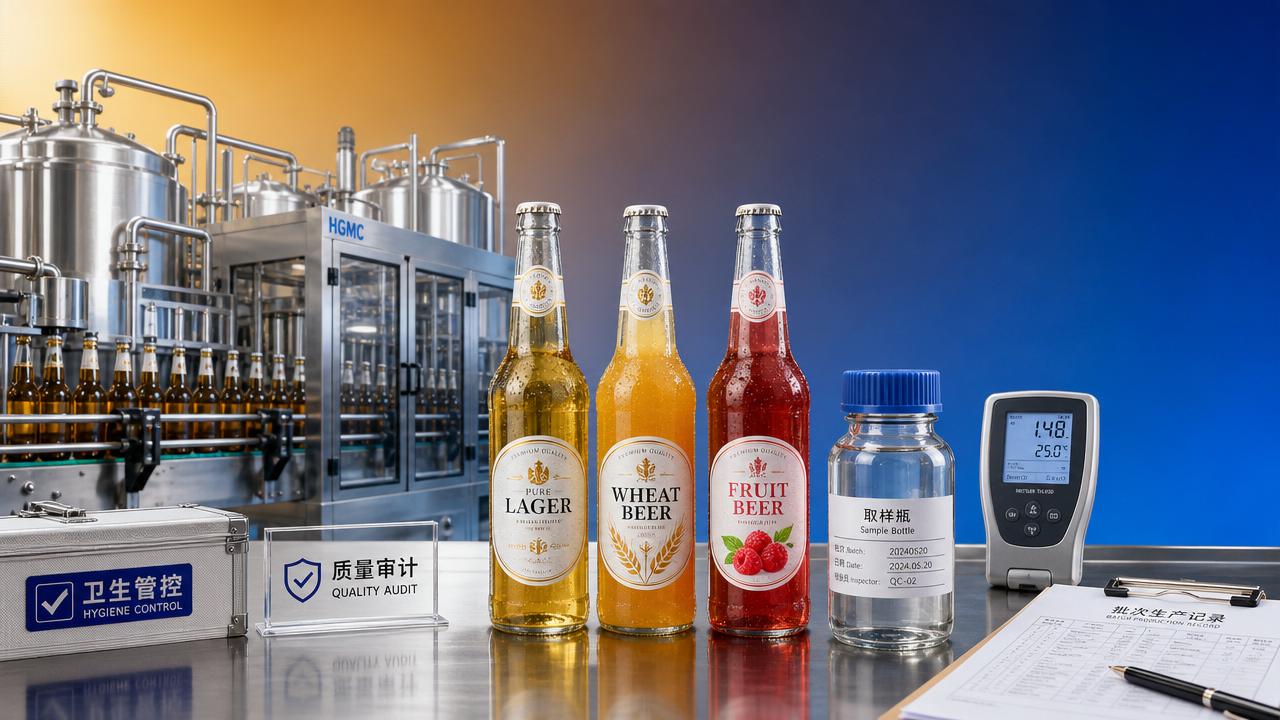
What Audits Reveal About a China Beer OEM Before Signing
Before committing to a China beer OEM, attractive pricing and polished samples are not enough.
A structured audit reveals how beer quality, hygiene, traceability, formulation control, and compliance are managed under real production conditions.
For lager, wheat beer, low-calorie beer, fruit beer, and specialty beers, audit findings protect brand reputation and market continuity.
Why the audit scenario matters before choosing a China beer OEM
Different beer sourcing scenarios create different audit priorities.
A standard lager program may focus on consistency, capacity, filtration, packaging accuracy, and stable shelf life.
A fruit-flavored beer project needs stronger control of flavor dosing, microbial risk, ingredient sourcing, and sensory stability.
A China beer OEM serving multiple markets must also show practical knowledge of labeling, alcohol declaration, allergens, and claims.
The audit should not only confirm equipment ownership.
It should show whether routine production can match approved samples after scale-up, season changes, and repeated batches.
Scenario one: classic lager programs needing batch-to-batch stability
Lager is often judged by clarity, foam, crispness, bitterness balance, and clean aroma.
An audit of a China beer OEM should verify malt inspection, water treatment, yeast handling, fermentation temperature, and dissolved oxygen control.
The most useful evidence is not a single laboratory report.
Review several recent batch records and compare original gravity, alcohol level, pH, bitterness, turbidity, and sensory release notes.
If records are incomplete, the China beer OEM may struggle when orders expand or delivery windows become tighter.
Key audit checks for lager sourcing
- Water source testing and treatment validation.
- Yeast propagation, storage, and generation control.
- Fermentation temperature records and alarm handling.
- Filtration, carbonation, and oxygen pickup control.
- Finished product retention and release approval.
Scenario two: wheat beer requiring sensory and process discipline
German-style wheat beer depends on yeast-driven aroma, smooth mouthfeel, foam quality, and controlled haze.
A China beer OEM should demonstrate that haze is intentional, stable, and not caused by poor sanitation.
Audits should examine yeast strain control, fermentation profile, tank cleaning, and sensory panel routines.
Taste panels should include defined acceptance criteria, not informal comments.
For wheat beer, the China beer OEM must also protect aroma during packaging and distribution.
Check whether the brewery tracks aging notes, oxidation, sediment behavior, and temperature exposure during storage.
Scenario three: sugar-free and low-calorie beer with claim sensitivity
Low-calorie and sugar-free beer programs create higher compliance pressure than standard beer lines.
A China beer OEM must support nutrition data, carbohydrate calculations, ingredient validation, and claim consistency.
The audit should confirm how formulas are approved, locked, changed, and verified before production.
Look for documented controls over enzymes, adjuncts, sweeteners, and process steps affecting residual sugar.
If the China beer OEM cannot explain claim substantiation, export risk increases.
Labels, certificates, laboratory methods, and batch documents should tell the same technical story.
Scenario four: fruit beer where flavor and hygiene risks rise
Fruit-flavored beer attracts wider retail interest, yet it increases complexity inside the brewery.
Fruit juices, concentrates, essences, and color adjustments may introduce microbial, allergen, and consistency risks.
A capable China beer OEM should separate flavor storage, dosing, cleaning, and allergen review from ordinary brewing controls.
During the audit, trace one fruit ingredient from receiving through batching, filling, and finished product release.
This exercise reveals whether the China beer OEM can prevent misdosing, cross-contact, and flavor drift.
It also shows whether shelf-life claims are based on testing or assumption.
Scenario five: functional specialty beer needing stricter formulation control
Functional specialty beers may include botanical extracts, vitamins, minerals, electrolytes, or other value-added ingredients.
These products need careful regulatory screening before any claim reaches a label or sales page.
A China beer OEM should provide ingredient certificates, supplier qualification records, formula approval logs, and dosage verification.
Audits should also review whether specialty ingredients affect fermentation, haze, flavor stability, and microbial limits.
When functional positioning is planned, the China beer OEM must understand both beverage science and claim discipline.
Different beer sourcing scenarios and audit priorities
This comparison helps align the audit plan with the product, instead of applying one checklist to every China beer OEM.
What a reliable China beer OEM audit should uncover
Raw material control
Beer quality starts with malt, hops, yeast, water, adjuncts, flavors, and packaging materials.
A China beer OEM should qualify suppliers, inspect incoming materials, and keep certificates linked to production batches.
Hygiene and sanitation
Clean-in-place systems should have validated cycles, chemical concentration checks, and documented corrective actions.
Swab results, micro testing, and environmental monitoring reveal whether sanitation works beyond paperwork.
Traceability and recall readiness
A qualified China beer OEM should complete backward and forward tracing quickly.
Mock recall records should show affected materials, batch quantities, customers, warehouse locations, and decision timing.
Packaging and labeling control
Cans, bottles, cartons, and labels must match approved artwork and destination market requirements.
The China beer OEM should prevent mixed labels, wrong alcohol declarations, barcode errors, and missing allergen statements.
Scenario-fit recommendations before contract approval
- Audit the exact product type planned for launch, not only the cleanest production line.
- Review three to five recent batches similar to the intended beer style.
- Ask the China beer OEM to demonstrate traceability during the visit.
- Check whether corrective actions are verified, closed, and prevented from repeating.
- Compare the sample formula, commercial formula, label file, and quality specification.
- Request shelf-life evidence matching package type, alcohol level, and distribution temperature.
For customized beer, audit depth should increase with formulation complexity, claim exposure, and market regulation.
A China beer OEM with strong systems will welcome specific questions and provide evidence without delay.
Common misjudgments when reviewing a China beer OEM
One common mistake is trusting pilot samples without checking commercial-scale repeatability.
Another is focusing on visible equipment while ignoring records, training, maintenance, and deviation handling.
Some reviews overlook packaging performance, although oxygen pickup and seam quality can shorten shelf life quickly.
Label review is also often delayed until after production planning.
That timing can create rework, shipment delays, or compliance problems in target markets.
A China beer OEM should be evaluated on prevention ability, not only reaction speed after defects appear.
How Jinpai Beer supports audit-ready OEM and ODM cooperation
Jinpai Beer develops, produces, and distributes craft beer for global online and offline channels.
Product options include classic lager, German wheat, sugar-free low-calorie beer, fruit-flavored beer, and functional specialty beers.
As a China beer OEM and ODM partner, Jinpai Beer supports wholesale supply, private label projects, and customized beer solutions.
Cooperation can serve restaurants, supermarkets, bars, retail channels, distributors, agents, and long-term beverage partners worldwide.
The most productive next step is a scenario-based audit discussion.
Share the beer style, target market, package format, claim requirements, expected volume, and launch schedule.
Then evaluate whether the China beer OEM can document, produce, release, and improve the product with consistent discipline.
Before signing, request batch records, quality specifications, label review support, and shelf-life evidence for the intended beer scenario.
A well-run audit turns supplier selection into a controlled decision, not a pricing gamble.
Thank you very much for writing to us. Please leave your message and contact information, we will reply to you within 24 hours.