



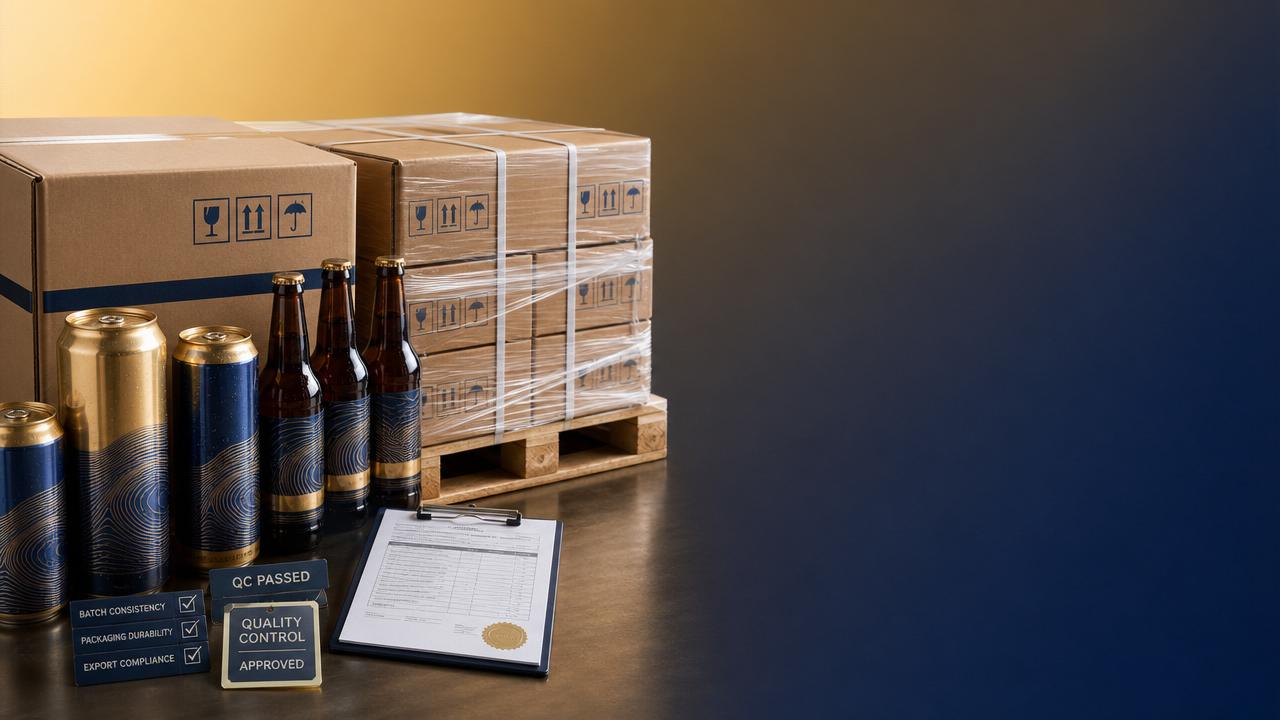
Choosing a Chinese beer factory for private label can create strong margin and product expansion opportunities, but the biggest risks are usually not price-related. The most important risks involve product consistency, legal compliance, packaging performance, delivery reliability, and whether the supplier can scale without losing quality.
For most buyers, the real question is not whether China can produce private label beer competitively. It is whether a specific factory can repeatedly deliver the exact beer, packaging, documents, and timelines your market requires without creating hidden commercial problems.
If you are evaluating a Chinese beer factory for private label, the safest approach is to assess sourcing risk in layers. Start with beer quality and formula control, then move to compliance, packaging, production planning, logistics, and supplier transparency.
This article explains which risks matter most, why they affect your business outcomes, and how to screen brewing partners in China before you place a trial order or commit to long-term cooperation.
Why Sourcing Risk Matters More Than the Initial Quote
Many buyers start by comparing unit price, minimum order quantity, and packaging options. Those factors matter, but they do not reveal whether the supplier can protect your brand once the product reaches shelves, restaurants, bars, or distributors.
A low quote becomes expensive if the beer tastes different from batch to batch, labels fail customs review, cans dent in transit, or lead times slip during peak season. In private label beer, the hidden cost of failure is often much higher than the visible cost of production.
For importers, brand owners, and channel distributors, the most damaging problems are usually delayed launches, customer complaints, unsellable inventory, and compliance issues. That is why supplier evaluation should focus on operational reliability, not only manufacturing price.
Risk 1: Inconsistent Beer Quality Across Batches
The first major risk is inconsistency in taste, aroma, color, carbonation, mouthfeel, or alcohol content. A sample can taste excellent, but if later production batches differ, your private label loses credibility quickly in competitive retail and on-premise markets.
This risk is especially important for craft beer, wheat beer, fruit beer, low-calorie beer, and functional specialty beers because these styles are more sensitive to ingredient balance, fermentation control, and shelf-life stability than very simple standard lagers.
Buyers should ask how the brewery standardizes recipes, controls raw material variation, manages yeast health, and verifies each batch before filling. A dependable factory should be able to explain its quality checkpoints rather than giving only general assurance.
You should also confirm whether the supplier provides retained samples, batch records, sensory testing procedures, and core laboratory data. These details show whether product consistency is managed systematically or left to operator experience alone.
Risk 2: Formula Compliance in Your Target Market
A beer that is legal to produce in China is not automatically compliant in your destination market. Ingredient usage, additive declarations, alcohol labeling, nutritional claims, sugar-free statements, and functional positioning may all face different regulatory standards.
This is one of the most underestimated risks when working with a Chinese beer factory for private label. Buyers sometimes approve a formula based on taste and cost, only to discover later that the product claim or label wording cannot be used locally.
For example, terms such as “sugar-free,” “low-calorie,” “functional,” or fruit-related claims may require substantiation or specific formatting. Even when the beer itself is acceptable, the packaging presentation may trigger relabeling costs or customs delays.
Before mass production, ask the brewery for full ingredient specifications, process details, shelf-life data, and draft label files. Then review them against your local import, food labeling, and alcohol marketing requirements with a qualified compliance specialist.
Risk 3: Weak Packaging Quality and Poor Transport Performance
Packaging failures can erase the savings gained from offshore sourcing. Dented cans, leaking seams, broken bottles, fading print, weak cartons, or pallet instability can damage both product salability and your reputation with wholesalers and retailers.
Beer packaging is not just a branding issue. It is a protection system that must withstand filling pressure, warehousing, container movement, and final distribution. A supplier may offer attractive design options but still lack strong packaging execution discipline.
Ask whether the brewery controls can seam integrity, bottle filling accuracy, carton compression strength, adhesive performance, and pallet wrapping standards. If labels or shrink sleeves are used, confirm how they perform under moisture and cold-chain exposure.
It is also wise to request packing specifications and transit testing evidence, especially if your products will face long sea routes or multiple handling points. A professional supplier should understand that transport durability is part of product quality.
Risk 4: Lead Time Instability and Capacity Bottlenecks
Late delivery is a serious commercial risk in private label beer because launches are often tied to seasonal demand, promotions, and distributor schedules. Missing a window for summer sales, holiday campaigns, or chain rollouts can hurt profitability immediately.
Some factories perform well on samples and first orders but struggle when order volume grows, packaging becomes more customized, or multiple SKUs are produced together. The issue is not always production skill. It is often planning discipline and capacity management.
Buyers should ask how far in advance production slots must be booked, whether packaging materials are sourced in-house or externally, and which factors most commonly delay shipment. Clear answers are usually a sign of operational maturity.
It is also important to understand peak season pressure. If the supplier serves many export customers, lead times may widen sharply during busy periods. A reliable partner should communicate realistic schedules rather than promising timelines that cannot be sustained.
Risk 5: Limited Transparency on Ingredients and Sourcing
In beer production, ingredient quality strongly affects final taste stability, aroma profile, and shelf-life behavior. If a brewery is vague about its malt, hops, yeast, flavoring materials, or adjunct sourcing, buyers should treat that as a warning sign.
Transparency does not mean the factory must reveal every commercial detail. It means the supplier can clearly explain ingredient origin categories, substitution policy, quality standards, and how formula integrity is protected when supply conditions change.
This matters even more for fruit-flavored beers and specialty formulations because flavor compounds, concentrates, sweeteners, and other inputs can vary significantly. Small formulation changes may alter taste, labeling obligations, or product positioning in your market.
When comparing suppliers, ask whether any ingredients may be replaced without prior approval and whether your private label formula is locked after confirmation. This protects you from silent changes that create product inconsistency or compliance exposure later.
Risk 6: Shelf-Life and Stability Problems After Export
Beer that performs well when fresh may not perform equally well after international shipping and storage. Heat exposure, transit time, light sensitivity, oxygen pickup, and microbiological instability can all reduce flavor quality before the product reaches end customers.
This is particularly relevant for craft styles, wheat beers, fruit beers, and lower-calorie products, which can be more vulnerable to flavor drift. Export beer must be evaluated for its real route-to-market conditions, not only for immediate post-production quality.
Buyers should ask for shelf-life validation methods, storage recommendations, and packaging suitability for long-distance export. It helps to know whether the brewery has experience shipping to climates and distribution systems similar to your own market.
If possible, keep control samples from pilot or initial production and review them after transit simulation or storage intervals. A supplier that understands export stability will discuss oxygen control, pasteurization or filtration choices, and storage risk openly.
Risk 7: Documentation Errors That Slow Customs Clearance
Even if the beer and packaging are acceptable, incorrect paperwork can delay customs clearance and disrupt sales plans. Missing, inconsistent, or inaccurate documents create cost through storage fees, relabeling, shipment holds, or refused entry.
The exact document set depends on your market, but buyers usually need confidence that the supplier can support commercial invoices, packing lists, certificates, product specifications, origin documents, and any market-specific declarations required for alcohol imports.
Errors often happen when product names, alcohol percentages, packaging descriptions, or label details are not aligned across files. This is a preventable risk, but only if the brewery has export coordination experience and careful document review procedures.
Ask who prepares export documents, who checks consistency between packaging artwork and shipping paperwork, and how revisions are controlled. A capable export supplier should treat documentation accuracy as part of the delivery process, not as an afterthought.
Risk 8: Misalignment Between OEM Capability and Your Brand Strategy
Not every manufacturer is equally suitable for every private label project. Some are strong at standard low-cost lager with simple packaging, while others are better at differentiated craft, wheat, fruit, sugar-free, or functional specialty beer concepts.
The risk here is strategic mismatch. A factory may be able to produce beer, but not the type of portfolio, flavor development speed, customization depth, or market positioning your brand needs. That gap can limit growth after the first order.
For example, if your business model depends on frequent seasonal launches, limited editions, or multi-channel packaging formats, you need a supplier with responsive development and flexible production planning. A purely volume-driven plant may not support that well.
When evaluating a Chinese beer factory for private label, look beyond current price and ask whether the supplier can support your future roadmap. The best partner is one that matches both your current specifications and your next-stage business ambitions.
How to Evaluate a Reliable Chinese Brewing Partner
Practical supplier evaluation should move from evidence to commitment. Start with company background, export experience, and product range. Then review sample quality, technical responsiveness, packaging competence, and documentation discipline before discussing volume scaling.
Ask detailed questions, not just broad ones. Instead of asking whether quality is stable, ask how each batch is tested and recorded. Instead of asking whether exports are supported, ask which markets the brewery currently serves and what documents are routinely provided.
A trial order is often the best way to verify real capability. It allows you to assess communication speed, artwork handling, production accuracy, packaging execution, timeline control, and post-shipment support under actual commercial conditions.
You should also evaluate how the supplier handles problems. Strong partners do not claim perfection. They identify risks early, explain trade-offs clearly, and offer workable solutions when formulation, packaging, or logistics issues arise.
What Buyers Should Prioritize Before Signing a Supply Agreement
Before entering a long-term arrangement, buyers should confirm product specifications, formula lock procedures, packaging standards, approved materials, lead times, claims review responsibility, and acceptance criteria for finished goods. Ambiguity creates avoidable disputes later.
It is also smart to define communication checkpoints from artwork approval to production release and shipment booking. Many sourcing problems begin not in brewing itself, but in unclear coordination between brand owner, factory, packaging vendors, and freight parties.
If the supplier offers OEM and ODM support, clarify whether development recommendations are based on your market needs or standard factory options. A valuable partner should help adapt the product to channel realities, not simply push the easiest configuration to produce.
For serious buyers, the right decision is rarely the cheapest supplier. It is the supplier that reduces total risk while protecting brand consistency, launch timing, and customer experience across repeated orders.
Final Thoughts
The biggest risks in sourcing private label beer from China are not mysterious, but they are highly practical. Buyers should focus most on batch consistency, formula compliance, packaging durability, delivery reliability, export documentation, and long-term supplier fit.
China can be an excellent source for private label beer when the brewery has strong R&D, disciplined production control, flexible OEM or ODM support, and real export experience. The opportunity is substantial, but only when supplier evaluation is rigorous.
If you are selecting a Chinese beer factory for private label, the smartest approach is to treat sourcing as a brand protection decision, not just a procurement exercise. The right partner helps you launch faster, reduce risk, and build durable market trust.
For importers, distributors, retailers, and hospitality buyers, that is the standard that matters most. A reliable brewing partner does more than make beer. It helps turn your private label strategy into a repeatable and scalable business asset.
Thank you very much for writing to us. Please leave your message and contact information, we will reply to you within 24 hours.