



What Makes a Beer Supplier ‘Restaurant-Ready’? Key Criteria Beyond Price and Volume
For project managers sourcing beverages for high-turnover foodservice venues, choosing the right Beer for bars and restaurants goes far beyond cost and case volume. You’ve seen it before: a supplier checks the boxes on price, ABV range, and minimum order—then fails at delivery timing, draft compatibility, or label compliance in a new market. That gap between “available” and “restaurant-ready” is where real operational risk lives.
“Restaurant-ready” isn’t a marketing tagline. It’s a functional threshold—defined by how smoothly a beer integrates into your venue’s workflow, not just its shelf life or foam head. It’s about whether your bar team can pour it consistently at 38°F without foaming out, whether your distributor can replace a damaged keg within 48 hours in Bangkok or Berlin, and whether your menu descriptions align with local alcohol labeling laws—not just your internal brand guide.
Consistency Isn’t Just About Flavor—It’s About Flow
A craft beer supplier might nail the first batch of German wheat—crisp, cloudy, with just the right banana-clove balance. But if Batch #7 drifts noticeably in carbonation or attenuation, your bar manager spends more time adjusting tap pressure than upselling. In high-volume settings, even minor variation compounds: inconsistent CO₂ levels affect pour speed, foam stability, and perceived freshness. That’s why restaurant-ready suppliers invest in batch-level QC—not just final-product tasting, but lab-grade monitoring of dissolved oxygen, pH, and yeast viability across production runs.
At Jinpai Beer, this means building lagers and wheat beers to spec—not just “style guidelines,” but parameters tied to draft system performance: target carbonation (2.4–2.6 volumes CO₂), cold-side filtration thresholds, and pasteurization alternatives that preserve mouthfeel without compromising shelf stability. Low-calorie variants aren’t just stripped-down versions; they’re reformulated with enzymatic control to avoid residual sweetness that clashes with savory dishes. Fruit-infused styles use cold-steeped purees—not artificial extracts—to hold up under refrigerated storage without separation or haze formation.
Logistics That Don’t Assume Your Back Door Is Open 24/7
A “global supplier” promise means little if your venue in Lisbon gets pallets marked “Fragile” stacked on wet cardboard, or if your Miami bar receives kegs with non-standard Sankey D couplers. Restaurant-ready logistics account for real-world constraints: narrow service elevators, shared loading docks, seasonal port delays, and customs paperwork that stalls shipments mid-Atlantic.
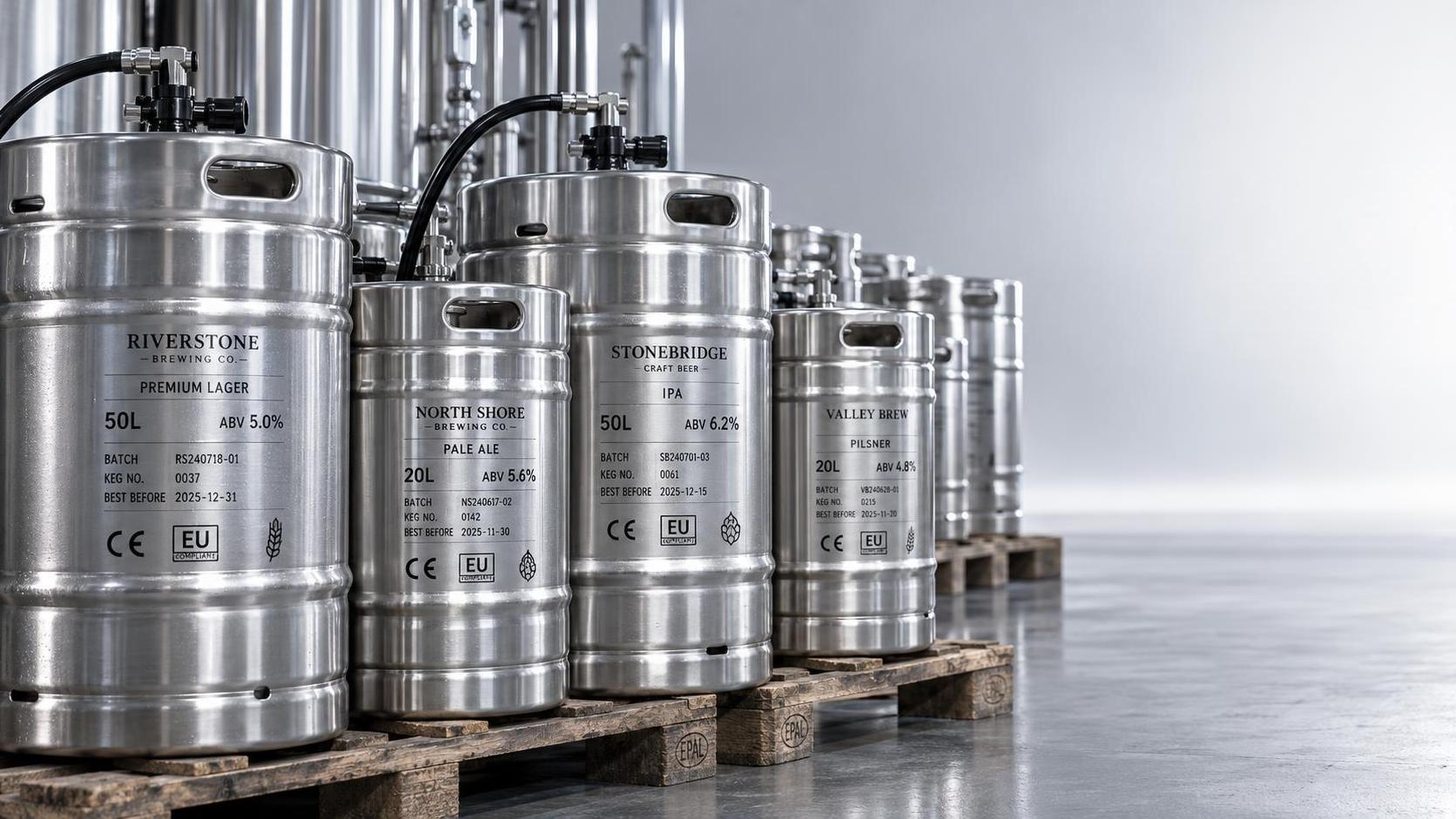
That’s why flexibility in packaging isn’t optional—it’s diagnostic. Can the supplier offer 20L kegs alongside standard 50L for smaller venues? Do they provide shatter-resistant PET growlers for takeout programs, with tamper-evident seals validated for 72-hour ambient transit? Are labels printed with EU-compliant allergen statements *and* bilingual English/Spanish nutrition panels—not just slapped on post-brewing?
Jinpai Beer structures its distribution partnerships around these variables—not just FOB terms. For instance, their OEM/ODM framework includes regional label compliance support, meaning a partner in Canada doesn’t need to redesign artwork from scratch for Health Canada’s alcohol labeling rules. Likewise, their wholesale program offers mixed-case configurations: one pallet with classic lager (for draft lines), sugar-free variant (for health-conscious menus), and fruit-infused seasonal (for limited-time promotions)—reducing SKU fragmentation in back-of-house storage.
Technical Support That Speaks Draft Lines, Not Data Sheets
You don’t need another PDF spec sheet. You need someone who knows whether your existing glycol chiller can handle a higher-viscosity fruit beer without freezing the line—and who’ll walk your staff through recalibrating flow meters after switching from lager to wheat.
Restaurant-ready technical support starts pre-sale: reviewing your current draft setup, understanding your peak service windows, and mapping potential bottlenecks (e.g., using nitrogen-blended stout in a system designed only for CO₂). It continues post-delivery—not just “here’s our training deck,” but onsite troubleshooting during soft launch, plus access to brewers who understand commercial kitchen constraints, not just sensory evaluation.
This is where functional specialty beers introduce real nuance. A “functional” brew—say, one with added electrolytes or botanical adaptogens—isn’t just a novelty. It changes serving temperature tolerance, foam retention, and even glassware recommendations. A restaurant-ready supplier doesn’t treat it as a separate SKU; they embed usage guidance into staff training: “Serve chilled, but not ice-cold—cold enough to preserve function, warm enough to release aroma.”
The Compliance Gap Most Suppliers Won’t Name
Price lists rarely include regulatory overhead—but it’s often the hidden cost of switching suppliers. A beer certified for sale in Germany may lack the required health claim disclaimers for Singapore’s HSA. A low-calorie formulation approved under EU Nutrition & Health Claims Regulation might trigger additional scrutiny in Mexico’s COFEPRIS framework.
Restaurant-ready means the supplier shoulders part of that burden—not by promising blanket compliance, but by making documentation auditable, modular, and locally contextualized. That includes batch-specific certificates of analysis, ingredient traceability down to hop lot numbers, and clear flags where formulations require country-specific adjustments (e.g., removing certain botanicals for Middle Eastern markets).
None of this replaces your due diligence. But it shifts the work from “Can we make this legal?” to “Which version meets our next market’s baseline requirements—and what’s the lead time for adaptation?”
So—How Do You Test for ‘Restaurant-Ready’?
Start small, but test deeply. Order a single keg—not for tasting, but for workflow validation: Does it arrive sealed and undamaged? Does the coupler match your system? Does the pour behave as expected over two full service periods? Ask for the COA *before* signing off. Request a copy of their most recent third-party audit report—not just “certified,” but *what was audited*, and when.
And ask one direct question: “If our venue opens in Tokyo next quarter, what’s the earliest date you can deliver compliant, draft-ready kegs—and what’s the single biggest variable that could delay that?” Their answer tells you more than any brochure.
Because in the end, restaurant-ready isn’t about perfection. It’s about predictability—knowing that when the dinner rush hits, your beer performs like part of the infrastructure, not a variable waiting to break.
Thank you very much for writing to us. Please leave your message and contact information, we will reply to you within 24 hours.