



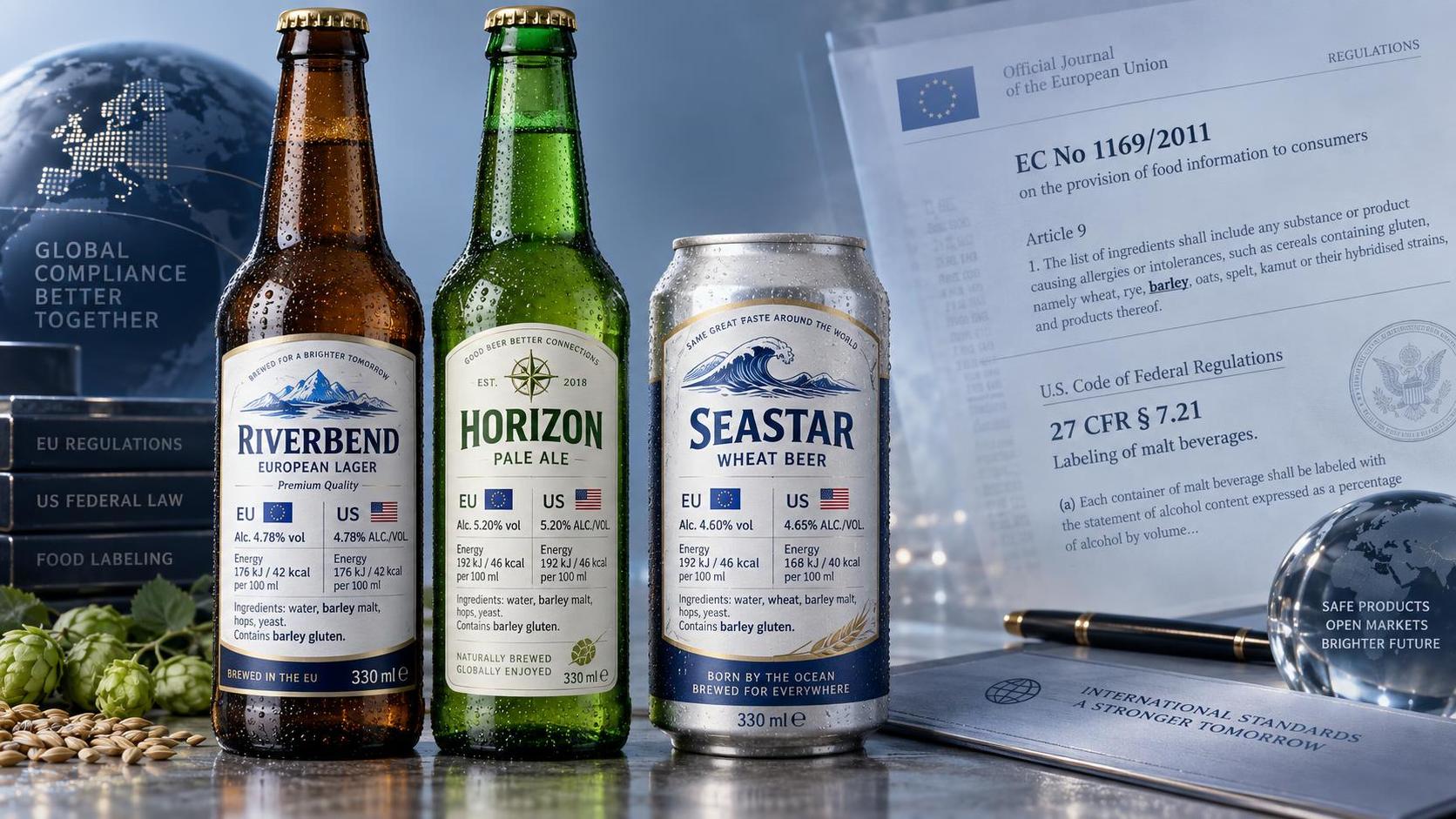
Labeling Isn’t Just Translation—It’s Regulatory Architecture
When a Jinpai Beer German wheat arrives at a Berlin gastropub or a Brooklyn taproom, the label isn’t just a branding surface—it’s a legal interface. EU Regulation (EC) No 1169 and U.S. TTB standards don’t treat beer labels as marketing collateral. They’re enforceable technical documents. That means “alcohol by volume” isn’t optional phrasing—it’s a defined metric with placement rules, font size thresholds, and decimal precision requirements. For example, under TTB 27 CFR § 7.21, ABV must appear on the principal display panel in characters no smaller than 2 mm high for containers under 187 mL—and it must be expressed *only* as “% vol” (not “ABV”, “alc.”, or “alcohol content”). In contrast, EC 1169 requires ABV to be listed *with* the energy value (kJ/kcal), and both must appear in the same field of vision as the product name. Miss either, and the shipment stalls at customs—or worse, triggers a recall post-distribution.
ABV Disclosure: Why “Approximately 4.8%” Is a Red Flag
Many Chinese breweries still default to rounding ABV to one decimal (e.g., “4.8%”) across all SKUs—even when lab testing shows batch variation between 4.72% and 4.89%. That’s acceptable domestically. It’s not acceptable in the EU or US on-premise channel. Why? Because both jurisdictions require declared ABV to reflect *actual measured values*, not averages or targets. Under TTB, if your declared ABV is 4.8%, the actual must fall within ±0.2%—but only if you’re using the “tolerance allowance” clause. And that clause applies *only* if you’ve submitted full lab reports per batch to TTB *before* import. Most Beer wholesale China partners skip this step, assuming “4.8%” is safe. It isn’t. A single batch at 5.03% with a declared 4.8% triggers mandatory relabeling—or rejection. We’ve seen three shipments held in Rotterdam last year for exactly this: unverified ABV claims without supporting analytical data.
Packaging: Sustainability Claims That Survive Audit Scrutiny
“Eco-friendly packaging” sounds straightforward until a UK wholesaler asks for ISO 14021-compliant proof of recycled PET content—or a California distributor requests Prop 65 documentation for ink migration into beer. Jinpai’s functional specialty beers, for instance, use UV-curable inks for shelf-life-sensitive fruit-flavored variants. Those inks must pass TTB’s migration testing (27 CFR § 25.152) *and* EU’s Framework Regulation (EC) No 1935/2004 for food contact materials. But here’s what often gets overlooked: the *adhesive* holding the label to the can. Many standard acrylic adhesives contain trace formaldehyde donors—permissible in China, but flagged under EU REACH Annex XVII for direct food contact applications. We now pre-test every adhesive-liner-substrate combo against EN 13628-1 before approving a new SKU for EU export. Not because it’s flashy—but because a bar owner in Copenhagen doesn’t care about your sustainability story if their health inspector cites non-compliant glue.
Allergen & Ingredient Transparency: Beyond “Contains Gluten”
EC 1169 mandates allergen declaration *by ingredient source*, not just category. So “gluten” isn’t enough—you must specify “barley gluten” or “wheat gluten”, especially critical for German wheat and sugar-free low-calorie beers where hydrolyzed wheat protein may be used as foam stabilizer. In the US, TTB doesn’t yet require allergen labeling—but FDA’s Food Allergen Labeling and Consumer Protection Act (FALCPA) *does* apply once beer enters mixed-use venues (e.g., a restaurant that also serves food). That means if your craft lager shares a storage area with peanut butter sandwiches, FDA expects clear, unambiguous allergen statements—not buried footnotes. We’ve had two US distributors decline a trial order because their compliance officer couldn’t verify whether our “natural flavorings” included sulfites derived from yeast autolysate—a known asthma trigger under FALCPA.
Functional Beers Add Another Layer: When “Adaptogens” Become Drug Claims
Jinpai’s functional specialty beers—like those with added GABA or L-theanine—pose unique challenges. In the EU, any physiological effect claim (“promotes relaxation”, “supports focus”) triggers classification as a “health claim” under Regulation (EC) No 1924/2006. That means pre-authorization from EFSA, which takes 12–18 months and requires human clinical trials—not just in vitro data. In the US, TTB prohibits *any* structure/function claim unless it’s pre-approved by FDA as a dietary supplement ingredient. So “contains ashwagandha for stress relief” is illegal on a beer label—even if the ashwagandha is below 0.1% by weight. Our workaround? Remove all functional descriptors from primary labels. Instead, we supply separate, TTB-compliant technical datasheets to on-premise buyers—detailing ingredient origin, dosage range, and third-party test results—for internal staff training only. It’s not sexy. But it keeps the beer on tap.
What Technical Evaluators Should Verify—Before Signing Anything
If you’re assessing a Beer wholesale China partner for EU/US on-premise entry, don’t stop at “Do they have ISO 22000?” Ask instead:
- Can they produce batch-specific ABV lab reports dated within 30 days of shipment—and are those reports signed by an ILAC-MRA accredited lab?
- Do their packaging vendors hold current BRCGS Packaging Material certification—or at minimum, EN 13628-1 test reports covering *all* layers (ink, adhesive, substrate)?
- Is their allergen statement written to EC 1169 Annex II level—naming species, not just families?
- For functional ingredients: Are claims limited to technical specs (e.g., “0.8 mg/100mL GABA”), with zero physiological language on any consumer-facing material?
Compliance isn’t a one-time audit. It’s how rigor lives in the R&D notebook, the QC log, and the label spec sheet—not just the certificate folder.
Thank you very much for writing to us. Please leave your message and contact information, we will reply to you within 24 hours.