



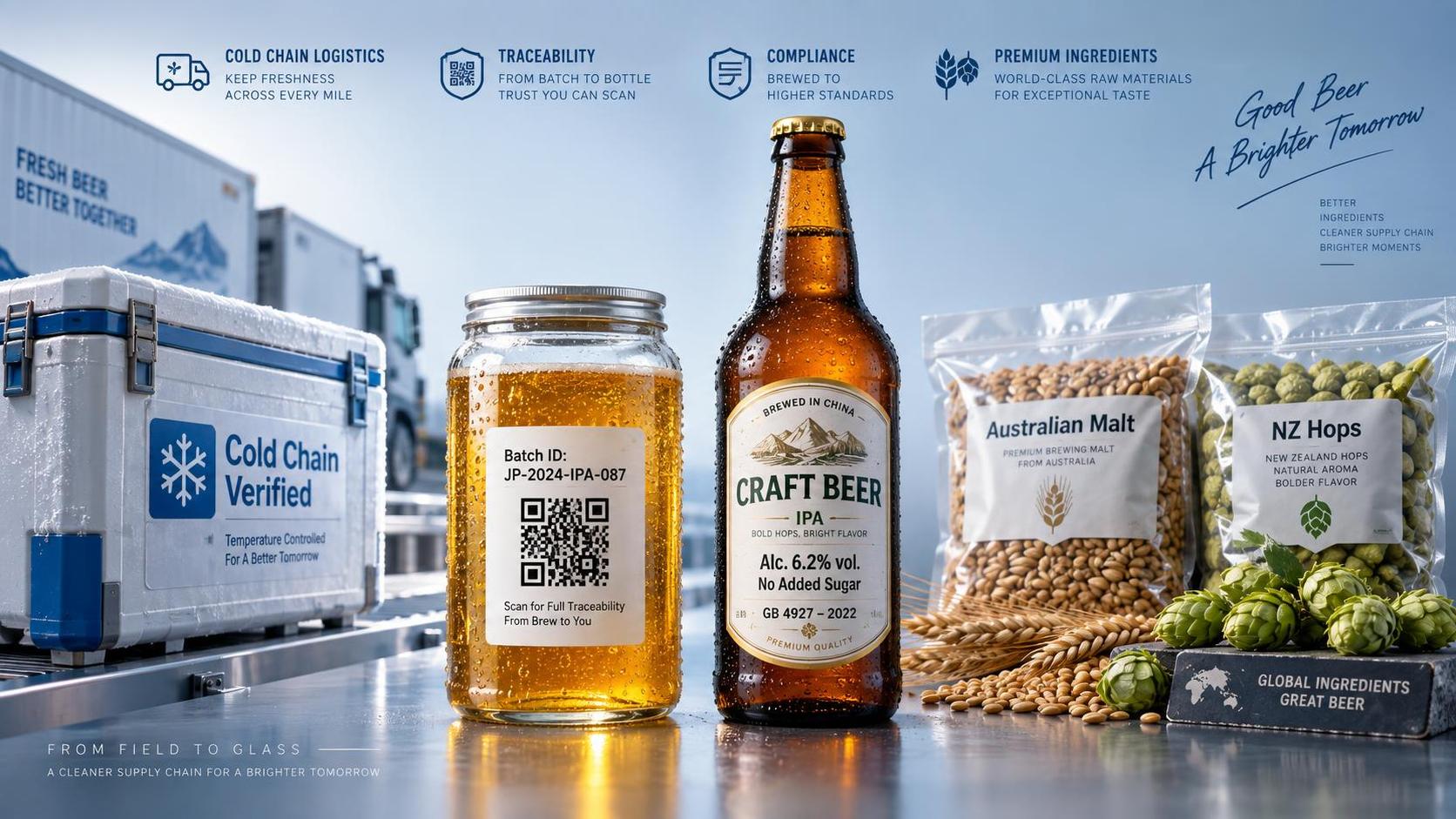
Navigating the beer wholesale China market demands more than just logistics—it requires deep visibility across every link, from brewhouse innovation to bar-floor delivery. For global distributors and F&B decision-makers, supply chain fragility—ranging from raw material volatility and regulatory shifts to last-mile bottlenecks and quality consistency—can erode margins and brand trust. This isn’t theoretical risk. It manifests in delayed seasonal launches, inconsistent flavor profiles across batches, unexpected customs holds on imported ingredients, or sudden stockouts at high-traffic venues during peak demand periods. When a craft beer’s reputation hinges on freshness, authenticity, and sensory reliability, each handoff in the wholesale chain introduces a potential point of failure.
Where Risk Accumulates: Four Critical Touchpoints
Supply chain risk in China’s beer wholesale market doesn’t distribute evenly. It concentrates where information flow breaks down, regulatory thresholds tighten, physical handling intensifies, or demand signals lag. These are not abstract vulnerabilities—they’re operational realities that directly impact procurement planning, shelf-life management, and partner confidence.
1. Ingredient Sourcing & Seasonal Volatility
China’s domestic barley production remains limited and climate-sensitive. Most craft brewers—including those supplying the wholesale channel—rely on imported malt (primarily from Australia, Canada, and Europe) and hops (Germany, USA, New Zealand). Price fluctuations of 15–25% year-on-year are common due to droughts, export restrictions, or port congestion. More critically, lead times for specialty malts and cryo hop pellets can stretch beyond 12 weeks. If your procurement cycle assumes stable 8-week replenishment, you’ll face unplanned reformulations—or worse, gaps in core SKUs. The risk isn’t just cost; it’s formulation drift. A lager brewed with a substitute malt may pass lab specs but fail sensory validation at the bar counter.
2. Production Handoffs & Batch Traceability Gaps
Many wholesale suppliers operate multi-tier production models: contract brewing, co-packing, or blended sourcing across regional facilities. Without unified batch numbering, real-time fermentation logs, and cross-facility QC protocols, traceability collapses. A single off-spec batch of sugar-free low-calorie beer—perhaps due to yeast stress during summer fermentation—can be distributed across three provinces before detection. By then, it’s no longer a quality incident; it’s a brand recall with cascading liability. Traceability here isn’t about compliance paperwork—it’s about isolating root cause within 48 hours, not 10 days.
3. Regulatory Translation at the Border & Shelf
China’s GB 4927–2022 beer standard mandates specific labeling formats, alcohol-by-volume rounding rules, and allergen declarations—even for imported craft products sold through bonded warehouses or cross-border e-commerce. But regulation extends beyond labeling. Functional claims (e.g., “digestive support” for a probiotic-infused wheat beer) trigger NMPA pre-approval. “Sugar-free” requires ≤0.5g/100mL residual sugar—and third-party lab verification upon customs inspection. Misalignment between marketing copy, technical dossier, and actual lab reports is the top reason for shipment rejection at Shanghai or Shenzhen ports. It’s not about noncompliance intent; it’s about inconsistent internal handoffs between R&D, regulatory affairs, and commercial teams.
4. Last-Mile Consistency in Temperature-Sensitive Distribution
Craft beer—especially hazy IPAs, fruit sours, and unfiltered wheats—is thermally fragile. Yet over 60% of China’s cold-chain logistics for beer still relies on passive cooling (gel packs + insulated boxes), not active refrigerated transport. Temperature excursions above 15°C for >48 hours accelerate staling compounds (trans-2-nonenal), dulling hop aroma and introducing cardboard notes. Worse, temperature logs are rarely shared with wholesale partners. You receive pallets stamped “cold chain maintained”—but without time-stamped data, you cannot correlate sensory complaints from bars in Chengdu or Hangzhou with actual transit conditions. That disconnect turns quality disputes into relationship friction.
What Resilience Actually Requires
Resilience isn’t redundancy. It’s precision in visibility, alignment in execution, and discipline in verification. That means moving beyond supplier scorecards and annual audits toward embedded operational controls.
First, ingredient risk mitigation starts upstream—not with dual-sourcing alone, but with joint forecasting. Jinpai Beer shares quarterly demand projections with key malt and hop suppliers, enabling them to reserve forward capacity and buffer inventory. In return, Jinpai receives early notice of crop shortfalls or shipping delays—allowing proactive SKU rationalization or limited-edition substitutions that maintain brand integrity.
Second, batch-level traceability requires integration—not just internal systems, but shared digital access. When a distributor places an order, they receive not only a delivery note but also a secure link to batch-specific fermentation logs, centrifugation parameters, and QC test results (pH, IBU, turbidity, microbiological status). This isn’t transparency as marketing; it’s diagnostic capability. If a bar reports haze instability, the distributor can instantly verify whether filtration pressure deviated during that batch—or whether the issue emerged post-delivery.
Third, regulatory readiness must be built into product development—not layered on at launch. At Jinpai, every new functional beer undergoes parallel technical dossier drafting alongside recipe finalization. Label mockups are validated against GB 4927–2022 *before* pilot brewing. This eliminates the “regulatory surprise” that forces reformulation after 2000 cases are already packaged.
Fourth, cold-chain accountability depends on verifiable data—not declarations. Jinpai equips all outbound shipments with IoT temperature loggers synced to a shared dashboard. Distributors see real-time ambient temp, door-open events, and cumulative time above thresholds. If a consignment shows 72 hours at 18°C, the resolution isn’t debate—it’s automatic replacement, with root-cause analysis of the logistics partner’s reefer unit calibration.
Practical Steps for Wholesale Partners
You don’t need to rebuild your entire supply chain overnight. Start with three actionable checks:
- Audit your ingredient lead-time assumptions. Map actual order-to-receipt timelines for your top five raw materials over the past 12 months—not catalog lead times. Identify where variance exceeds ±15%. That’s where joint forecasting or safety stock recalibration delivers immediate ROI.
- Test traceability depth. Pick one recent batch. Can you trace its malt lot number back to harvest date and farm? Can you access the original yeast viability report from propagation? If either answer is “no,” that’s your highest-leverage data gap.
- Validate cold-chain claims. Request temperature logs for your last three deliveries. Compare timestamps against delivery notes. If logs are unavailable or incomplete, treat that as a contractual gap—not a logistical oversight.
These aren’t theoretical exercises. They’re diagnostic filters. Each reveals whether your current wholesale relationships operate on assumption—or on evidence. In China’s beer wholesale market, the margin between scalability and fragility lies in how precisely you measure, share, and act on that evidence—not in how broadly you distribute.
Thank you very much for writing to us. Please leave your message and contact information, we will reply to you within 24 hours.