



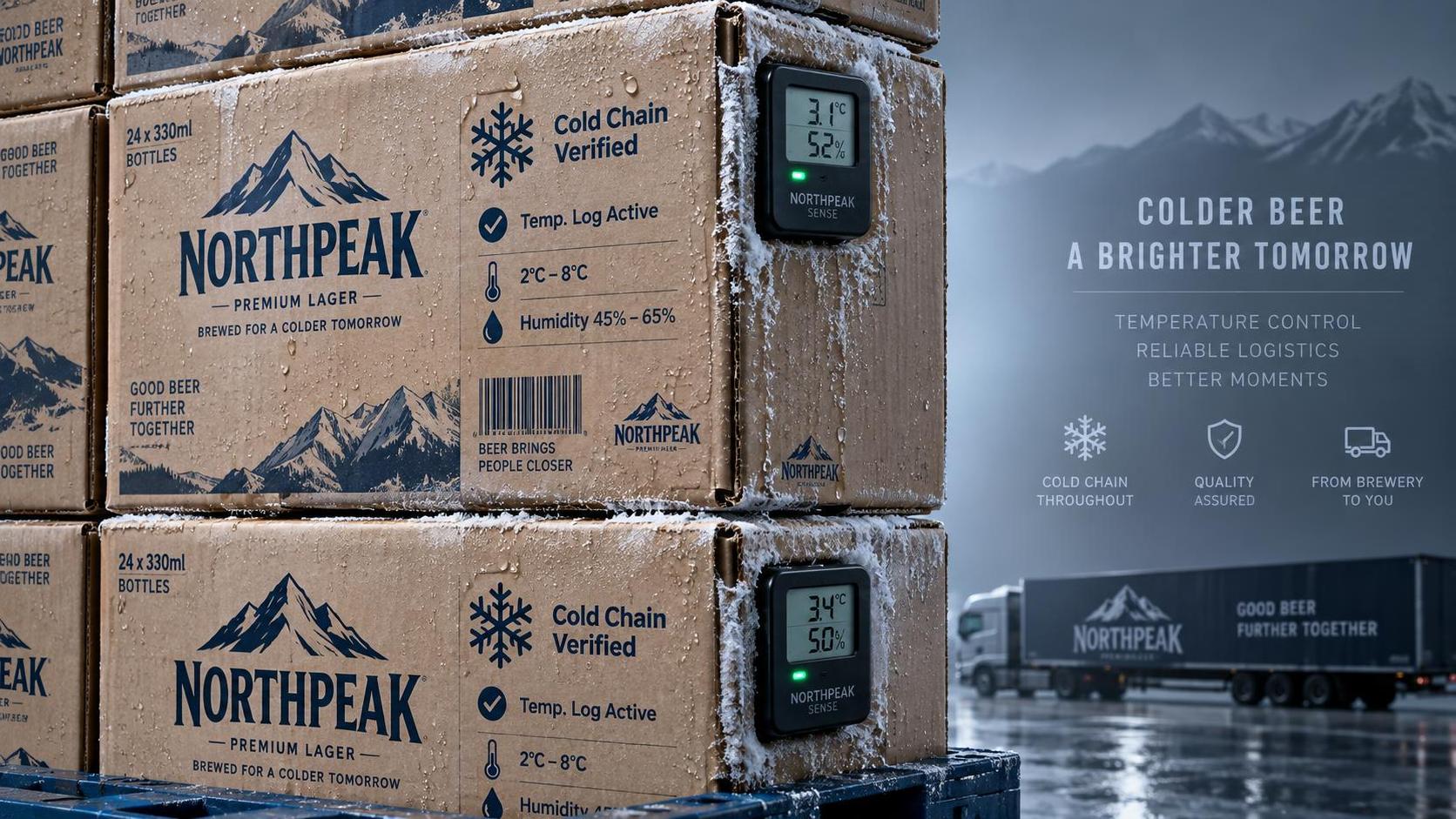
When evaluating beer supply for bars and restaurants, the line item on the invoice rarely reflects operational reality. A lower unit price may appear advantageous—until it triggers cascading cost impacts tied directly to shelf life instability, logistical fragility, and temperature control failure. These are not secondary concerns; they are primary drivers of total cost of ownership (TCO), often compounding margin erosion far beyond procurement savings.
Shelf Life Isn’t Just a Date Stamp—It’s a Function of Handling History
Beer is a biologically active product. Its flavor, clarity, carbonation, and foam stability degrade predictably under suboptimal conditions—and that degradation accelerates nonlinearly once thresholds are crossed. A lager shipped at ambient temperatures for 72 hours before refrigerated storage may lose 40% of its intended shelf life—not because of age, but because of thermal cycling. Each warm exposure triggers oxidative reactions, hop compound breakdown, and yeast autolysis, even in pasteurized or filtered products. This isn’t theoretical: studies show that repeated temperature fluctuations above 15°C during transit or storage can reduce perceived freshness by up to six weeks relative to consistent cold-chain handling.
Low-margin suppliers often lack infrastructure to enforce batch-level traceability or environmental monitoring. Without real-time temperature logging per pallet—or even per case—there’s no way to verify whether a shipment spent eight hours on a non-refrigerated dock in July. That uncertainty forces operators to apply conservative shelf-life buffers, increasing waste rates and reducing usable inventory turnover. For high-volume venues, this translates into measurable loss: a 3% increase in spoilage across a $250,000 annual beer spend adds over $7,500 in avoidable cost—before labor, disposal, or lost sales from off-flavor complaints.
Logistics Isn’t About Speed—It’s About Thermal Consistency
“Fast delivery” means little if the cold chain breaks en route. Refrigerated transport requires more than just a chilled trailer—it demands pre-cooled cargo, insulated packaging, validated loading patterns, and verified door-seal integrity. Low-margin supply chains frequently substitute dry-van trucks with portable coolers or rely on “last-mile chillers” that operate only intermittently. These solutions fail under load, ambient heat, or extended dwell times. A single unmonitored 90-minute delay at a distribution hub can raise internal case temperature above 12°C—enough to initiate staling pathways that accelerate over subsequent days.
Worse, fragmented logistics often mean multiple handoffs: manufacturer → regional warehouse → third-party freight forwarder → local distributor → venue. Each transfer introduces risk points—uncontrolled ambient staging areas, shared non-dedicated refrigeration units, or mislabeled temperature zones. Unlike durable goods, beer cannot be reconditioned. Once compromised, its quality trajectory is irreversible—even if visual or sensory defects aren’t immediately apparent.
Temperature Control Is Not Optional—It’s a Compliance-Linked Operational Requirement
In most jurisdictions, beer stored above 18°C for more than 48 consecutive hours falls outside recommended storage guidelines—some health codes explicitly cite temperature deviation as grounds for rejection during inspection. But compliance is only part of the equation. More consequential is the impact on service consistency: a wheat beer served at 10°C delivers expected aroma and mouthfeel; the same beer served at 16°C loses head retention, flattens citrus notes, and amplifies solvent-like fusel character. Customers don’t complain about “temperature”—they complain about “flat,” “skunky,” or “off-tasting” beer. And those complaints drive repeat order reduction faster than any pricing adjustment can offset.
On-premise storage conditions compound the problem. Walk-in coolers vary widely in airflow uniformity, humidity control, and door-cycle frequency. Beer placed near evaporator coils or against uninsulated walls experiences localized freezing or condensation-induced label damage—both indicators of micro-environmental stress. Without calibrated monitoring at multiple interior points—not just near the thermostat—operators unknowingly serve batches exposed to repeated thermal micro-variations. These variations don’t trigger alarms, but they do degrade sensory performance batch after batch.
Why Standardized Procurement Models Fail in Practice
Many procurement frameworks treat beer as a commodity—applying blanket cost-per-unit benchmarks across SKUs, regions, or channels. But lager, wheat, low-calorie, fruit-infused, and functional specialty beers differ materially in stability profiles. A sugar-free, cold-filtered lager degrades faster under thermal stress than a pasteurized, malt-forward amber due to residual enzyme activity and lower antioxidant content. Fruit-infused variants face additional challenges: volatile esters dissipate rapidly above 10°C, while pectin haze formation increases in fluctuating humidity. Treating these as interchangeable line items ignores their distinct vulnerability thresholds—and invites misaligned inventory planning.
Further, wholesale contracts rarely include enforceable temperature compliance clauses. Penalties for thermal deviation are seldom defined, and verification relies on paper-based logs rather than embedded data loggers. Without contractual alignment on environmental accountability, responsibility defaults to the venue—where staff lack tools or training to audit upstream conditions. The result? Cost leakage shifts downstream, masked as “operational inefficiency” rather than supply chain failure.
What Real TCO Control Requires
True cost control begins before the first case is ordered. It requires visibility into three layers: production batch parameters (e.g., dissolved oxygen levels, filtration method, post-packaging stabilization time), real-time environmental telemetry across all transport legs, and venue-level storage validation—not just thermometer readings, but mapped thermal gradients within coolers. It also demands SKU-specific shelf-life modeling, not calendar-based expiration dates. A fruit-flavored variant may require 60-day cold-chain integrity; a traditional lager may hold for 90 days—if and only if mean storage temperature remains below 6°C with less than two excursions above 8°C.
This level of fidelity doesn’t emerge from price-led sourcing. It emerges from integrated supply design—where formulation, packaging, logistics engineering, and venue readiness are treated as interdependent variables, not isolated procurement decisions. When those variables align, beer transitions from a perishable cost center to a predictable brand asset—delivering consistent guest experience, reduced waste, and verifiable margin protection.
Thank you very much for writing to us. Please leave your message and contact information, we will reply to you within 24 hours.