



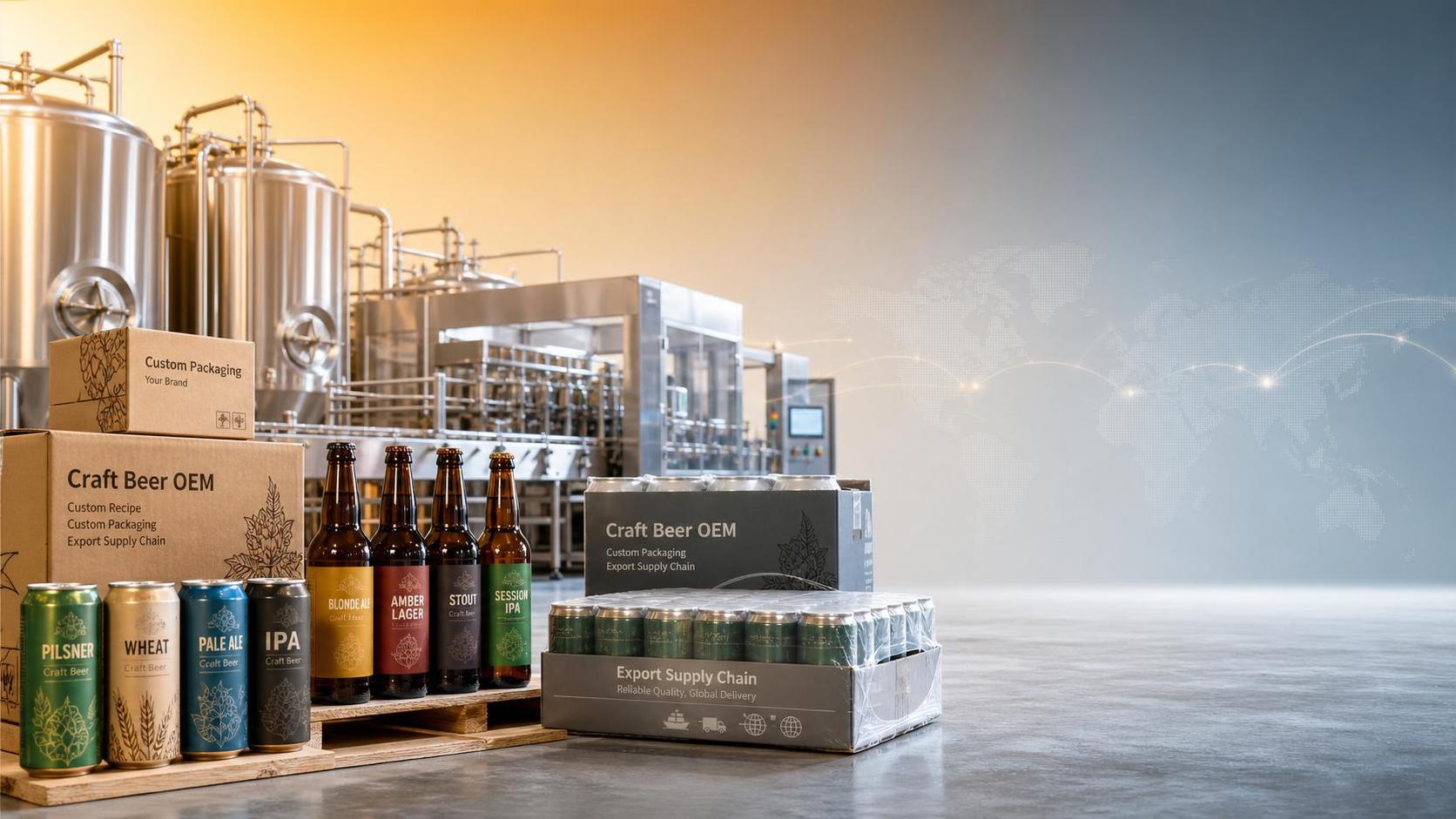
A Chinese beer factory OEM service usually reaches well beyond brewing on demand. In practice, it connects product development, packaging decisions, quality assurance, export readiness, and supply planning into one commercial process.
That matters because private-label beer is no longer limited to simple low-cost sourcing. Many beer projects now target specific retail shelves, bar menus, health-conscious segments, and regional taste preferences.
For that reason, understanding what a Chinese beer factory OEM service includes helps clarify whether a supplier can support a real market launch, not just fill cans or bottles.
What the service usually covers
At the core, a Chinese beer factory OEM service is a contract manufacturing arrangement. A factory produces beer under another brand, often with customized recipes, branding, and packaging formats.
The scope can vary, but most serious OEM programs include formulation, sample making, raw material selection, production scheduling, packaging execution, and shipment coordination.
Some factories also operate as ODM partners. That means they do not only manufacture a client’s existing idea, but also help shape the product concept itself.
In beer, this difference is important. A label design can be copied quickly, but a stable beer profile, shelf-ready package, and compliant export file set require more technical support.
Why the topic matters in today’s beer business
Global beer demand is fragmenting. Instead of one mainstream style, the market now rewards variety, niche positioning, and faster response to changing consumer preferences.
That creates space for private-label projects in supermarkets, restaurant chains, convenience channels, bars, and online retail. Each channel expects different pricing, pack sizes, and taste profiles.
A capable Chinese beer factory OEM service can help bridge that complexity. China’s brewing supply chain offers scale, packaging flexibility, and a broader range of formulation options than many buyers expect.
This is especially relevant for companies entering craft-adjacent segments. Lagers remain important, but German wheat, fruit beer, sugar-free low-calorie beer, and functional specialty beer are gaining attention.
Recipe development is often the first real test
Many projects begin with a target taste rather than a finished formula. In that case, the factory’s R&D strength becomes one of the most valuable parts of the service.
A strong Chinese beer factory OEM service should be able to discuss style direction, alcohol level, bitterness, mouthfeel, sweetness balance, and aroma expectations in practical terms.
It should also explain how those choices affect production stability, ingredient cost, and shelf life. A good-tasting pilot sample is useful, but repeatability matters more.
Factories with broader craft beer experience can usually support a wider product map. That may include classic lager, German wheat, fruit-flavored lines, low-calorie variants, and functional concepts.
In practical terms, this shortens development time. It also reduces the risk of launching a product that tastes attractive in testing but becomes unstable in volume production.
Questions worth clarifying early
- Can the factory develop samples from a flavor brief, not only from an existing formula?
- How many sample rounds are typical before commercial approval?
- Which ingredients can be adjusted without affecting production stability?
- What shelf life can be supported for each beer style and packaging format?
Packaging is more than design work
Another major part of a Chinese beer factory OEM service is packaging customization. This usually includes container selection, label application, carton layout, tray options, and pallet configuration.
The packaging format affects logistics, retail presentation, and product perception. A can built for e-commerce may differ from one designed for bars or high-volume supermarket placement.
Standard options often include bottles and cans in multiple sizes. Beyond that, the factory may help adapt artwork to printing limits, color standards, and local labeling rules.
This is where many buyers underestimate the service. Packaging mistakes usually do not come from design taste alone, but from technical mismatches between concept, line capability, and destination market rules.
Quality control should be visible, not assumed
A reliable Chinese beer factory OEM service needs a quality system that covers both brewing and packaged goods. Beer quality problems often appear after production, not during the filling run.
That is why process control matters at several points. Raw materials, fermentation, filtration, carbonation, filling accuracy, seam integrity, and microbiological testing all affect final performance.
For export business, consistency is as important as flavor. The same product must remain stable across repeated orders and long shipping cycles.
A serious factory should be ready to explain test items, recordkeeping, and how nonconforming batches are handled. Vague assurances are not enough in cross-border beverage trade.
What quality discussions should include
- Batch consistency standards
- Microbiological and chemical testing routines
- Filling line inspection and packaging defect control
- Sample retention and traceability records
- Shelf-life validation under transport conditions
Compliance and export support often shape the final decision
One of the less visible parts of a Chinese beer factory OEM service is compliance support. Yet this is often where projects slow down or fail.
Beer exports can involve ingredient disclosure, alcohol labeling, barcode setup, date coding rules, packaging language requirements, and destination-specific document preparation.
Factories with regular global business are usually better prepared for these details. They understand that a private-label beer is not finished when the beer is brewed.
It must also clear customs, match local retail rules, and arrive with the documentation needed by the importer, distributor, or chain buyer.
Scalability matters from the beginning
Many buyers first approach a Chinese beer factory OEM service with a limited run. That is sensible, but pilot-friendly service alone is not enough.
The more useful question is whether the factory can scale the same product without changing its character, packaging execution, or delivery rhythm.
This becomes important when a product moves from market testing to broad retail placement. Minimum order quantity, lead time, ingredient sourcing, and seasonal production slots all start to matter.
A factory engaged in R&D, production, and distribution is often better positioned here. It usually has more experience aligning development, manufacturing, and route-to-market requirements.
Where these services are most useful
The value of a Chinese beer factory OEM service changes by channel. Different business models need different beer styles, pack formats, and ordering patterns.
For restaurants and bars, differentiated taste and steady replenishment may be the priority. For supermarkets, packaging clarity and price architecture often matter more.
Online retail may favor compact case formats and visually strong cans. Wholesale programs often focus on scalable SKUs with predictable repeat orders.
Factories offering classic lager, wheat beer, fruit beer, sugar-free low-calorie beer, and functional specialty lines can support a wider range of these channel strategies.
How to evaluate a potential OEM partner
Not every Chinese beer factory OEM service is built the same way. Some are packaging-driven. Others are stronger in formulation, export coordination, or long-term private-label support.
A practical evaluation should look at product capability, not only quotation speed. The cheapest sample stage can become the most expensive launch if core details are weak.
- Check whether the beer portfolio fits your target market, not just current trends.
- Review how the factory handles recipes, pilot samples, and version control.
- Confirm packaging formats, MOQs, and artwork adaptation support.
- Ask for quality documents, test routines, and traceability methods.
- Clarify export documentation and destination market experience.
- Compare lead times for both first orders and repeat production.
A useful next step
A Chinese beer factory OEM service is easiest to assess when requirements are organized clearly. Start with the beer style, target price, packaging format, channel plan, and intended market.
From there, compare factories on development depth, quality visibility, and export readiness, not only on headline manufacturing cost.
When a supplier can connect R&D, production, packaging, and global supply support in one process, the project usually moves faster and with fewer corrections later.
That is the real value behind a Chinese beer factory OEM service: turning a beer idea into a market-ready product with fewer blind spots and stronger commercial control.
Thank you very much for writing to us. Please leave your message and contact information, we will reply to you within 24 hours.