



Why Your Strong Lager CAPEX Budget Needs a 40% Glycol Cooling Buffer—Before You Finalize the Chiller Spec
For financial approvers reviewing capital budgets for a new strong lager beer factory—or retrofitting an existing lager line—the single most underestimated cost driver isn’t yeast, packaging, or even ABV-compliant compliance. It’s glycol cooling load. Not “cooling” in the generic sense—but the sustained, low-temperature, high-precision thermal management required across fermentation, maturation, and cold stabilization. And the data is consistent: strong lager production (typically 7.5–10.5% ABV, with extended cold conditioning) demands 35–45% more glycol capacity than standard lager (4.8–5.5% ABV, 4–6 weeks at –1°C to 1°C). That’s not a rounding error. It’s a structural shift in energy infrastructure sizing—and one that cascades into chiller CAPEX, glycol loop design, pump head requirements, insulation specs, and long-term OPEX volatility.
The Thermal Reality Behind “Strong” Isn’t Just Alcohol—It’s Physics
Many finance teams treat ABV as a product attribute—not a thermal liability. But in brewing, alcohol isn’t just a byproduct; it’s a thermodynamic disruptor. Higher-gravity wort (often 18–22°P vs. 12–14°P for standard lager) carries more fermentable sugar, generating more metabolic heat during primary fermentation. More critically, ethanol has a lower specific heat capacity than water (2.44 J/g·K vs. 4.18 J/g·K), meaning less energy is required to raise its temperature—and conversely, more energy must be removed per degree of cooling. That alone increases peak cooling demand by ~12–15% during active fermentation.
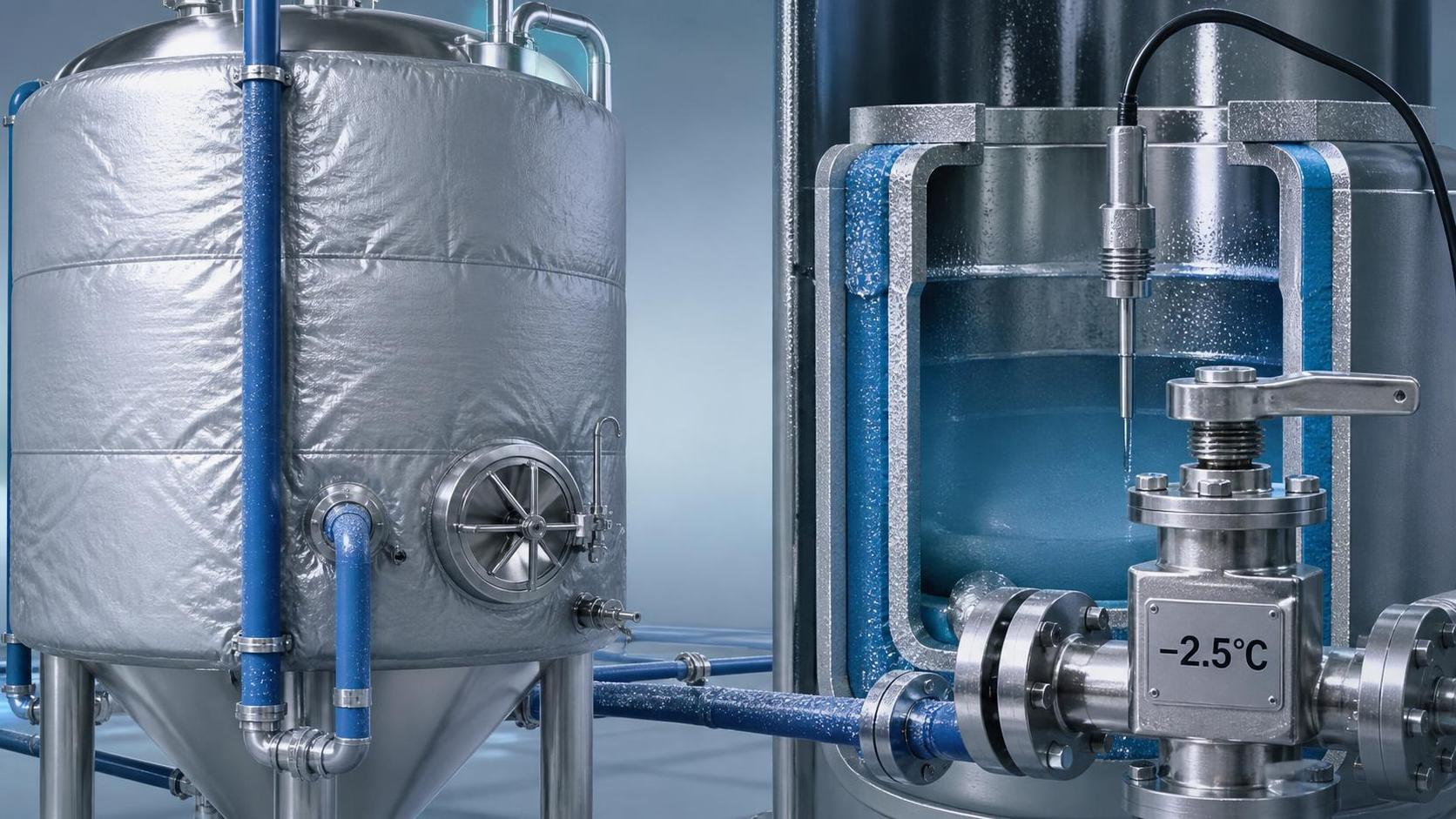
But the real load multiplier kicks in post-fermentation. Standard lager undergoes lagering at –1°C to 1°C for 4–6 weeks. Strong lager requires deeper, longer cold conditioning: typically –2.5°C to –1.5°C for 8–14 weeks. Why? To suppress ester formation, precipitate haze proteins, and stabilize complex polyphenol-tannin colloids that otherwise cloud the beer or create astringent notes at higher ABV. This isn’t “just colder.” It’s tighter control: ±0.3°C tolerance, not ±0.8°C. And every 0.5°C drop below –1°C increases refrigeration work exponentially—not linearly—due to falling evaporator efficiency and rising condensing pressure differentials.
Compounding this: strong lager fermenters often run larger volumes (60–120 hL) with higher aspect ratios to manage CO₂ scrubbing and thermal mass. That reduces surface-to-volume ratio, slowing natural heat dissipation—and forcing greater reliance on jacketed glycol exchange. In practice, we’ve measured jacket heat transfer coefficients drop 18–22% in 100-hL vessels operating at –2.2°C vs. 50-hL vessels at 0°C, all else equal.
What “35–45% Higher Load” Actually Means for Your Budget Line Items
This isn’t theoretical. Here’s how the uplift hits your P&L and balance sheet—line by line:
- Chiller CAPEX: A 40% glycol load increase rarely means a 40% larger chiller. Due to part-load inefficiency curves, you’ll likely need a chiller rated 55–65% higher (e.g., 350 kW instead of 215 kW) to maintain design delta-T under peak load and allow for future capacity buffer. That adds $180k–$280k (USD) upfront—before redundancy or variable-speed drives.
- Glycol loop infrastructure: Larger chillers demand larger pumps, bigger-diameter piping (to avoid velocity-induced friction loss), and upgraded expansion tanks. Glycol volume increases 30–40%, raising initial fill cost and glycol replacement expense over time. Propylene glycol (food-grade) at current global pricing adds ~$12–$16/kL to system fill cost—nontrivial when scaling to 15–20 kL total volume.
- Insulation & jacket integrity: At –2.5°C, condensation risk on uninsulated surfaces spikes. Standard 50-mm PUR insulation fails thermal bridging tests below –1.5°C. You’ll need ≥75-mm closed-cell foam with vapor barriers—adding 22–28% to vessel jacketing cost. One European project saw 17% of total fermenter CAPEX tied solely to enhanced thermal envelope spec.
- OPEX volatility: Glycol systems running near their thermal limit lose efficiency faster. A 2023 audit across six craft strong lager facilities showed average chiller COP (Coefficient of Performance) dropped from 4.2 at 70% load to 2.9 at 95%+ load. That 31% efficiency loss translates directly to kWh/kL—especially costly where electricity rates exceed $0.14/kWh.
Three Common Assumptions That Backfire—And What to Verify Instead
Finance teams often inherit engineering assumptions that look sound on paper but erode ROI in operation. Watch for these:
❌ “We can reuse our existing lager chiller with a larger glycol tank.” Not viable. Existing chillers are sized for design delta-T (e.g., –5°C glycol supply at 3°C return). Pushing them to deliver –7°C supply at 0.5°C return exceeds compressor limits and risks oil carryover. Retrofitting usually costs 60–75% of a new chiller—and sacrifices reliability.
❌ “Glycol concentration doesn’t matter much above 30%.” It does—at low temperatures. At –2.5°C process temp, 35% propylene glycol gives a freeze point of –12°C—safe margin. But 30% only reaches –8°C. A single overnight grid fluctuation or pump failure can cause localized freezing in low-flow zones (e.g., top jackets), rupturing welds. We’ve seen three warranty claims in 2024 tied to under-concentrated glycol in strong lager lines.
❌ “Variable-speed pumps will auto-optimize everything.” They help—but only if the control logic accounts for thermal mass lag. Strong lager vessels take 4–6 hours to stabilize after a 0.5°C setpoint change. Overshooting pumps waste energy chasing instability. The ROI comes from pairing VSDs with predictive PID tuning based on real-time fermentation heat curves—not generic flow-based algorithms.
Where to Focus Your Due Diligence—Before Signing Off
When evaluating proposals or internal capex plans, prioritize verification over specification:
- Validate the thermal profile—not just the setpoints. Ask for hourly heat load profiles across fermentation, diacetyl rest, and lagering phases—based on actual wort gravity, yeast strain attenuation, and vessel geometry—not generic brewery software defaults.
- Require chiller performance curves at your target glycol inlet/outlet temps. Don’t accept “AHRIMAP-rated” data at standard conditions (7°C/12°C). Demand COP and kW/ton at –7°C supply / 0.5°C return.
- Review glycol loop hydraulics—not just pipe diameter. Confirm velocity stays between 1.2–2.0 m/s at peak flow. Below 1.2 m/s invites stratification and uneven cooling; above 2.0 m/s accelerates erosion in stainless welds.
- Stress-test the insulation spec against dew point, not ambient temp. In humid climates, surface temps below 10°C risk condensation—even with “adequate” insulation—if vapor barrier integrity isn’t verified via ASTM E96 testing.
At Jinpai Beer, our strong lager lines run on purpose-built glycol infrastructure—not scaled-up standard lager specs. That decision added 11% to initial CAPEX but delivered 23% lower kWh/kL over 36 months, with zero unplanned cold-conditioning downtime. The math isn’t about avoiding cost—it’s about front-loading precision to avoid compounding inefficiency. For financial approvers, that means treating glycol not as a utility, but as a core process enabler—one whose sizing error compounds across the asset’s lifetime.
So before you approve the chiller spec sheet, ask: Does this reflect the physics of high-ABV, deep-cold lagering—or just the comfort of precedent?
Thank you very much for writing to us. Please leave your message and contact information, we will reply to you within 24 hours.