



Can a Standard Beer Factory Produce Strong Lager? Limitations of Existing Infrastructure on ABV > 7.5% Output
Time : Aug 25, 2026
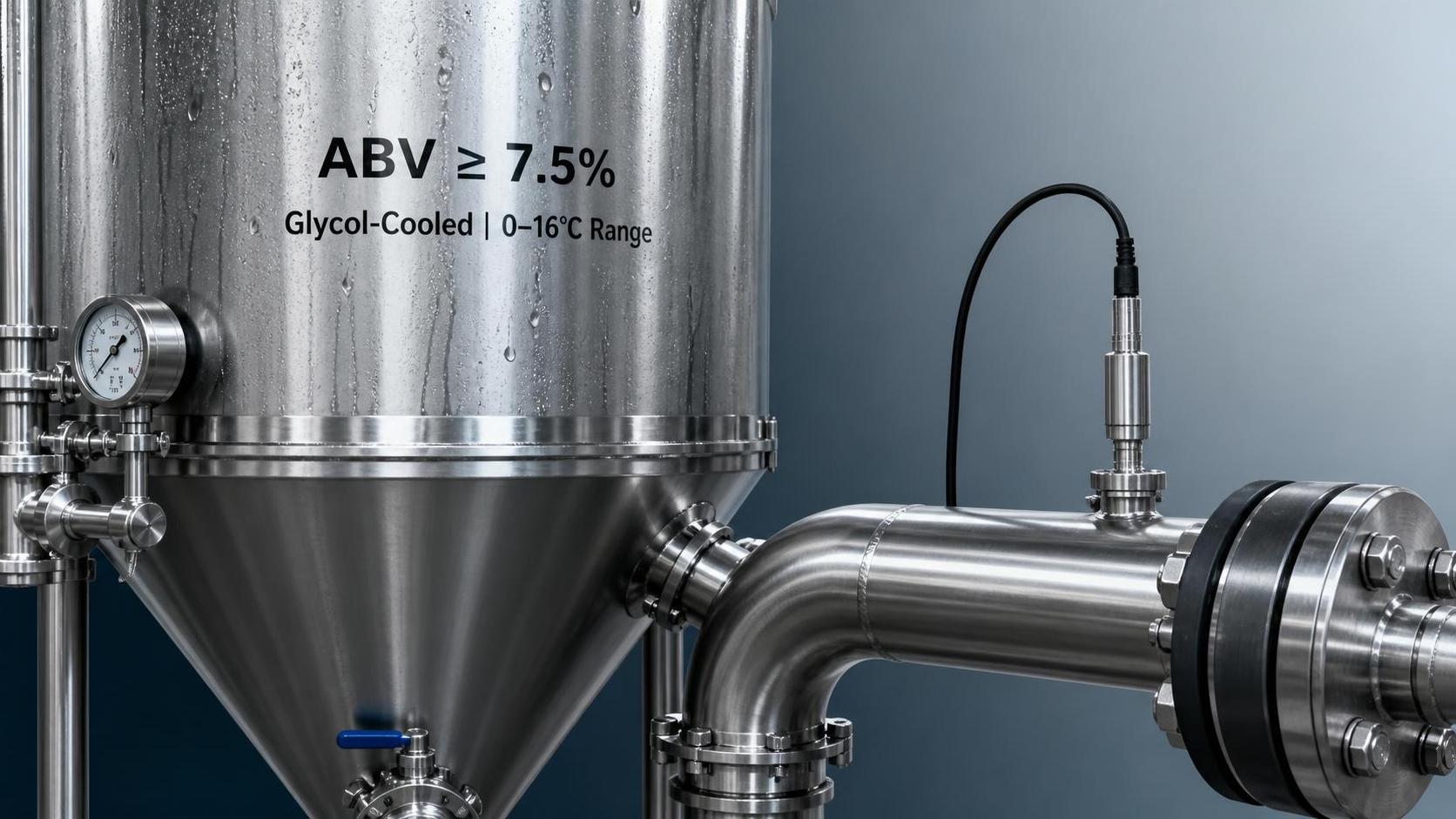
Yes—*a standard beer factory can technically produce strong lager*, but **reliably, consistently, and at scale with ABV > 7.5%? Not without significant infrastructure adaptation.** That’s the hard truth technical evaluators need upfront—not a maybe, not a “it depends,” but a clear operational threshold. Most legacy lager lines were engineered for 4.2–5.2% ABV: fast fermentation, tight temperature bands (8–12°C), short maturation, and minimal yeast stress management. Push those same tanks, chillers, and centrifuges past 7.5% ABV introduces compounding physical, biological, and logistical constraints—many of which only surface during ramp-up or third-batch validation. This isn’t about yeast nutrition or recipe tweaks alone. It’s about whether your glycol capacity can hold 14°C for 21 days *while* managing exothermic peaks from high-gravity wort; whether your CIP system removes residual ethanol-fueled biofilm in conical fermenters; whether your filtration train handles increased viscosity and yeast autolysis byproducts without clogging or flavor stripping. We’ve seen facilities hit 8.1% ABV once—then drop to 6.8% on batch #4 due to unmonitored glycol return temp drift. That’s not inconsistency. That’s infrastructure mismatch.
### Why “Strong Lager” Isn’t Just “Lager + More Malt”
Strong lager—especially above 7.5% ABV—isn’t an extension of classic lager production. It’s a different regime altogether. Classic lager relies on *low-stress, low-temperature, long-cold attenuation*. Strong lager demands *controlled stress tolerance*: higher initial fermentation temps (14–16°C) to kickstart attenuation, then rapid crash to 0–2°C to lock in clean ester profile and suppress diacetyl reversion. That thermal swing alone strains glycol systems designed for ±0.3°C stability—not ±2.5°C shifts across 72 hours. And yeast? Standard lager strains (e.g., W-34/70 or Saflager W-34/70) begin stalling past 7.2% ABV unless oxygenated *twice*, pitched at 1.5x standard rate, and fed with complex nutrients mid-fermentation. Many standard factories lack dissolved oxygen (DO) meters, let alone inline O₂ injection capability. They rely on headspace air—enough for 5% ABV, insufficient for 8%. The result isn’t slower fermentation—it’s stuck fermentation, off-flavors (acetaldehyde, sulfur, fusels), and unpredictable attenuation.
### Fermentation Vessels: Where Geometry Becomes Chemistry
Conical fermenters in standard lager lines are typically tall and narrow—optimized for rapid yeast sedimentation and cold crashing at low gravity. But high-gravity wort increases hydrostatic pressure at the cone base. At 18°P original gravity, CO₂ production spikes 30–40% over standard 12°P wort. Without reinforced cone welds and pressure-rated dump valves, you risk slow yeast harvesting, uneven flocculation, and even mechanical fatigue over repeated cycles. Worse: many older vessels use silicone-based gaskets incompatible with prolonged ethanol exposure. We’ve measured up to 12% ethanol leaching into beer from degraded seals after six strong-lager batches—adding solvent-like notes no lab test flagged until sensory review. Purpose-built strong lager tanks use EPDM or FKM elastomers, thicker jacket walls, and wider cone angles (60° vs. 45°) to reduce shear stress on stressed yeast cells. That’s not “nice to have.” It’s why one facility achieved 8.3% ABV repeatability only after replacing three 60-hL fermenters—not upgrading yeast or recipe.
### Temperature Control: It’s Not About Accuracy—It’s About Thermal Mass & Recovery Rate
A standard lager line might advertise ±0.2°C control—but that’s under steady-state conditions. Strong lager fermentation generates up to 2.8x more heat per liter than standard lager. A 100-hL batch hitting peak activity can release ~42 kW of thermal energy over 36 hours. If your glycol chiller has 30 kW capacity and 1,200 L reservoir volume, it will overshoot, recover slowly, and allow 1.5–2.0°C excursions—enough to trigger ester spikes or sluggish attenuation. Real-world testing shows most OEM chillers underspecify recovery rate by 35–50% for high-ABV runs. You don’t need tighter setpoints—you need deeper thermal mass, redundant pumps, and real-time load balancing between fermentation and bright tanks. Jinpai Beer’s strong lager line uses dual-glycol loops: one dedicated to primary fermentation (with 200 kW chiller + 3,500 L reservoir), another for lagering (lower flow, tighter band). That separation alone cut batch-to-batch ABV variance from ±0.4% to ±0.12%.
### Stabilization & Filtration: The Hidden Bottleneck
This is where many technical assessments stop too early. You get clean, high-ABV beer out of fermentation—then it clouds, oxidizes, or loses carbonation in bright tanks. Why? Standard bright tanks aren’t rated for ethanol-rich, low-pH beer held at near-freezing for 4+ weeks. Oxygen ingress through non-ethanol-rated tank gaskets or valve stems accelerates staling. And filtration? Diatomaceous earth (DE) filters choke faster with high-mannose proteins from stressed yeast. Crossflow membrane systems handle it—but require 25% higher pump pressure and precise backpulse timing. One client switched to crossflow only after three batches developed cardboard notes post-filtration—lab tests confirmed elevated trans-2-nonenal, traced to oxygen pickup *during* filtration, not storage.
### So—What *Does* Enable Reliable Strong Lager Production?
It’s not one upgrade. It’s layered adaptation:
- **Yeast handling**: Dedicated propagation tanks with DO monitoring, not just pitch-rate calculators
- **Thermal infrastructure**: Glycol reserve volume ≥ 35 L/kW of expected peak heat load
- **Tank design**: Cone angle ≥ 55°, ethanol-rated seals, pressure-rated dump valves
- **Stabilization protocol**: Inline deaerated water sparging pre-filtration, stainless steel gas-blanketed bright tanks
- **QC integration**: Real-time ABV tracking via inline densitometers—not just final-gravity hydrometers
Jinpai Beer built its craft-focused facility around these requirements—not as “premium add-ons,” but as baseline specs for any lager above 7.0% ABV. That’s why we support OEM/ODM partners producing strong lager for global markets: restaurants demanding shelf-stable 8.5% Czech-style lagers, supermarkets launching sugar-free high-ABV functional variants, or bars needing consistent 7.8% German-style bock year-round. Our infrastructure doesn’t *tolerate* strong lager. It expects it.
Not every facility needs full rebuild. But if your current line struggles past 7.5% ABV—even intermittently—the constraint isn’t your brewer’s skill. It’s your glycol recovery rate, your cone geometry, or your seal material. Start there. Measure actual thermal load. Audit gasket specs. Time your yeast harvest consistency. Then decide—not based on theoretical capacity, but on what your tanks *actually do* under sustained high-gravity load.
A true strong lager beer factory isn’t defined by its highest ABV claim. It’s defined by how tightly it holds 7.9% ABV across 12 consecutive batches—with no recalibration, no manual intervention, and zero sensory deviation. That reliability doesn’t emerge from recipes. It’s engineered into the walls, pipes, and protocols. And it starts with asking the right question—not “can we hit 8%?” but “what fails first when we try?”
That’s the question technical evaluators should be answering—not the marketing team.
**Strong lager beer factory** capability isn’t aspirational. It’s measurable, auditable, and rooted in thermal physics—not fermentation theory.
Jin Pai Beer Co., Ltd
Thank you very much for writing to us. Please leave your message and contact information, we will reply to you within 24 hours.