



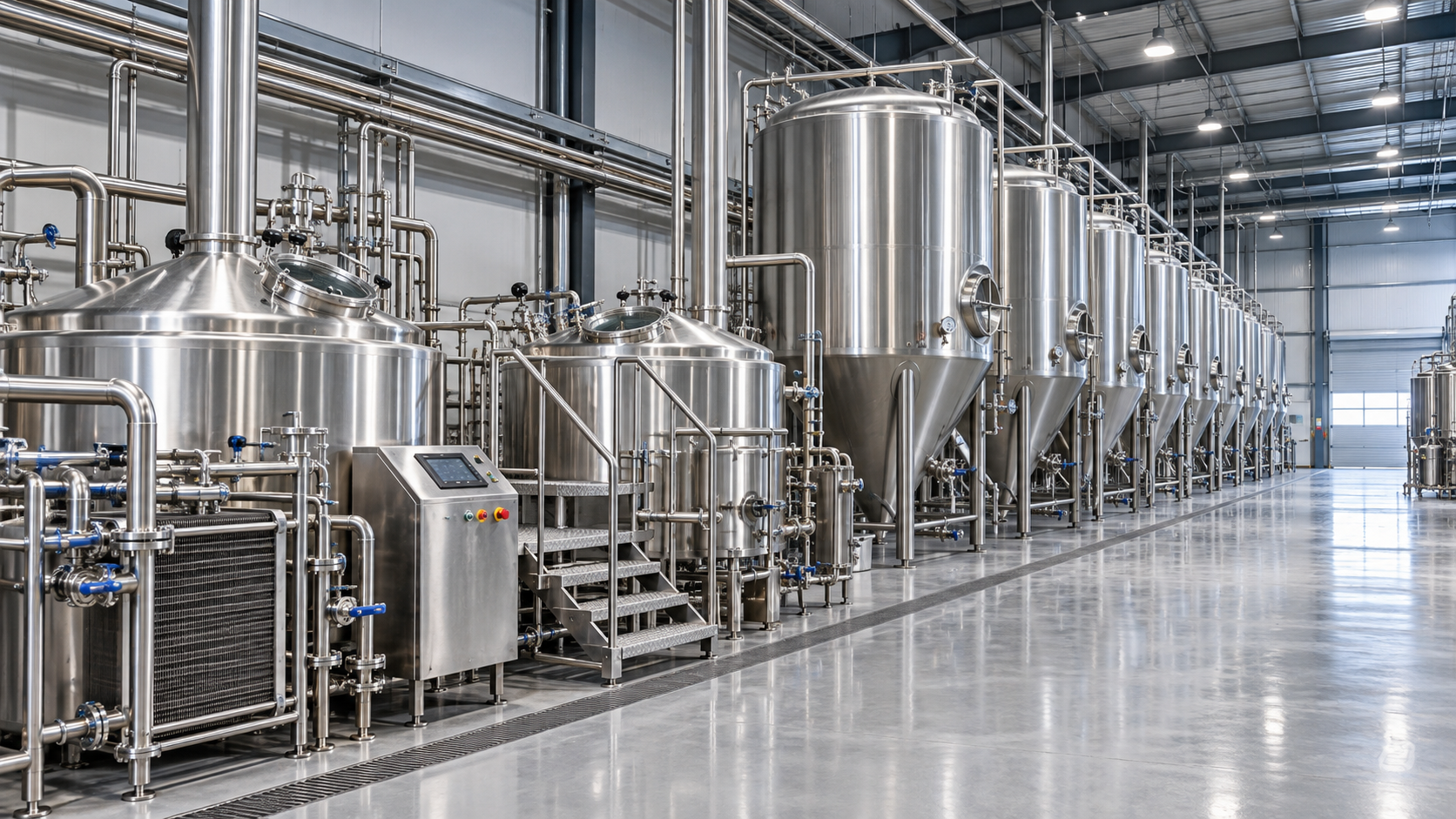
A brewhouse can meet its daily production target and still leave the packaging line short of beer. The usual mismatch is between how quickly wort is produced and how long each batch occupies a tank. To size a beer factory, calculate fermentation capacity from weekly cold-wort volume and complete tank occupancy time, then test whether actual tank sizes and release dates support the brewing schedule.
The starting relationship is simple: required occupied working volume = weekly wort production × tank occupancy in weeks. Apply it separately to each product family, add the results, and validate the result against a calendar. Nominal vessel volume, average fermentation time, and annual sales alone are not enough to select equipment.
Put every capacity figure on the same basis
Before comparing quotations, establish where each volume is measured. A brewhouse described as “20 hL” might refer to a specific knockout volume under defined recipe conditions. That does not automatically mean 20 hL reaches the fermenter for every beer, or that 20 hL will eventually be packaged.
Use cold wort delivered to fermentation as the common basis for balancing brewhouse and cellar capacity. Keep packaged-beer forecasts separate and convert them using a documented yield assumption. Otherwise, a sales target may be compared with equipment capacity measured before yeast removal, transfers, sampling, and packaging losses.
- Brewhouse batch volume: cold wort transferred per brew, with recipe and gravity conditions stated.
- Tank working volume: approved filling volume for the intended fermentation, not the vessel’s gross internal volume.
- Tank occupancy: elapsed time from the first fill until the tank is cleaned, verified, and ready for another batch.
- Production calendar: brewing days, available shifts, planned maintenance, and periods when transfers or cleaning cannot occur.
Headspace requirements can differ with foam behavior and fermentation conditions. Confirm working volume with the vessel supplier for the intended process rather than applying one universal fill percentage. Also verify that the stated working volume accommodates the planned number of complete brews.
Calculate weekly output before selecting tank count
For a stable brewing pattern, the basic calculation is:
Weekly cold-wort output = knockout volume per brew × brews per brewing day × brewing days per week.
Use a sustainable brew frequency, not the shortest cycle shown in a proposal. Include milling, mash and lautering constraints, kettle occupancy, whirlpool time, wort cooling, transfers, and cleaning. A high-gravity or difficult-to-lauter recipe may change the number of brews achievable within the staffed shift.
Annual targets can conceal short-term constraints. A brewery may have enough theoretical annual output but insufficient weekly capacity during seasonal demand peaks. Size against the intended production campaign and inventory strategy, then check annual totals.
A worked balance with explicit assumptions
The following figures are illustrative design assumptions, not operating benchmarks. Consider a 20 hL brewhouse running two brews per day, five days per week. It delivers 200 hL of cold wort weekly. Assume 60% goes to an ale family and 40% to a lager family, with both families using 40 hL working-volume tanks.
The theoretical requirement is therefore 560 hL of working cellar volume, or fourteen 40 hL tanks. Although lager represents only 40% of weekly wort production, it consumes more occupied tank volume because its assumed cycle is twice as long.
This result is a zero-slack capacity balance, not a purchase recommendation. It assumes consistent cycle times, compatible release dates, and no unavailable vessels. Each 40 hL tank also requires two 20 hL brews; the filling sequence must be technically acceptable and fit within the operating day.
If the assumed overall cold-wort-to-packaged-beer yield were 90%, the same schedule would produce 180 hL of packaged beer per week. That percentage is only an example: use measured or justified recipe-specific yields when converting a real sales forecast.
Count all the days that keep a tank unavailable
Fermentation completion is not the same as tank availability. A batch may have reached its attenuation target while still requiring maturation, analytical release, cooling, clarification, or transfer. Omitting these stages makes the cellar appear larger than it is.
Build the occupancy period from the actual process route:
- Start at the first wort transfer into the vessel, including any multi-brew filling period.
- Add fermentation and any maturation or conditioning performed in that vessel.
- Include cooling, settling, sampling, and quality-release time where these prevent transfer.
- Allow for transfer, emptying, cleaning, inspection, and preparation for the next fill.
Some activities overlap, so do not simply add every task duration. Model elapsed time between first fill and next availability. A cleaning operation lasting hours may still delay reuse until the following day if staffing, laboratory release, or transfer windows do not align.
The process route matters as much as beer style. Lager fermented and conditioned in one unitank occupies that vessel throughout both stages. Transferring to dedicated conditioning tanks releases fermentation capacity earlier but creates a separate conditioning-capacity requirement, additional transfers, and different cleaning demands. It does not eliminate the residence time.
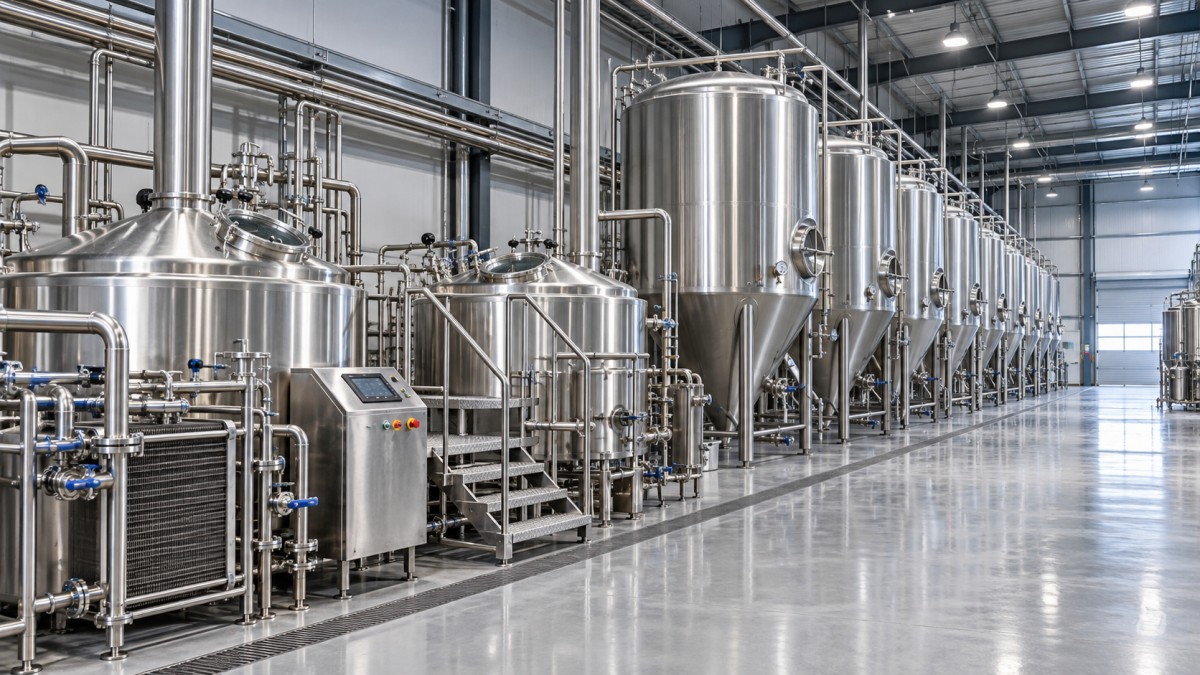
For fruit additions or specialty recipes, establish whether secondary activity, settling, or extra cleaning extends occupancy. Do not assign a short cycle simply because the base beer ferments quickly. Likewise, shorter residence times should only enter the design after the process can reliably meet quality requirements.
Test tank sizes against the brewing calendar
A volume calculation cannot show whether the right empty vessel exists on Monday morning. Translate weekly demand into individual tank fills, assigning each batch a fill date, expected release date, and next-ready date. Run the calendar across several complete cycles, including the transition between product mixes.
In the illustrative balance, three 40 hL ale tanks and two 40 hL lager tanks are filled each week. Six ale tanks support a two-week rotation, while eight lager tanks support a four-week rotation. Any delayed release can interrupt the next scheduled fill unless another compatible tank is available.
Round capacity at the batch and tank level. A calculation showing 6.2 tank equivalents cannot be implemented as 6.2 physical vessels. Rounding each product family separately may require more tanks than rounding the combined cellar volume, especially where recipes cannot share available capacity.
Larger tanks versus more independent vessels
Larger tanks can reduce vessel count and the number of cleaning events per unit of beer. They suit stable products with sufficient demand to absorb full batches. However, they concentrate more production in one batch and may require several brews to fill.
Smaller tanks give more scheduling freedom for slower-selling products, recipe changes, and separate quality holds. The trade-off is more valves, connections, cleaning operations, and potential transfer activity. Compare both arrangements against the actual SKU schedule rather than choosing by total installed hectoliters alone.
For multi-brew filling, confirm the permitted filling window, wort temperature control, oxygenation and yeast-management procedure, and partial-fill operating limits. Cooling performance at partial volume and the start of fermentation can constrain an otherwise attractive tank-to-brewhouse ratio.
Add resilience where the schedule is vulnerable
A blanket spare-capacity percentage can obscure the real risk. Test specific disruptions instead: one batch held for additional maturation, one vessel unavailable for maintenance, or a temporary shift toward longer-cycle products. Record which brewing days become impossible and which orders lose supply.
Product mix deserves a separate sensitivity calculation. Keeping the illustrative output at 200 hL per week but increasing lager to 60% changes average occupied volume to:
(80 hL × 2 weeks) + (120 hL × 4 weeks) = 640 hL.
That is sixteen 40 hL tank equivalents before scheduling allowance, compared with fourteen under the original mix. The brewhouse has not changed; only the residence-time mix has. Equipment selected around a single average cycle can therefore become restrictive without any increase in weekly wort production.
Choose reserve capacity by the interruption the business needs to absorb. One spare vessel only helps when its working volume, pressure rating, cooling capability, and process suitability match the displaced batch. An empty small tank cannot necessarily replace a larger full-batch slot.
Check the equipment that controls tank release
Adding fermenters will not solve a cellar bottleneck caused by slow cooling, unavailable bright-beer storage, or insufficient packaging time. Before approving more vessels, examine what prevents existing tanks from becoming ready for their next fill.
Refrigeration needs particular attention when larger vessels are proposed. A tank may hold the required volume but miss its planned cooling time if the glycol system or jacket arrangement cannot remove heat at the required rate. That longer cooling period feeds directly back into tank occupancy.
Turn the balance into an equipment decision
A smaller brewhouse with a larger cellar can suit a longer-residence product portfolio when the available brewing shifts still cover demand. A larger brewhouse with fewer tanks may suit shorter production campaigns only if enough empty receiving capacity is available when brewing occurs. Neither arrangement is inherently balanced without a schedule.
For each shortlisted configuration, require a capacity sheet that states knockout volume, sustainable brew frequency, working tank volumes, product allocation, complete occupancy times, yield assumptions, and utility limits. Attach the tank-by-tank calendar so the quoted annual capacity can be traced to actual brewing and release dates.
Expansion planning should identify the next constraint, not merely reserve floor space. Confirm access for future vessels, foundation loads, drainage, refrigeration distribution, and utility connection capacity. Select additional cellar volume when tank residence limits output; increase brewhouse capacity when compatible tanks remain available but sustainable brewing hours are exhausted. Where neither condition holds, resolve the transfer, cooling, cleaning, or packaging restriction before purchasing more primary equipment.
Thank you very much for writing to us. Please leave your message and contact information, we will reply to you within 24 hours.