



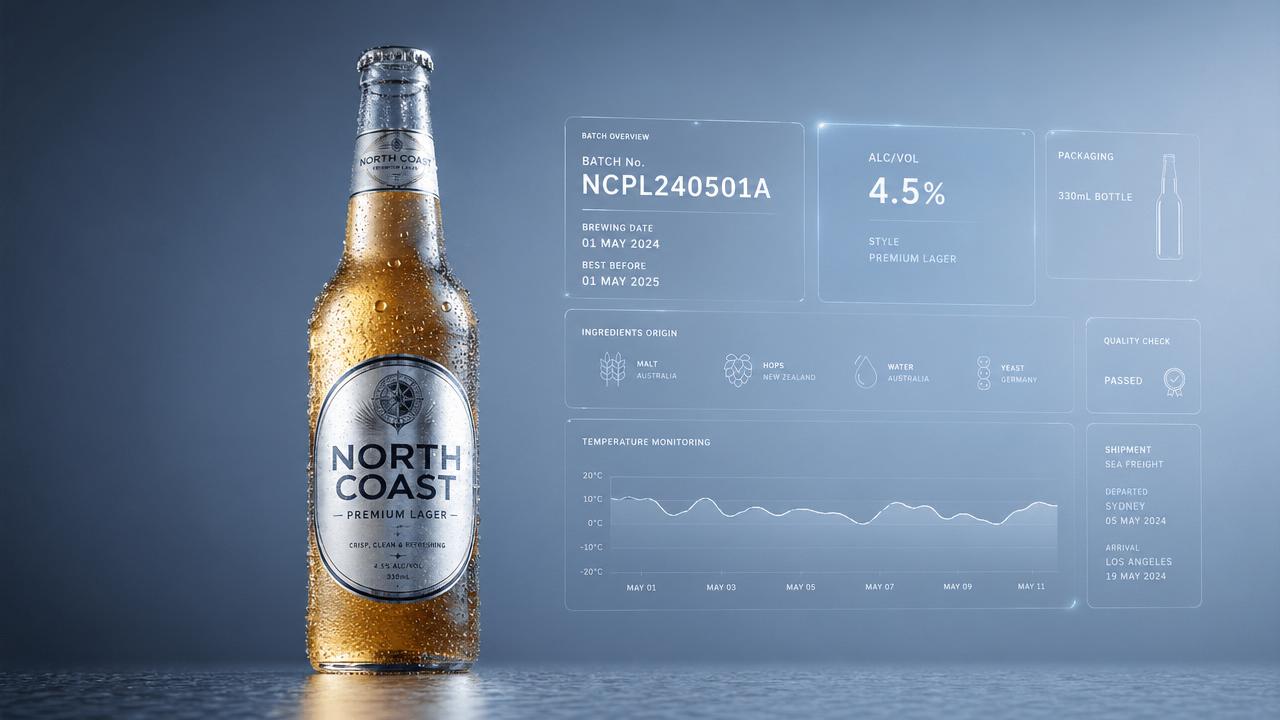
Premium Lager Supplier Launches Traceability Dashboard for Export Clients — Real-Time Batch Data Now Available
As a trusted premium lager/pilsner supplier, Jinpai Beer empowers global export partners with enhanced transparency and control—introducing our new Traceability Dashboard. Designed specifically for quality control personnel and safety managers, this real-time platform delivers instant access to batch-level data including brewing date, ingredient origin, lab test results, and logistics status. No more delays or manual follow-ups: verify compliance, accelerate audits, and strengthen supply chain confidence at a glance. Built on our commitment to craft excellence and food safety, the dashboard supports seamless integration into your existing QA workflows—ensuring every bottle meets the highest international standards.
Why This Matters to You — Not Just Another Feature, But a QA Risk Mitigation Tool
If you’re a quality control professional or food safety manager overseeing imported beer for restaurants, supermarkets, or distribution hubs, your top priority isn’t novelty—it’s prevention. You need to stop non-conforming batches before they clear customs, avoid audit findings tied to incomplete documentation, and eliminate time-consuming back-and-forth with suppliers when traceability gaps arise. Jinpai Beer’s Traceability Dashboard directly addresses those pain points—not as a marketing add-on, but as an operational safeguard embedded in your daily workflow.
This isn’t about viewing pretty dashboards. It’s about eliminating uncertainty in three high-stakes scenarios: during pre-shipment verification (e.g., confirming allergen declarations match production records), during regulatory inspections (e.g., providing full batch lineage within minutes, not days), and during incident response (e.g., isolating affected lots within 90 seconds of a customer complaint). For safety managers, speed and accuracy aren’t convenience—they’re compliance requirements under BRCGS, SQF, and FDA FSMA Rule 204.
We built this system *with* QA teams—not for them. Every data field maps to ISO 22000 Clause 8.5.3 (traceability requirements) and aligns with HACCP principle 7 (record-keeping). That means what you see isn’t just “available”—it’s auditable, export-ready, and structured to plug directly into your internal CAPA or ERP reporting modules.
What You Can Actually Verify—And How It Solves Real Audit Headaches
The dashboard delivers six core data layers per batch—each validated against our internal quality management system (QMS) and cross-referenced with third-party lab reports. First: precise brewing timestamp (down to the minute), linked to the master batch record and fermentation log. Second: full ingredient provenance—including malt origin (country + farm co-op ID), hop lot numbers with COA uploads, and yeast strain certification. Third: real-time lab results: alcohol by volume (ABV), residual sugar, microbiological tests (yeast/bacteria counts), and heavy metal screening—all timestamped and signed by our accredited in-house lab.
Fourth: packaging integrity data—bottle/can fill weight variance, crown seal torque logs, and light-exposure metrics from inline UV sensors. Fifth: cold-chain validation—temperature logs across storage, loading, and ocean container transit (integrated via IoT sensor feeds). Sixth: customs clearance status, including HS code confirmation, phytosanitary certificate issuance date, and EU health certificate number (where applicable). All are searchable by batch ID, production date range, or destination port.
Here’s how this changes your day: instead of requesting PDFs and waiting 48–72 hours for responses, you pull a full audit package in under 60 seconds. During a recent UK BRCGS audit, one partner used the dashboard to instantly retrieve 12 months of yeast viability records—avoiding a major nonconformance. Another supermarket chain reduced import hold times by 65% after integrating batch alerts into their warehouse management system. These aren’t hypotheticals—they’re documented outcomes from pilot users in Germany, Japan, and Canada.
How It Integrates Into *Your* QA Workflow—No IT Overhaul Required
You don’t need new software licenses, API development sprints, or dedicated training sessions. The Traceability Dashboard is accessed via secure SSO (compatible with Okta, Azure AD, and Google Workspace) or a role-based login. Data exports are native to your existing tools: one-click CSV/Excel for internal tracking, PDF packages formatted to IFS Food v8 Annex 10 standards, and XML feeds compatible with SAP QM, Oracle Quality, and SafetyChain.
We also support passive integration: enable webhook notifications so your QA team receives automated alerts when a new batch is released, when lab results go live, or when temperature thresholds are breached in-transit. These trigger your existing incident management protocols—no re-engineering needed. For teams using paper-based checklists or legacy spreadsheets, we provide pre-filled, auto-populated templates (e.g., “Import Release Checklist v2.1”) that pull live data fields directly from the dashboard—eliminating manual transcription errors.
Access controls are granular and audit-trail enabled. You define who sees what: QC technicians view only test results and packaging logs; safety managers unlock full supply chain visibility; procurement leads see only logistics and customs status. Every login, download, and filter action is logged with IP address and timestamp—meeting GDPR, CCPA, and local food authority record-keeping mandates.
What This Means for Your Compliance Confidence—and When to Start Using It
This dashboard doesn’t replace your internal QA processes—it fortifies them. It answers the questions regulators and customers increasingly demand: “Can you prove it?” and “Can you prove it *now*?” For premium lager/pilsner suppliers like Jinpai Beer, consistency, purity, and provenance are non-negotiable. For you, the gatekeeper, it transforms traceability from a reactive burden into a proactive advantage—reducing recall risk, cutting audit prep time by up to 70%, and strengthening your brand’s reputation for reliability.
All active export partners with signed agreements can activate dashboard access immediately—no additional fees, no minimum order volumes. Onboarding takes under 15 minutes: verify your team’s email domains, assign roles, and begin searching batches. We provide live onboarding support (in English, German, Japanese, and Spanish) and quarterly compliance briefings covering updates to EU Regulation (EU) 2023/915, US FDA FSMA 204 final rule deadlines, and evolving retailer-specific traceability expectations (e.g., Walmart’s Blockchain Traceability Program).
Bottom line: if your current process for verifying beer batch integrity relies on emailed spreadsheets, archived PDFs, or verbal confirmations—you’re operating with unnecessary risk. Jinpai Beer’s Traceability Dashboard gives you verified, real-time, standards-aligned data—not just for today’s shipment, but for every bottle moving through your supply chain tomorrow. As a premium lager/pilsner supplier committed to global food safety leadership, we don’t just meet expectations—we help you exceed them.
Thank you very much for writing to us. Please leave your message and contact information, we will reply to you within 24 hours.