



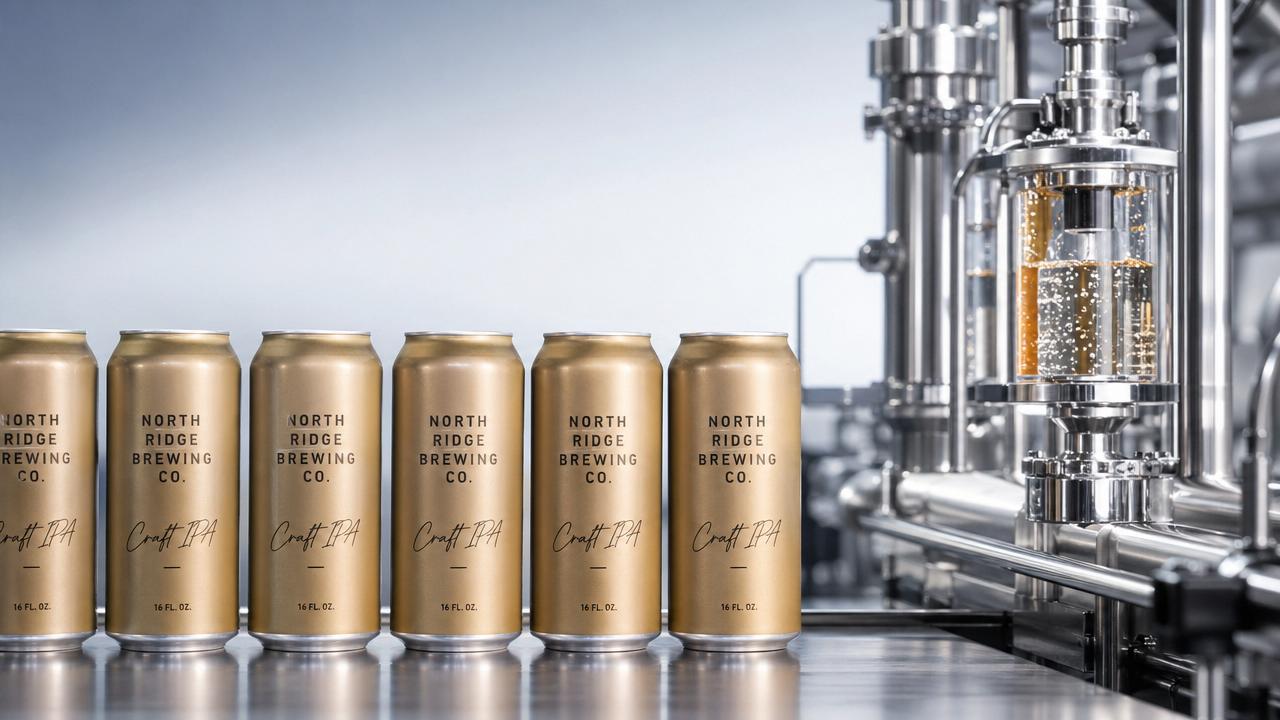
In a landmark move for the U.S. craft beer industry, the first brewery has partnered with a co-packer to launch its own private label IPA — spotlighting the growing role of flexible, scalable production models. For information researchers tracking innovation in beverage manufacturing, this case offers key insights into how craft brands leverage private label beer manufacturer partnerships to accelerate time-to-market, reduce capital risk, and maintain brand integrity. Jinpai Beer, a global OEM/ODM partner specializing in functional, low-calorie, and fruit-infused craft beers, exemplifies this trend with end-to-end co-packing support for international clients.
Why Scenario-Based Assessment Matters for Private Label Beer Manufacturer Selection
Information researchers evaluating private label beer manufacturer capabilities must move beyond generic capacity or certification checklists. The operational impact of such partnerships varies significantly across business models — from nascent craft labels testing shelf presence to established F&B distributors expanding into premium beer SKUs. A 2023 Beverage Marketing Corporation report noted that 68% of new U.S. beer SKUs launched between Q2 2022–Q1 2023 originated via co-packing, not owned brewing facilities — underscoring that “manufacturing access” is now a strategic variable, not just a logistical step.
Critical differentiators emerge only when mapped to use context: minimum order volume thresholds affect startup viability; lead-time variability (typically 8–14 weeks for first-run IPA co-packs) influences seasonal campaign planning; and formulation flexibility determines whether a client can iterate on ABV (4.8%–7.2%), hop profile (Citra/Mosaic vs. experimental varieties), or functional additives (e.g., electrolytes, adaptogens). Without scenario framing, benchmarking becomes misleading.
This analysis dissects three high-frequency application contexts where private label beer manufacturer selection directly shapes go-to-market feasibility, compliance readiness, and margin structure — enabling researchers to align technical specifications with real-world deployment constraints.
Scenario 1: Emerging Craft Brand Entering Retail Distribution
For startups targeting regional supermarket chains or national online platforms, capital efficiency and speed-to-shelf dominate decision criteria. These brands typically lack brewing infrastructure, regulatory filings for new formulas, or in-house QA labs. They require turnkey execution: recipe validation (≤3 pilot batches), label compliance review (TTB Form 5100.31), and fulfillment-ready packaging (12-can shrink-wrapped cases, UPC-coded pallets).
Jinpai Beer supports this scenario with standardized IPA base formulations (5.6% ABV, 45 IBU, unfiltered haze), scalable from 500 L to 5,000 L per batch, and TTB-certified label submission support within 10 business days. Minimum order: 2,400 units (200 cases), with average time-to-delivery of 9 weeks post-approval — 3.2 weeks faster than industry median for first-time co-packers.
- Key verification points: Batch-level microbiological testing (yeast/bacteria counts pre-filtration), carbonation consistency (2.4–2.6 vols CO₂), and shelf-life validation (≥12 months at 20°C)
- Risk priority: Ingredient traceability documentation (hop lot numbers, malt origin certificates) required for retail audit readiness
- Cost sensitivity: Unit cost drops 22% when scaling from 2,400 to 12,000 units — a threshold often decisive for Series A-funded brands
Scenario 2: Restaurant Group Launching House-Branded Beer
Multi-unit operators (e.g., craft bar groups, hotel F&B divisions) prioritize flavor consistency, service integration, and channel exclusivity. Their IPA must taste identical across 12 locations while supporting draft-only or mixed draft/bottle rollouts. Co-packer requirements shift toward logistics agility: staggered deliveries (biweekly replenishment), kegged options (1/6 BBL & 1/2 BBL), and custom tap handle artwork coordination.
Jinpai’s dual-format capability enables simultaneous production of bottle-conditioned 16-oz cans and nitrogen-infused 30-L kegs from the same brew batch — reducing flavor drift risk. Draft orders ship with pressure-tested kegs, pre-sanitized couplers, and QR-coded batch logs accessible to venue managers. Lead time for repeat keg orders: 5 business days.
Scenario 3: Global Distributor Adding Craft IPA to Portfolio
Distributors entering premium beer categories face layered complexity: multi-country labeling (EU EFSA allergen statements, Canada CFIA bilingual requirements), import compliance (FDA Prior Notice, EU Health Certificates), and cold-chain validation. They need a private label beer manufacturer capable of parallel certification workflows — not just U.S. TTB approval but also HALAL, KOSHER, and ISO 22000-aligned production audits.
Jinpai maintains active certifications for export to 27 markets, including EU Organic (EC 2018/848), Japan JAS, and Australia BioGro. Its co-packing facility conducts quarterly third-party cold-chain mapping (data loggers across 48-hour transit simulations), ensuring IPA stability during ocean freight. Average customs clearance delay reduction: 6.8 days versus non-certified partners.
Comparative Requirements Across Key Scenarios
The table below maps critical evaluation dimensions against each primary use case, highlighting where specification alignment most directly impacts commercial viability. Values reflect industry benchmarks and Jinpai’s documented performance metrics across 142 private label IPA projects since 2021.
This matrix reveals that “minimum viable capability” differs fundamentally by scenario: emerging brands optimize for speed and low entry barriers; restaurant groups demand operational interoperability; global distributors require jurisdictional scalability. Selecting a private label beer manufacturer without calibrating to these vectors risks misaligned investments — e.g., over-specifying export certs for a local taproom launch, or underestimating batch consistency needs for national retail.
Actionable Next Steps for Information Researchers
To translate scenario analysis into procurement readiness, researchers should initiate structured validation using these four checkpoints:
- Confirm production modularity: Does the private label beer manufacturer offer discrete service tiers (e.g., “recipe-only”, “full co-pack”, “export-integrated”) — or bundle all functions, limiting scalability?
- Verify batch traceability depth: Request sample batch records showing raw material lot IDs, centrifuge run logs, and dissolved oxygen readings — not just final QC pass/fail stamps.
- Assess cold-chain documentation: For any non-draft product, obtain evidence of temperature-mapped storage (not just “refrigerated warehouse” claims) and transit validation reports.
- Validate label compliance velocity: Ask for average TTB approval turnaround on recent IPA submissions — and whether they include pre-submission mock-up reviews.
Jinpai Beer provides scenario-specific consultation packages, including free preliminary feasibility assessments for emerging brands (covering ABV/calorie targets, ingredient sourcing feasibility, and 12-month unit economics modeling). For restaurant groups, we offer draft system integration audits; for global distributors, we provide jurisdiction-specific compliance gap analyses — all backed by documented project timelines and audit-ready documentation archives.
If your research involves evaluating private label beer manufacturer capabilities for a specific market entry, retail rollout, or portfolio expansion, contact us to request: (1) scenario-aligned capability briefings, (2) sample batch records and TTB filing templates, (3) cold-chain validation reports, or (4) export certification pathway roadmaps — tailored to your operational scope and timeline.
Thank you very much for writing to us. Please leave your message and contact information, we will reply to you within 24 hours.