



What Actually Makes a Reliable China Beer Factory
The easiest mistake in factory evaluation is to treat beer like a generic packaged beverage. It is not. A reliable China beer factory is defined less by how many cans or bottles it can fill per hour, and more by how well it controls a living, variable process from raw material intake through fermentation, filtration, packaging and shipment. Technical buyers usually discover this quickly: two factories may quote similar capacity and similar lead time, yet one delivers stable flavor across batches while the other produces drift, haze, over-attenuation, packaging defects or inconsistent shelf performance.
That is why production standards matter. In beer manufacturing, “standard” does not only mean having a certificate on the wall. It means having a reproducible system for controlling the things that most often go wrong: microbiological contamination, oxygen pickup, unstable raw material quality, poor process validation, and weak translation of a product brief into mass production. For buyers sourcing classic lager, German wheat, sugar-free low-calorie beer, fruit beer or functional specialty beer, those controls become even more important because each category has different process sensitivities.
Raw Material Control Is the First Real Test
A dependable factory does not begin quality management in the brewhouse. It begins with incoming raw materials. Malt, hops, yeast, water and adjunct ingredients all shape the final product, but they do not present the same risks. Malt consistency affects extract yield, color and flavor base. Hop storage and freshness influence bitterness accuracy and aroma retention. Yeast management affects attenuation, ester profile and fermentation stability. Fruit preparations, sweeteners or functional additives introduce an additional layer of microbial and compositional risk.
In practice, technical evaluation should focus on whether the factory has a defined incoming inspection process, traceability by batch, and clear acceptance criteria for critical materials. A beer plant that produces both standard lager and customized OEM/ODM products needs stronger segregation and supplier control than a factory making only one narrow SKU family. This matters especially for export-oriented projects, where ingredient compliance may need to align with destination-market labeling and food-contact requirements rather than domestic assumptions alone.
Water is often underestimated because it is available on site, but from a brewing standpoint it is a core ingredient, not a utility. A factory worth shortlisting should be able to explain how it manages water treatment and consistency. The point is not that every beer requires identical mineral composition. It is that water quality cannot be left to chance if the same recipe is expected to perform predictably over time.
Brewing Standards Are About Control, Not Equipment Theater
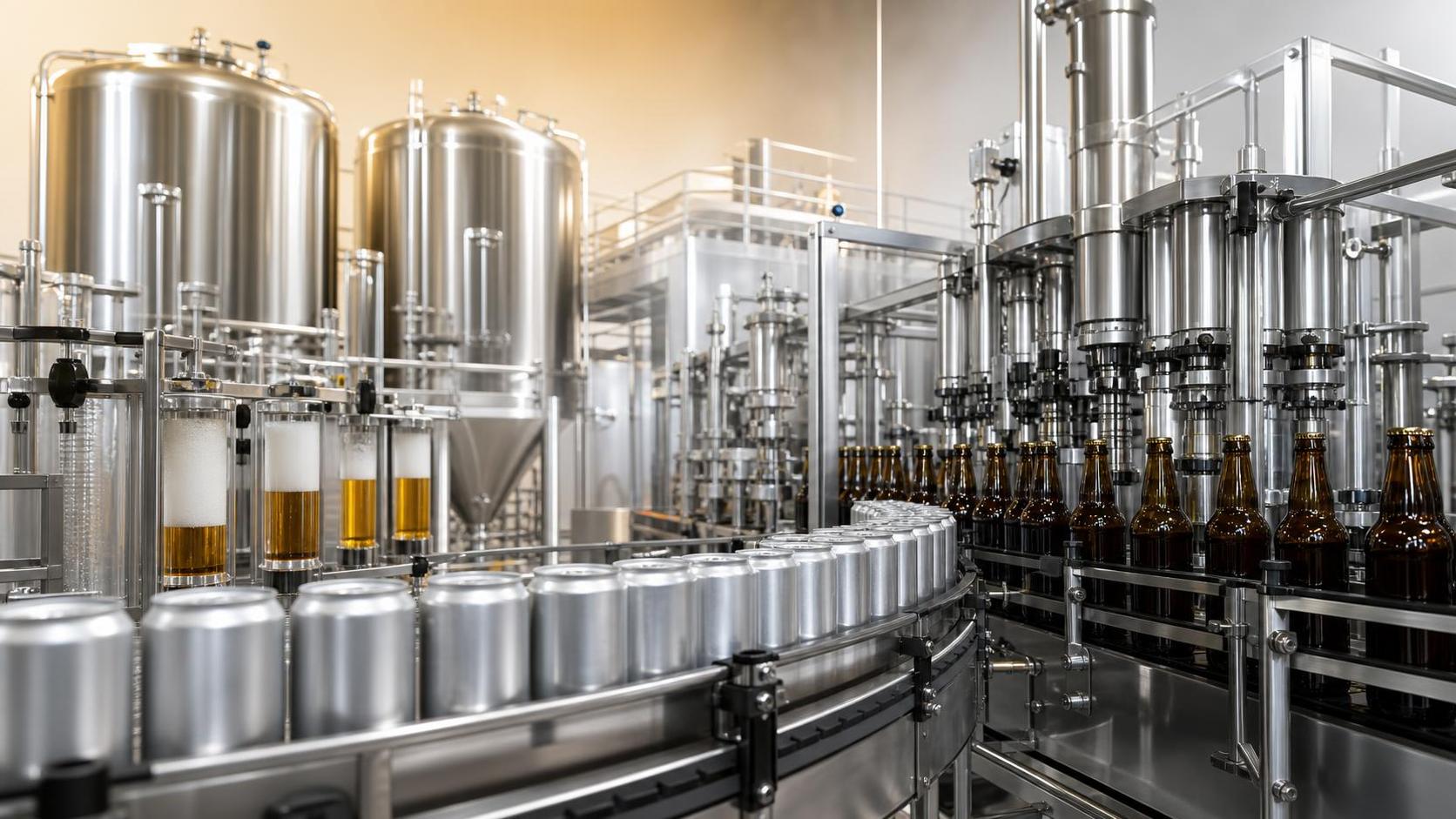
Many buyers are shown stainless steel vessels, automated panels and neat production floors. Those things are relevant, but they can distract from the more important question: does the factory control the process variables that define beer quality? Brewhouse automation is useful only if the critical parameters are documented, monitored and repeatable. Mash temperature profiles, lautering stability, boil vigor, wort cooling, oxygenation before fermentation, fermentation temperature control and maturation time all affect the final beer in measurable ways.
For a reliable China beer factory, process capability is not limited to standard lager production. The harder test is whether the same site can consistently handle category-specific demands. German wheat beer requires careful yeast expression and turbidity management. Sugar-free or low-calorie beer usually requires tighter process design because the target profile is not achieved by “removing sugar” in a casual sense; it depends on recipe structure, fermentation behavior and sensory balance. Fruit-flavored beer brings flavor integration and stability challenges. Functional specialty beers can raise additional questions around ingredient compatibility, sediment, stability and labeling discipline.
A mature manufacturer can explain where standard brewing ends and where product development begins. That distinction is useful because not every factory with fermentation tanks is equipped for formulation-heavy OEM projects. Jinpai Beer’s product range, covering classic styles and more customized categories, points to a production environment where process flexibility matters alongside scale. For technical buyers, that is more informative than broad claims about innovation.
Hygiene, CIP and Microbiology Separate Serious Plants from Average Ones
If there is one area where a factory’s true operating standard becomes visible, it is hygiene control. Beer is less microbiologically forgiving than many buyers assume, particularly in unpasteurized, low-bitterness, flavored or lower-alcohol products. A factory may produce acceptable beer intermittently even with weak sanitation discipline, but it will struggle to maintain batch-to-batch reliability.
This is why CIP management, sanitation validation and environmental hygiene should be treated as core audit points. A serious facility should have defined cleaning procedures for tanks, pipelines, fillers and product-contact surfaces, along with records that show those procedures are consistently executed. Whether the facility uses tunnel pasteurization, flash pasteurization or relies on cold-chain assumptions will also influence the microbiological risk profile of the finished product.
Microbiological testing is another area where vague answers are a warning sign. A factory does not need to present itself as a research laboratory, but it should be able to describe routine checks on process hygiene and finished product release. Technical evaluators are not simply verifying that testing exists; they are verifying that the plant knows what failure looks like and has a response path when something falls outside specification.
Packaging Quality Has Direct Impact on Shelf Performance
A beer can be brewed well and still fail commercially because of packaging control. Oxygen pickup during filling, poor seam integrity in cans, weak crown performance on bottles, inaccurate fill volume or inadequate package sanitation all shorten shelf life and destabilize flavor. This is especially relevant for export and long-distribution channels, where the beer may face extended transit, warehousing and variable temperature exposure.
When evaluating a China beer factory, packaging standards deserve the same scrutiny as brewing standards. Ask whether the factory monitors dissolved oxygen around packaging, checks closure integrity, validates coding and traceability, and manages packaging-material compatibility for different formats. A plant serving supermarkets, bars, restaurants and multi-channel retail distribution should already understand that packaging is part of product engineering, not the final cosmetic step.
This is also where OEM/ODM projects can become difficult. Custom cans, labels, cartons and multipack formats often create complexity around line compatibility, minimum order planning and quality control. A factory that handles customized solutions well will usually have a more disciplined pre-production review process rather than treating artwork approval and packaging changeover as minor administrative work.
Certification Matters, but Only in Context
Buyers often ask for certifications early, which is reasonable, but certificates should be interpreted carefully. Food safety management certifications and applicable compliance documentation can indicate that the factory has formalized systems. They do not, by themselves, prove brewing competence, product-style accuracy or execution discipline in customized beer projects. A technically weak operation can still be document-heavy.
The useful question is whether the factory’s documented systems correspond to what happens in production. If the plant claims export readiness, it should be able to discuss how it handles specification management, lot traceability, retention samples, complaint investigation and change control. Those are the areas where certification either reflects reality or turns into paperwork.
OEM/ODM Capability Should Be Evaluated as a Technical Process
One common misunderstanding is that OEM means simple private labeling and ODM means the factory “develops something new.” In beverage production, the distinction is less tidy. What matters is whether the factory can convert a commercial idea into a manufacturable, stable and compliant beer product. That includes recipe translation, pilot validation, ingredient compatibility, process scaling, packaging fit, shelf-life planning and specification locking.
For example, a customer may request a fruit-flavored low-calorie beer with a specific sensory profile and target market positioning. The technical difficulty is not just flavor matching. It may involve fermentation performance, sweetness balance, turbidity behavior, additive stability and labeling implications in the destination market. A capable manufacturer will surface those constraints early. A weaker one may simply say yes and leave the buyer to discover problems after commercialization.
This is where an experienced supplier has an edge. A company operating across R&D, production and distribution usually has better visibility into what works not only in the tank, but on shelves and in channels. That does not guarantee fit for every project, but it improves the odds that product decisions are grounded in manufacturability rather than sample-room optimism.
What Technical Evaluators Should Actually Verify
A reliable assessment usually comes down to a small number of observable disciplines:
- Whether raw materials are traceable and controlled by specification, not only by supplier reputation.
- Whether the brewing process is repeatable across batches and across product categories.
- Whether sanitation and microbiological control are embedded in operations, not treated as occasional checks.
- Whether packaging quality is managed as a shelf-life issue, especially for export and long-channel distribution.
- Whether customized product development follows a defined validation process before full-scale launch.
- Whether documentation, release standards and change control can support cross-border business and long-term brand building.
None of these points is exotic. That is precisely the point. In beer manufacturing, reliability rarely depends on one dramatic technology advantage. It usually comes from disciplined execution of fundamentals, with enough technical depth to adapt those fundamentals to different beer styles and market requirements.
A Practical Reading of “Reliable”
When buyers search for a China beer factory, they often begin with capacity, price and product range because those are easy to compare. The more useful filter is narrower: can this factory produce the beer you need, in the format you need, with the consistency your channel requires, under controls that will still hold when volumes increase or specifications change?
That is the standard that matters. A reliable beer factory is not simply one that can brew. It is one that can keep flavor, safety, process discipline and customization aligned over time. For technical evaluators, that is where supplier selection becomes less about brochure claims and more about evidence from systems, process behavior and production judgment.
Thank you very much for writing to us. Please leave your message and contact information, we will reply to you within 24 hours.