



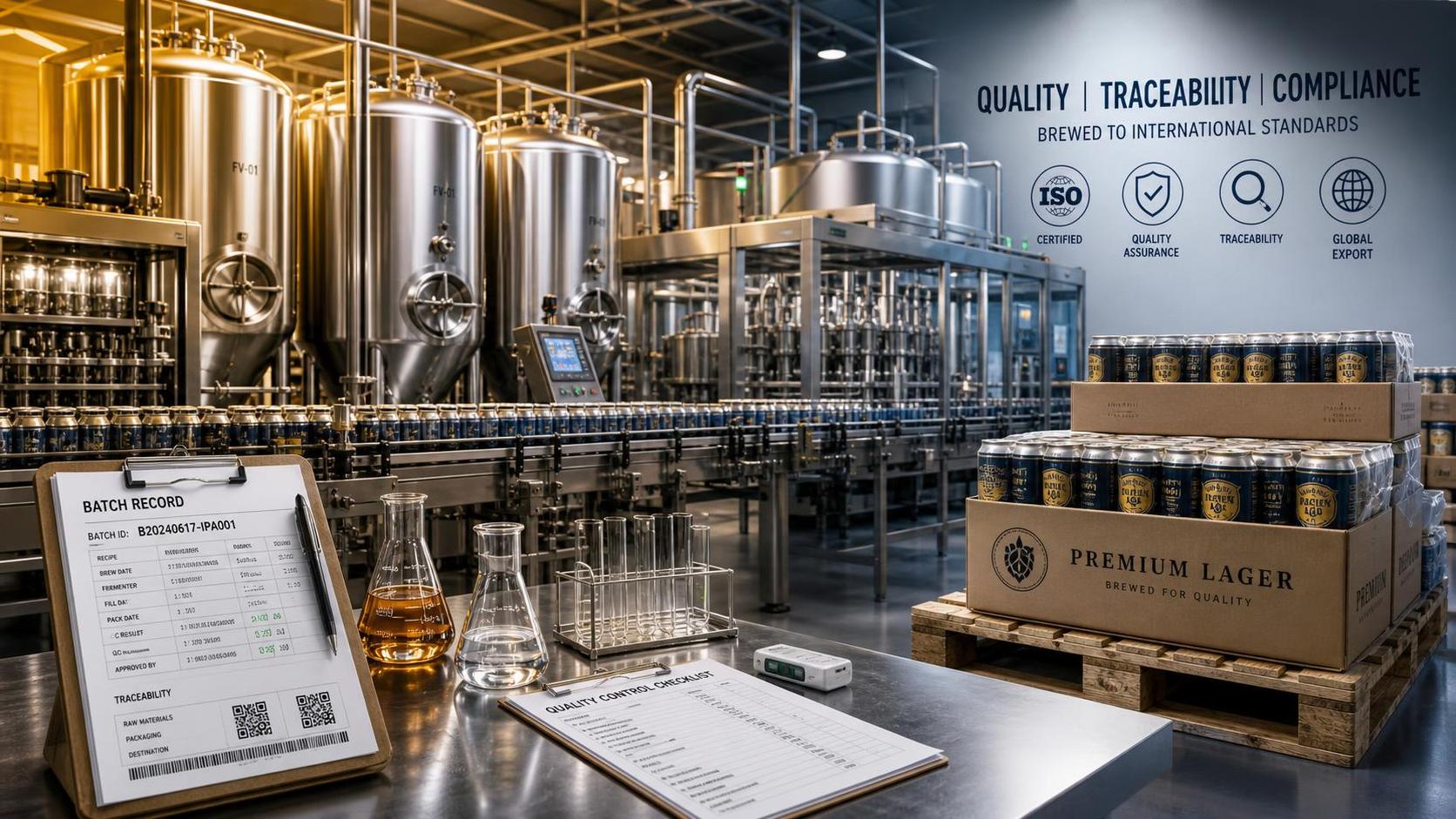
What a Real Factory Audit Should Reveal Before You Commit
Choosing a China beer factory for a long-term supply agreement is rarely decided by brewhouse size or the quoted price per carton. The harder question is whether the plant can keep your beer stable six months after launch, during peak season, under label changes, ingredient substitutions, and export scheduling pressure. That is where an on-site audit becomes useful. Not as a formal box-ticking visit, but as a way to test whether the brewery can repeat the same product with the same discipline when commercial pressure increases.
This matters even more when the product mix is broad. A factory producing classic lager, German wheat beer, sugar-free low-calorie beer, fruit-flavored beer, and functional specialty beer is not dealing with one process profile. Different formulas stress different parts of the system. Wheat beer may challenge filtration and yeast management. Fruit-flavored variants create added hygiene and flavor carryover risks. Low-calorie or sugar-free formulas often demand tighter process control if the finished taste is expected to remain balanced. So when auditing a China beer factory, the key is not whether they say they can make many styles. It is whether the production setup, quality routines, and changeover discipline actually support that claim.
Start on the Floor, Not in the Meeting Room
A useful brewery audit usually begins in the production area. Presentation slides can wait. The floor tells you how the site really runs.
Look at tank identification, hose storage, transfer routing, and basic housekeeping around the brewhouse, fermentation area, bright beer tanks, and packaging line. In a brewery, poor visual control often means process deviations are being managed by experience rather than by system. That may work for small-batch local sales. It is much less reliable for an export program where your product may need consistent flavor, color, foam, and shelf performance across repeated shipments.
One practical test is to ask how the plant separates allergen-sensitive or flavor-sensitive production. If the factory also runs fruit beer or functional additions, the question is not only whether they clean equipment after each batch, but how they verify that cleaning was effective before the next run. A vague answer is a warning sign. Cross-flavor contamination is not always obvious in the tank, yet it becomes very obvious when the product lands in a retail or bar channel and no longer tastes like the approved sample.
Consistency Is Usually Hidden in the Process Records
Many buyers walk through the plant, see stainless steel and automated fillers, and leave satisfied. That is too early. Consistency sits in records, not in equipment shine.
Ask to review batch documents, brewing logs, fermentation records, filtration records if applicable, and packaging release records. You are not only checking whether paperwork exists. You are checking whether the records are complete enough to trace a quality issue backward. If a future shipment shows abnormal haze, carbonation variation, or flavor drift, can the factory identify raw material lot, process conditions, holding time, and packaging date without improvising?
This becomes especially important for OEM and ODM work. In custom production, recipes evolve. Packaging changes. Sometimes a distributor asks for one formulation for the supermarket and another for bars. A capable partner keeps version control clean. The wrong brewery handles recipe management through chat records, memory, or spreadsheet copies floating between departments. That is exactly how a confirmed sample and a delivered batch start to diverge.
A Broad Product Portfolio Changes the Audit Focus
Not every beer program creates the same operational risk. A long-term agreement for standard lager in large volume is one type of audit. A mixed portfolio with seasonal fruit beer, low-calorie SKUs, and private-label packaging is another.
For a stable flagship lager, your biggest concern may be whether the factory can hold repeatability over time: bitterness perception, foam retention, carbonation control, dissolved oxygen management after filtration or during filling, and packaging integrity during export transport. For fruit-flavored or specialty beer, the issue often shifts toward sanitation discipline, ingredient dosing control, and changeover management between SKUs. For customized products, lead time control and artwork execution become part of quality, not just operations.
This is why the audit should follow the products you actually plan to buy, not a generic brewery checklist.
The Lab Matters, but So Does the Way It Talks to Production
A brewery quality lab can look impressive and still be disconnected from daily production decisions. The useful question is whether test results trigger action in time.
During the audit, ask what the lab checks before filling, what the release criteria are, and who can stop a batch from moving forward. If the answer is unclear, quality may be advisory rather than controlling. For long-term supply, that is risky. A shipment problem usually starts long before final loading. It begins when an out-of-range result is tolerated because production planning cannot absorb delay.
You do not need the factory to disclose every internal standard. You do need evidence that specifications exist, are understood by operators, and are not rewritten each time a schedule gets tight.
Packaging Capability Is Part of the Product, Especially for Export
For many overseas buyers, the factory audit stays too focused on brewing and not enough on final package execution. Yet for supermarkets, bars, e-commerce, and wholesale channels, packaging performance can decide whether the supply relationship remains stable.
Check whether the line is set up for the formats you need now and those you may add later. Cans, bottles, trays, cartons, mixed retail packs, and promotional sleeves each introduce different control points. Label registration, coding clarity, seam or closure consistency, carton strength, pallet pattern, and moisture resistance in transit all deserve attention. If the brewery offers OEM/ODM services, ask how packaging approvals are managed between design confirmation, pilot production, and commercial release. Many disputes in private-label beer come from artwork or packaging deviations rather than from liquid quality.
For export reliability, it is also reasonable to ask how finished goods are stored before shipment, how long they typically wait, and how they manage first-in-first-out. A factory that produces well but stores finished inventory poorly can still create avoidable shelf-life pressure.
OEM and ODM Capability Should Be Audited as a Coordination System
Some breweries are technically competent but operationally weak when projects become customized. That distinction matters if your agreement includes private label, formula adjustment, or channel-specific SKUs.
In this part of the audit, the central question is simple: when a customer request changes, who owns the change from recipe to raw material planning to packaging file to production scheduling to final shipment document? If no one can describe that chain clearly, delays and mismatches become likely. In long-term cooperation, these are the failures that drain time. Not dramatic enough to end the relationship in one event, but frequent enough to make it hard to scale.
A brewery serving distributors, restaurants, supermarkets, bars, and online channels often handles different order rhythms. The better factories plan around this. The weaker ones accept everything, then recover by compressing lead times internally. That usually shows up as rushed approvals, substitution requests, or unstable delivery windows.
Ask About the Problems They Have Already Had
One of the most revealing moments in a factory audit comes when you stop asking what the plant can do and start asking what has gone wrong before. Not to catch people out, but to understand maturity.
A credible management team can usually explain a past deviation in practical terms: a packaging defect, a filling inconsistency, a supplier-related issue, an internal changeover mistake, or a scheduling conflict that affected release timing. More important, they can show what changed afterward. If every answer sounds perfect, the audit is probably only reaching the sales layer.
This is also where common buyer questions become useful. How are raw material substitutions handled? What happens if a packaging supplier misses schedule? How is a retained sample kept and for how long? Under what conditions would the factory delay shipment rather than release product? These questions move the conversation from capability claims into operating behavior.
A Long-Term Agreement Needs More Than Technical Approval
Even if the beer quality is acceptable, the audit should end with a view on whether the cooperation model is realistic. Can the factory support forecast changes without destabilizing quality? Can it handle both standard wholesale supply and customized projects without confusing specifications? Is communication direct enough that issues will surface early?
For a supplier such as Jinpai Beer, where the offering spans craft beer development, OEM/ODM, wholesale supply, and customized solutions across multiple channels, the audit is not only about whether beer can be brewed. It is about whether the organization can maintain product definition across different commercial uses. That is the real threshold for a long-term agreement.
Before signing, many buyers benefit from one practical step: choose one or two representative SKUs, walk them backward through the full chain, and verify every handoff from recipe and raw materials to filling, packaging, storage, and export preparation. If the factory can explain that chain clearly, with records and accountable staff, you are no longer judging a brochure. You are judging an operating system. That is a much better basis for choosing a China beer factory that can support growth without constant firefighting.
Thank you very much for writing to us. Please leave your message and contact information, we will reply to you within 24 hours.