



Meta Title: Beer OEM Compliance Requirements for Export Markets | Labels, Safety, and Documentation
Getting a Beer OEM product into an export market is rarely blocked by taste alone. In practice, the trouble usually starts with the paperwork, the label file, or one ingredient detail that does not match local rules. If you are sourcing beer for resale under your own brand, the real question is simple: can this product clear customs, pass market checks, and stay compliant after launch? That depends on three things working together from the start: correct labeling, product safety control, and complete trade documentation.
A short answer first: Beer OEM export compliance means the beer itself must meet the destination market’s food and beverage standards, the label must match local legal requirements, and the shipment must carry accurate supporting documents. If one of these three fails, delays and relabeling costs usually follow.
Many buyers assume compliance is mainly the manufacturer’s problem. It is not. The factory carries production responsibility, but the importer, brand owner, or local distributor often carries market-entry risk. That is why experienced partners do not only ask for price, MOQ, or flavor options. They ask how the brewery handles formula records, shelf-life validation, label review, batch traceability, and export document consistency.
Where Beer OEM export projects usually go wrong
The most common mistake is treating export beer like a standard domestic SKU with a translated sticker. That works in very few markets. Alcohol labeling rules often differ by country, and the differences are not cosmetic. Some markets focus heavily on allergen statements and alcohol declaration. Others pay closer attention to ingredient naming, local language rules, importer details, date format, recycling marks, health warnings, or deposit system marks. A label that is acceptable in one market can be rejected in another even when the liquid inside is unchanged.
The second mistake is assuming that one test report covers every market forever. It does not. Product safety evidence needs to match the product type, the market, and sometimes the shipment timing. Authorities or buyers may ask for microbiological data, heavy metal screening, packaging material declarations, or shelf-life related records. Exact requirements depend on destination regulations and channel standards, so they need to be checked against official local rules.
The third mistake is document mismatch. A beer label may say one volume, while the commercial invoice shows another. The ingredient list may differ between the approved artwork and final production. The carton mark may use a different brand name from the certificate set. These are small errors on paper, but they are big enough to trigger inspections or customs holds.
Label compliance is usually the first checkpoint
When customs officers, import regulators, or retail compliance teams review a Beer OEM product, the label is often the first visible point of control. It needs to be legally usable, not just visually attractive.
At minimum, buyers should verify whether the target market requires the following:
- Product name in the required language
- Alcohol by volume declaration in the accepted format
- Net content
- Ingredient list
- Allergen declaration, especially for cereals such as barley or wheat
- Name and address of manufacturer, importer, or responsible food business operator
- Production date or best-before date, in the locally accepted format
- Lot number or batch code for traceability
- Country of origin if required
- Storage instructions where relevant
- Mandatory warning statements for alcohol sale
That sounds basic, but one detail deserves attention: “ingredient list” in beer is not handled identically everywhere. Some markets allow simplified treatment for certain alcoholic beverages, while others are becoming stricter about full disclosure. The same applies to nutrition panels. For a sugar-free low-calorie beer or fruit-flavored beer, claims need even more caution. If the label says “sugar-free,” “low calorie,” or implies a functional benefit, the supporting basis must align with the destination market’s rules. This is not an area for casual wording.
In actual export work, the best habit is to freeze the compliance text before final artwork production. Do not approve cans, bottles, trays, and cartons in separate rounds without checking that every version carries the same legal information. One missed update on the outer carton can create confusion during inspection.
Safety is not just about whether the beer tastes fine
Buyers new to export sometimes ask only for a sample tasting and a general quality certificate. That is not enough.
For Beer OEM projects, product safety is built on process control, raw material control, packaging suitability, and traceability. The destination market may not ask for every internal record, but a serious OEM brewery should be able to show a structured quality system behind the shipment.
What matters in practice?
- Stable sourcing and control of malt, hops, yeast, adjuncts, fruit ingredients, and flavoring materials
- Process hygiene and contamination prevention during brewing, filtration, filling, and packing
- Batch identification and recall capability
- Packaging compatibility for beer style, shelf life, and transport conditions
- Finished product testing based on product risk and buyer requirements
This becomes more important with products outside a basic lager line. A German wheat beer, fruit-flavored beer, or specialty functional beer may involve added ingredients, haze tolerance, refermentation behavior, or claim-sensitive positioning. Each of these can affect what supporting documents or internal checks should exist. The issue is not whether the product is “premium” or “craft.” The issue is whether its risk profile has been understood and controlled.
For distributors, one useful screening question is: can the factory explain its quality control in a way that matches your product type? If the answer is generic for every SKU, look closer.
Documentation is where many shipments lose time
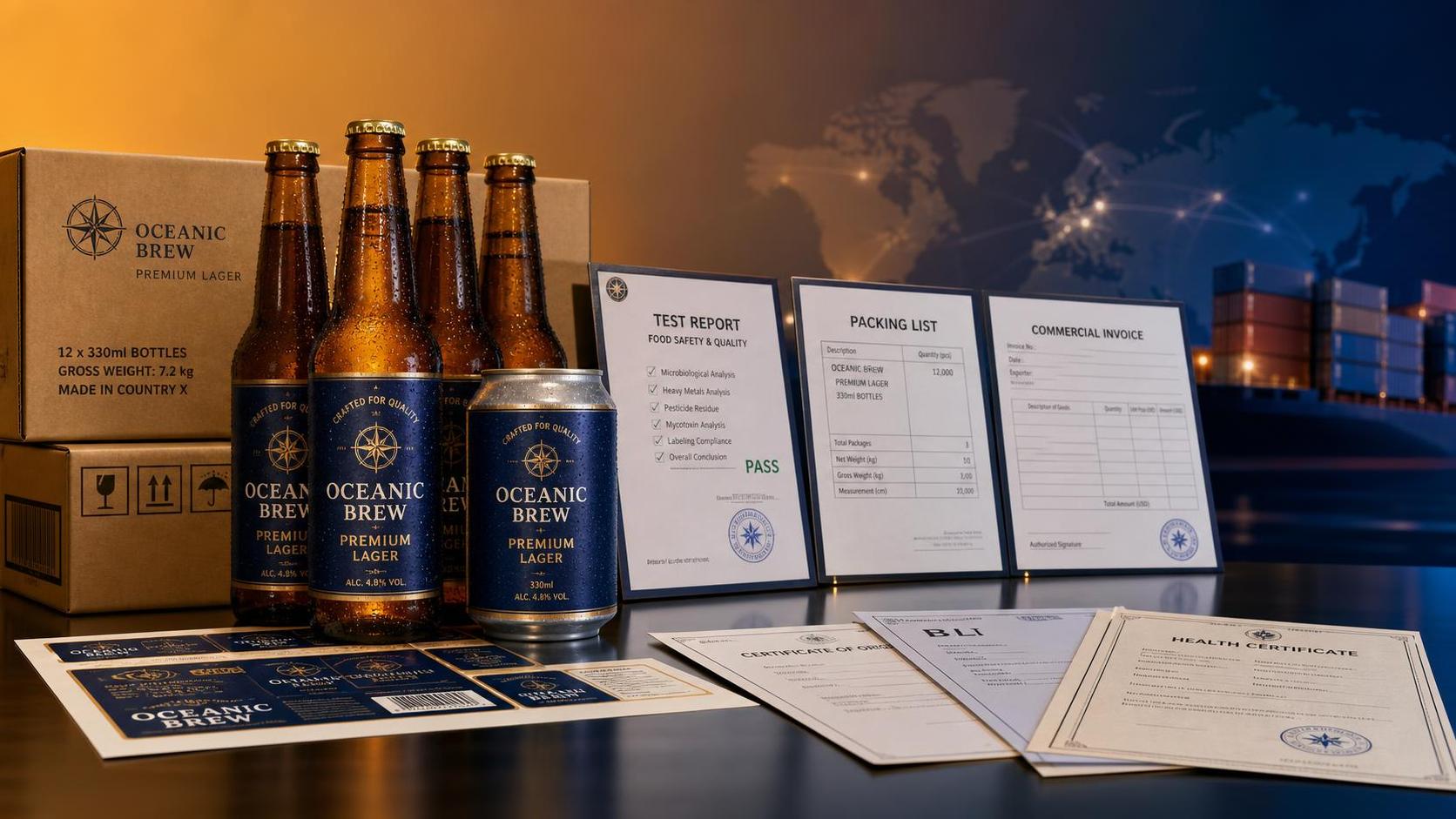
A compliant Beer OEM shipment usually requires more than a commercial invoice and packing list. The exact file set depends on the country, importer, channel, and trade terms, but these are commonly reviewed during export projects:
- Commercial invoice
- Packing list
- Bill of lading or airway bill
- Certificate of origin where required
- Health certificate, sanitary certificate, or similar government-backed export certificate where applicable
- Certificate of analysis or product test report when requested
- Label files or approved packaging artwork
- Manufacturer qualifications and food production licenses as needed for buyer review
- Importer registration information if the destination market requires it
None of these documents should be prepared in isolation. The product name, packaging specification, batch references, and legal entity names must align across the full set. A frequent problem in alcohol exports is that the customs declaration language, invoice description, and label name are all slightly different. That can look harmless internally, but it raises questions externally.
Another point many buyers underestimate is lead time. If your market needs legalized documents, consular handling, or pre-market registration, the compliance timeline can be longer than the production timeline. That affects launch planning far more than most first-time importers expect.
One product, different markets, different rules
There is no single universal Beer OEM compliance pack. Export beer for supermarkets in one region may require very different preparation than beer for bars, specialty retail, or e-commerce in another. Some buyers need retail-ready labels from day one. Others can import with compliant over-stickers under local supervision. Some markets are relatively straightforward for standard lager. Others become much more sensitive when the product includes fruit components, sweeteners, nutrition claims, or wellness-style positioning.
This is why experienced breweries do not promise “global compliance” as a blanket statement. They ask destination-specific questions first. What is the target country? Which channel will sell the product? Is it a standard beer, wheat beer, flavored beer, or a claim-based item such as sugar-free? Will the local importer handle registration, or is the factory expected to provide a broader compliance file?
Those questions matter more than brochure language.
How to evaluate a Beer OEM supplier before signing
If you are comparing suppliers, do not only compare flavor range and unit price. Compliance capability should be part of the selection process.
A practical review often includes these checkpoints:
- Can the brewery provide export experience by market type, not just say “we ship worldwide”?
- Is there an internal team that reviews labels and document consistency?
- Can they support multiple product styles with appropriate technical records, such as classic lager, wheat beer, low-calorie variants, or fruit-flavored beer?
- Do they understand claim-sensitive wording on labels?
- Can they explain what quality documents are standard and what must be confirmed market by market?
- How do they manage batch coding and traceability?
Jinpai Beer is a useful example of the kind of supplier profile many buyers look for in this category: a brewery involved in R&D, production, and distribution, with a broad product portfolio that includes classic lager, German wheat, sugar-free low-calorie beer, fruit-flavored beer, and specialty beer lines, while also offering OEM/ODM and wholesale cooperation. That does not replace destination-market verification, but it does matter when your product plan spans multiple beer styles and channels. A supplier with a narrow operational base may be fine for a simple local-label lager project, but less suitable for more complex export programs.
Still, the right approach is to verify, not assume. Ask for sample label review support. Ask what export documents are routinely available. Ask who checks final artwork against the market requirement list. A good OEM partner should answer these clearly.
Some compliance risks only appear after the first order
Initial approval is one thing. Ongoing compliance is another.
After the first shipment, problems often come from artwork changes, seasonal promotions, formula adjustments, pack-size changes, or importer updates. A new can design may accidentally remove mandatory text. A fruit variant extension may introduce a new allergen issue. A switch in closure, liner, or secondary packaging may require fresh review depending on market expectations.
This is why repeat orders should not run on autopilot. For established distributors, a light compliance check before each production round is usually worth the time. It is cheaper than fixing stock that has already landed.
What to confirm before moving forward
If you are planning an export Beer OEM project, confirm five things before approving production: the exact destination market, the final sales channel, the legal label text, the required document list, and the responsible party for local registration or filing. If any of those are still vague, the order is not really ready.
In this trade, smooth customs clearance usually comes from early discipline, not late corrections. Good beer opens the door. Good compliance gets it through.
FAQ
Do all export beer products need the same label format?
No. Label requirements vary by country and sometimes by sales channel. A design that works in one market may need changes for another.
Can I use one test report for every Beer OEM shipment?
Not safely as a general rule. Some buyers or authorities accept standard supporting reports, but requirements can differ by market, product type, and timing.
Is a translated sticker enough for market entry?
Sometimes, but only where local rules allow it and the sticker content is fully compliant. It should never be treated as a default solution.
Who is responsible for compliance, the factory or the importer?
Usually both have responsibilities. The factory controls production and base documentation; the importer or brand owner often carries market-entry and local legal responsibility.
Are claim-based products like sugar-free beer harder to export?
Often yes. Claims need closer review because wording, nutrition disclosure, and substantiation standards can be stricter than for standard beer.
Internal Link Anchor Text Suggestions
- Beer OEM labeling checklist: compliance guide or resource page
- Craft beer OEM and ODM services: service page
- How to choose a beer private label manufacturer: buyer guide page
- Export documentation for alcoholic beverages: knowledge base page
- Fruit-flavored and low-calorie beer customization: product category page
External Authority Source Suggestions
- Government food safety and import regulation agency pages in target markets
- Customs authority guidance on import documentation for alcoholic beverages
- Industry association or chamber resources covering alcohol labeling and trade compliance
Thank you very much for writing to us. Please leave your message and contact information, we will reply to you within 24 hours.