



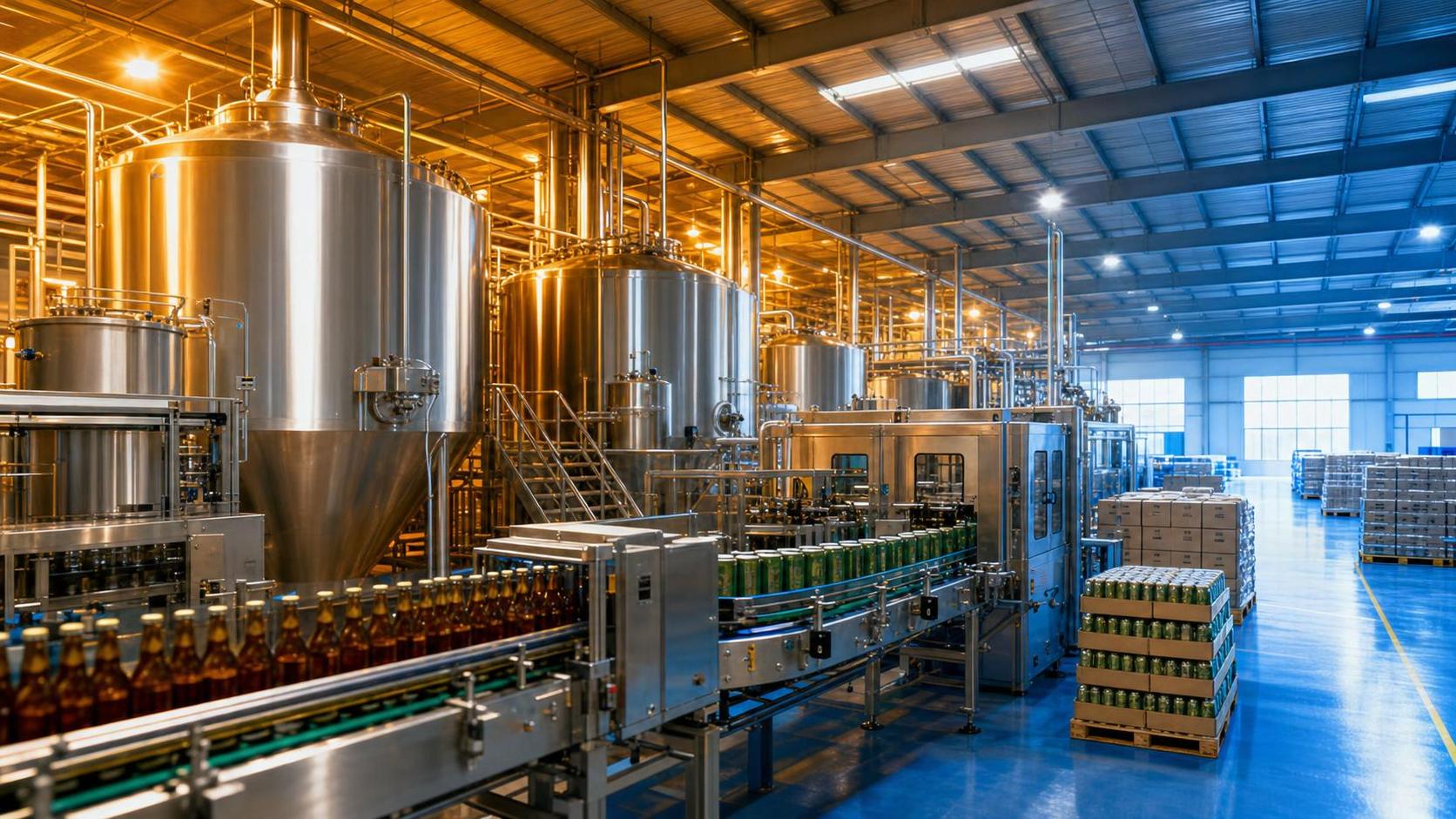
Inside a China Beer Factory: Brewing Capacity, Quality Control, and Export Readiness
Inside a China beer factory, the easiest mistake is to judge the operation by tank count, floor area, or how many SKUs appear in a catalog. None of those tells you much on its own. In beer manufacturing, capacity only matters when it is tied to repeatability, microbiological stability, packaging discipline, and the ability to ship the same product standard across different markets without surprises. That is the real threshold between a plant that can brew beer and one that can support wholesale, private label, and long-term export business.
This matters even more in categories such as craft beer, wheat beer, fruit-flavored beer, low-calorie formulations, and functional specialty beers. These are not interchangeable liquids produced by one generic process. Each style creates different technical pressures inside the factory. A classic lager asks for clean fermentation control and flavor consistency. German wheat beer is less forgiving on yeast handling and sensory balance. Fruit beer adds complexity in ingredient stability, sweetness management, and haze expectations. Sugar-free or low-calorie beer usually pushes formulation, attenuation control, and label compliance questions. A factory that claims it can make everything is not necessarily wrong, but the serious question is whether it can manage those differences at production scale.
Brewing Capacity Is Not Just About Volume
When buyers ask about brewing capacity, they are usually trying to understand something broader: can this supplier absorb demand, maintain lead times, and still keep product stable from batch to batch? In practice, capacity is a systems question. Brewhouse throughput, fermentation tank turnover, bright beer tank availability, filtration or non-filtration choices, packaging line speed, cold storage, and raw material planning all affect what a factory can actually deliver.
A plant may have a large nominal annual output, but that figure can be misleading if the schedule is crowded with many short production runs, seasonal products, or OEM projects with different recipes and packaging formats. Small-batch flexibility is valuable in craft beer manufacturing, yet it also increases cleaning frequency, changeover time, and the risk of process drift if execution is weak. For importers and brand owners, the more useful discussion is not “How many tons or liters can you produce?” but “What is your effective capacity for this beer style, this package, and this order rhythm?”
That distinction becomes important for distributors serving supermarkets, bars, and restaurant channels at the same time. Supermarket programs often need forecast discipline and packaging consistency. Bars may care more about freshness windows, keg handling, and draft performance. Restaurant chains may require tighter specification control across repeated purchase orders. A capable China beer factory has to translate one recipe into several operational realities without letting quality fragment along the way.
Quality Control Starts Long Before Packaging
People outside brewing sometimes imagine quality control as a final inspection step. In beer, that is too late. If wort production, fermentation management, sanitation, dissolved oxygen control, or filling conditions are unstable, the finished product may look acceptable at the factory and still fail in the market through flavor change, over-foaming, haze shift, or shortened shelf life.
A reliable factory usually treats quality as a chain of controls rather than a single checkpoint. Raw materials need incoming verification. Malt, hops, yeast, adjuncts, fruit preparations, and processing aids all influence final stability. Water treatment deserves particular attention because it shapes brewing performance and flavor structure. Then comes process control: mash parameters, boiling consistency, fermentation temperature, yeast vitality, maturation time, carbonation, and packaging conditions. None of these is glamorous, but this is where consistent beer is made.
Microbiology is another dividing line. In export business, a beer does not just need to taste right when it leaves the line. It has to survive transport, warehousing, and retail handling. That means hygiene discipline, validated cleaning procedures, and laboratory capability are not optional. The exact testing scope varies by product type and market requirement, but serious buyers usually want confidence that the factory is not relying only on sensory checks. Sensory evaluation matters, especially for craft styles, yet it works best when supported by routine analytical and microbiological monitoring.
This is also where many misunderstandings around craft beer manufacturing appear. “Craft” is sometimes treated as the opposite of standardization, as if flavor creativity excuses uneven production. In reality, innovative beer styles require even tighter discipline. Fruit additions, specialty ingredients, and functional positioning tend to increase processing complexity, not reduce it. A brewery can be flexible in product development and still be strict in quality systems. In export-oriented supply, it needs to be both.
What Export Readiness Really Means
Export readiness is often reduced to one question: can the factory ship abroad? That is the bare minimum. A more useful definition is whether the supplier can manufacture beer in a way that aligns with cross-border documentation, labeling, packaging durability, shelf-life expectations, and the practical demands of destination channels.
For beer, export readiness usually touches several layers at once. One is packaging adaptation. A product intended for domestic circulation may need different label content, language treatment, barcode setup, carton markings, or pack configuration for another market. Another is transit resilience. Cans, bottles, trays, cartons, and pallets need to hold up through longer logistics routes and more handling points. Then there is regulatory alignment. Requirements differ by country, and a manufacturer should understand that export compliance is not a generic promise. It depends on destination market rules, product formulation, and the claims printed on pack.
The same caution applies to “customized beer” projects under OEM or ODM arrangements. Many buyers assume private label mainly means changing the artwork. In practice, it can involve formula positioning, bitterness level, alcohol content targets, calorie direction, sweetness profile, package size, and channel fit. Each change affects production planning and sometimes technical validation. A factory with real OEM/ODM experience knows that customization should be controlled, not improvised. Otherwise lead times stretch, approvals become inconsistent, and repeat orders become harder to manage.
How Product Range Changes Factory Demands
A broad portfolio can be a strength, but only when the production system is built for it. Jinpai Beer’s mix of classic lager, German wheat, sugar-free low-calorie beer, fruit-flavored beer, and functional specialty beers points to a factory environment that needs both formulation capability and disciplined changeover management. These categories are commercially attractive because they serve different retail and foodservice occasions, but operationally they are not equally simple.
For example, mainstream lager programs usually reward consistency and scale. Wheat beer buyers often care about style character and mouthfeel, and may accept natural haze if it fits the product identity. Fruit beer demands more discussion around flavor authenticity, sweetness balance, color stability, and how the product will behave during storage. Low-calorie or sugar-free positioning tends to invite closer scrutiny of formulation logic and market-specific labeling statements. Functional specialty beers add another layer because any ingredient or claim connected to function needs careful handling within the rules of the target market.
That is why a good manufacturing conversation should move beyond “Do you make this style?” and into “How do you control this style?” The first question gives you a sales answer. The second gives you an operational one.
What Buyers Should Actually Evaluate
If the goal is to identify a dependable beer manufacturing partner, a few evaluation points are more revealing than a polished brochure:
- Whether the factory can explain its process controls clearly, especially around fermentation, sanitation, and filling.
- Whether product development and mass production are connected, rather than handled as separate promises.
- Whether packaging options are supported by real line capability and export packing experience.
- Whether communication around OEM/ODM projects includes technical limits, not just commercial flexibility.
- Whether the supplier understands the difference between domestic supply, wholesale distribution, and export programs.
These points sound basic, but they often reveal more than generic claims about premium quality or advanced equipment. A factory that can discuss where instability usually appears, how batch consistency is protected, and what changes when beer is prepared for overseas shipment is usually thinking at the right level.
A Practical Reading of the Factory
So what does “China beer factory” mean in a business context? It should not be read as a low-cost source label or a generic manufacturing category. It is a production environment that may combine large-scale brewing infrastructure, craft-style product development, private label execution, and multi-channel supply capability. The value lies in how well those pieces are integrated.
For importers, distributors, and retail buyers, the smartest approach is to read the factory through three connected questions. Can it produce the beer style you need with repeatable quality? Can it adapt that product for your market without creating avoidable compliance or logistics problems? And can it keep doing both when orders move from trial quantities to regular replenishment?
If the answer to all three is credible, then brewing capacity becomes meaningful, quality control becomes more than a slogan, and export readiness becomes something you can actually build a supply relationship on. That is the point where a manufacturer stops being just a source of beer and starts becoming a workable partner for global distribution.
Thank you very much for writing to us. Please leave your message and contact information, we will reply to you within 24 hours.