



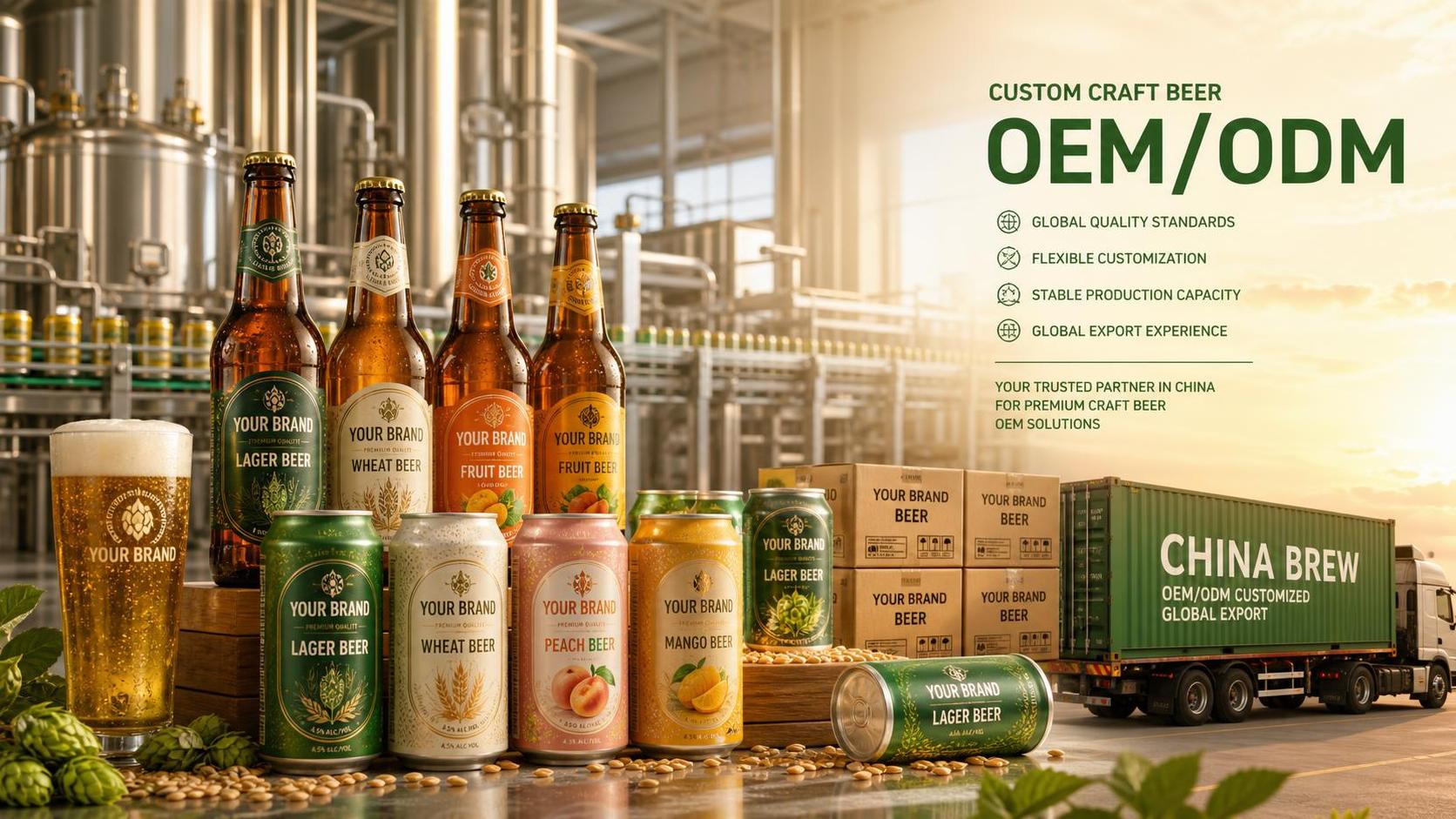
When Customization Is Real, Not Just a Label Change
Can a China beer factory support craft beer customization for overseas brands? In practical terms, yes, but only when customization means controlled formulation, stable process execution and a supply model that still works after the first shipment. Many overseas buyers ask for “craft beer customization” when they are actually dealing with very different business goals: a restaurant group that wants a house wheat beer, a supermarket private label that needs repeatable flavor at scale, a start-up brand testing fruit beer in small runs, or a distributor looking for sugar-free and low-calorie options that fit local shelf trends. Those are not the same project, even if they all begin with the same inquiry email.
That is where a capable China beer factory either proves its value or exposes its limits. Jinpai Beer’s product range, from classic lager and German wheat to fruit-flavored and functional specialty beers, suggests a factory set up for formulation diversity rather than single-SKU manufacturing. But range alone does not answer the real question. The real test is whether the factory can translate a brand concept into a commercially viable beer that survives transit, local compliance review, retail turnover and repeated reordering without drifting away from the original profile.
Different Overseas Projects Ask for Different Kinds of Flexibility
The most misunderstood part of OEM/ODM beer work is the word “custom.” Some buyers expect full recipe development from scratch. Others already have a benchmark sample and need an industrial partner that can scale it. Some only need packaging customization because the liquid profile is already close to market expectations. If these distinctions are not clarified early, both sides waste time discussing flavor notes while the real issue sits elsewhere, often in minimum order structure, lead time, alcohol stability, canning format or label compliance.
For example, a bar chain or restaurant group usually cares more about drinkability, house-style identity and reorder consistency than about extreme recipe novelty. A classic lager or German wheat beer may be the better base for customization because it has broad acceptance and easier menu pairing. In that setting, customization often means adjusting body, aroma expression, bitterness balance or visual identity rather than building a highly experimental SKU. The site condition here is straightforward: on-premise accounts need predictable pours, storage-friendly packaging and a flavor profile that works across varied consumer preferences.
Retail channels create a different pressure. Supermarkets and larger distributors tend to ask harder questions about shelf life, batch uniformity, carton robustness and whether the product can sit in mixed logistics environments without quality complaints. Fruit-flavored beer may perform well in some markets, but fruit expression that is attractive in a sample tasting can become unstable, too sweet or commercially polarizing if the target market expects a drier finish. This is where an experienced manufacturer matters. Not because it can promise everything, but because it knows when a concept should be simplified before launch.
R&D Strength Matters Most When the Brief Is Vague
A large share of overseas inquiries arrive with incomplete technical definitions. The buyer may say they want a “crisp craft lager for Southeast Asia” or a “healthy beer line for online channels,” but those are market directions, not production instructions. A factory with real R&D capability can turn that into a usable development path: choosing a suitable beer style base, discussing sweetness level, identifying whether sugar-free or low-calorie positioning is realistic for the target taste expectation, and checking whether the chosen format is still viable after shipping and storage.
This is particularly relevant for functional specialty beers and reduced-calorie products. These categories attract interest because they fit current consumer conversations, but they also carry higher risk of misunderstanding. Buyers sometimes assume they can combine strong flavor, reduced sugar, low calories and broad market appeal without compromise. In practice, each adjustment can affect mouthfeel, fermentation behavior or repeat-purchase acceptance. A responsible factory should not treat those tradeoffs as a sales inconvenience. It should surface them early.
When evaluating a China beer factory for this kind of project, one useful question is not “Can you make this?” but “What would you change to make this stable for my channel?” The quality of the answer reveals more than a brochure does.
Production Capacity Only Helps If It Matches the Brand’s Growth Pattern
Scalability is often discussed too loosely. Buyers say they need a factory with strong capacity, yet many custom beer programs do not fail because the factory is too small. They fail because the order pattern and the manufacturing setup do not fit each other. A new overseas brand may need trial volumes, faster flavor iteration and more patience with packaging changes. A mature importer may need the opposite: fewer formula changes, tighter scheduling and larger repeat runs. Those are different operational environments.
A factory serving both OEM/ODM and wholesale channels, as Jinpai Beer does, is usually better positioned to handle this range if its internal planning is disciplined. The practical issue is whether small-batch customization can be managed without disrupting standard production, and whether successful SKUs can move into larger recurring runs without changing the sensory result too much. That transition point matters. Many beers taste fine in development lots and then lose definition when scaled if process control is not tight.
Overseas brands should pay attention to how the factory discusses batching logic, not just annual output claims. Capacity is useful only when it supports the actual commercial rhythm of the brand.
Where the Channel Changes the Beer
The intended sales channel often shapes the beer more than the recipe brief does. For bars and restaurants, a beer has to perform in service. That means clean finish, stable carbonation behavior and a profile that remains attractive after the first glass. Visual storytelling helps, but repeat orders depend on drinkability. In this channel, overdesigned flavor concepts can disappoint because they taste impressive in a sample and tiring in normal consumption.
For supermarket shelves, packaging resilience and product clarity matter more. Consumers are deciding quickly. A fruit-flavored beer or functional specialty beer can stand out, but only if the positioning is easy to understand and the liquid matches what the front label implies. If a package suggests refreshing light fruit character and the actual beer drinks heavy or overly sweet, the problem is not marketing. It is product-channel mismatch.
Online channels introduce another layer. Products sold digitally often rely on sharper differentiation because the first purchase may happen without tasting. Sugar-free low-calorie beer can attract clicks, but online growth can also amplify complaints if flavor expectation is not managed well. A factory that understands this will push for tighter alignment between formula, package claims and target audience language.
Compliance and Export Reality Should Enter the Discussion Early
One of the fastest ways to derail a custom beer project is to treat compliance as a finishing step. Overseas brands often focus on recipe and design first, then discover that ingredient declaration, alcohol labeling, claim language or import-side documentation needs changes. Those requirements vary by market, and they should not be guessed. A serious manufacturing partner will usually ask where the beer is going before locking the final version. That is not bureaucracy. It is project control.
This is especially important for functional specialty beers and products positioned around reduced sugar or lower calories. Even when the liquid is technically feasible, wording and claim use may need review in the destination market. If the factory has experience supplying multiple countries through online and offline channels, it is more likely to anticipate these points, though the importer or brand owner still needs to confirm local regulatory requirements on its side.
Questions That Reveal Whether the Factory Can Really Support the Project
Buyers often ask about price too early and process detail too late. A better sequence is to test whether the factory can reason through the business model behind the beer. Some of the most useful questions are very practical:
How much recipe freedom is realistic at the target volume? What changes usually happen between sample approval and commercial production? Which beer styles are easiest to keep stable across repeat orders? What packaging formats are better suited to long export transit? At what point does a fruit-flavored or specialty concept become too complex for the intended retail turnover?
Factories with real project experience tend to answer with conditions, constraints and tradeoffs. Factories that only want to close the deal usually answer with broad assurance.
So, Can a China Beer Factory Support Overseas Craft Beer Customization?
It can, and in many cases it can do so effectively, provided the factory has three things in balance: formulation capability, production discipline and enough market understanding to challenge weak briefs before they become expensive mistakes. For a company like Jinpai Beer, the breadth of product types and its OEM/ODM orientation make it structurally suitable for overseas customization work. The more important question is whether the specific project is matched to the right beer style, the right channel and the right production model.
If an overseas brand is evaluating a China beer factory, the decision should rest less on whether the supplier says “yes” to customization and more on how it defines the limits of that customization. That is usually where the strongest partners stand out. They do not just make beer. They help determine which version of the idea can actually survive the market it is meant to enter.
Thank you very much for writing to us. Please leave your message and contact information, we will reply to you within 24 hours.