



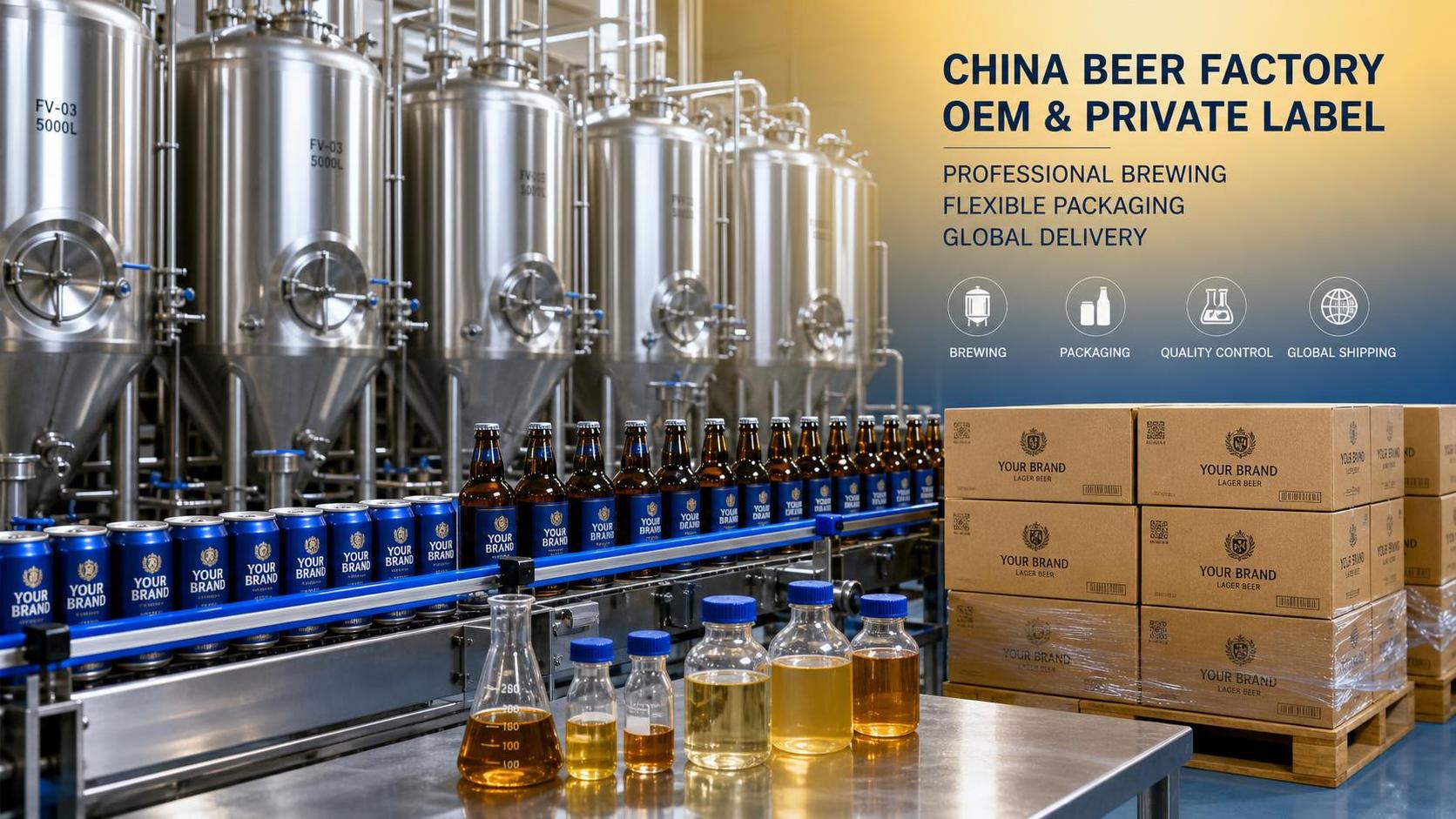
Where should a buyer start when comparing a Chinese beer factory?
Start with the part that affects your risk most: whether the factory can repeatedly make the beer you want, at the quality level your market expects, in the packaging format your channel needs. That sounds obvious, but many sourcing teams begin with price and only discover later that the supplier is strong in one category and weak in another.
A Chinese beer factory may look capable on paper, but OEM and private label work depends on details. Ask what styles they already produce, whether they handle both standard and customized recipes, what packaging lines they run, and how much of their business is export-oriented. A factory that mainly sells domestic bulk beer is not automatically the right partner for a private label launch in supermarkets, bars, or restaurant chains abroad.
At the first screening stage, buyers usually need answers to four practical questions: Can this factory brew the right product? Can it pack it the way I need? Can it ship consistently? Can it support the documents and communication required for international trade?
How do you know if the factory is a real fit for OEM or private label, not just general beer production?
The difference shows up in flexibility. A factory built for its own branded beer may be efficient, but OEM buyers need room for recipe adjustment, label changes, carton design, multilingual packaging, and channel-specific product positioning. If the supplier cannot explain its process for formula development, sample approval, packaging proofing, and production sign-off, that is a warning sign.
You should also look at product range. If a supplier can only offer one or two basic SKUs, it may struggle when your portfolio needs more than a standard lager. Many buyers now ask for differentiated products such as wheat beer, sugar-free low-calorie beer, fruit-flavored beer, or functional specialty beers because retail shelves and on-premise menus are more segmented than before. A factory with broader R&D capability is usually easier to work with when market feedback changes after launch.
What technical questions matter most before asking for a quotation?
Before pricing, pin down the commercial and technical scope. Otherwise quotes from different suppliers are not comparable.
- Beer type: classic lager, wheat, low-calorie, flavored, or another style
- Alcohol level and flavor direction
- Packaging format: can, bottle, keg, or mixed formats
- Pack size and secondary packaging
- Target market and language requirements for labels
- Expected annual volume, not just trial order volume
- Whether you need recipe development, label design support, or only filling service
A vague RFQ often produces a low opening price that later rises through packaging upgrades, formula changes, or export documentation charges. Procurement teams save time by fixing the specification first, then asking suppliers to quote against the same brief.
How should you evaluate brewing capability without overcomplicating the audit?
You do not need to inspect every valve and tank to make a sound decision. Focus on whether the brewery can control consistency from batch to batch. Ask about raw material management, brewing process control, filtration or other product handling methods, filling stability, and shelf-life management. Then connect those answers to actual samples.
Samples matter more than presentation slides. Taste at least two batches if possible, especially for customized recipes. A single good sample can be made with extra attention. Repeatability is the real test.
If your channel is sensitive to product drift, such as supermarket retail or multi-location restaurant supply, ask how the factory handles batch records, in-process checks, and release approval. A supplier that answers clearly usually has a more mature operation than one that stays at the level of general claims.
Which documents should a buyer review during supplier evaluation?
The right documents depend on product type and destination market, but buyers should at least review the core records that show the factory is legally operating, producing food-grade products, and managing export transactions in an organized way.
For destination-specific compliance, do not ask a supplier for a generic promise that the product is “fine for export.” Ask instead which exact label files, formula details, and product fields they need from you to prepare the correct documents for your market.
What packaging questions affect cost more than buyers expect?
Packaging is where many beer projects become expensive. The liquid price may look competitive, but the final landed cost changes quickly once custom cans, embossed bottles, special cartons, low-volume printed labels, or mixed pack configurations are added.
Ask the Chinese beer factory whether your packaging will use existing supply formats or require new procurement. That single point affects lead time, minimum order quantity, and dead stock exposure. If your first order is small, choosing standard bottle or can formats with customized labels is often more efficient than building a fully custom package from day one.
Also check who owns leftover packaging inventory if artwork changes or orders slow down. This is a common blind spot in private label buying.
How can procurement teams judge MOQ and production flexibility?
MOQ is not just a sales term. It usually reflects line efficiency, packaging sourcing thresholds, and changeover cost. A factory may accept a low trial order for a standard SKU but require much higher volume for a custom recipe or printed packaging.
The better question is not “What is your MOQ?” but “What changes the MOQ?” That reveals whether the supplier understands cost drivers and whether your launch plan is realistic.
Typical variables include:
- Custom formula versus existing formula
- Printed can or bottle requirements
- Label type and carton design
- Single SKU or multi-SKU production run
- Peak season scheduling
A flexible supplier can sometimes reduce entry cost by using a proven base beer, a standard container, and a simpler packaging route for the first run.
What are the biggest cost traps in OEM beer sourcing?
Three traps show up repeatedly.
- Comparing ex-works prices without aligning packaging and documentation scope.
- Approving a product sample before locking the commercial specification.
- Ignoring freight efficiency, especially when pack dimensions waste container space.
There is also a softer cost issue: communication drag. If artwork revision, sample confirmation, and booking coordination take too many cycles, your internal cost rises even when unit price looks attractive. Buyers often underestimate this when screening suppliers only by quote sheet.
How important is export experience when the beer itself is straightforward?
Very important. Beer is not a difficult product only because of brewing. Export execution matters just as much. A factory that regularly supports overseas customers is usually better at label coordination, shipping document flow, production timing around vessel schedules, and handling questions from importers, distributors, or retail buyers.
This becomes even more relevant if your product is headed into multiple channels. A supermarket buyer may need different carton labeling and barcode handling than a bar chain or restaurant group. The supplier does not need to run your business for you, but it should be comfortable working within those commercial realities.
Should you choose a factory with broad product development capability?
If you are building a long-term beverage line, yes. Even if the first order is a standard lager, portfolio expansion usually follows. Buyers often begin with an easy-to-sell product, then add something more differentiated once the channel responds. That might be a German wheat for casual dining, a low-calorie option for modern retail, or a fruit-flavored beer aimed at convenience and younger consumer segments.
A supplier with active R&D and multiple beer categories gives you room to scale without restarting the sourcing process. It also makes reformulation easier if tax structure, consumer taste, or channel feedback changes.
What does a practical evaluation process look like?
Keep it structured, but not bureaucratic. A workable sequence is:
- Define product, packaging, target market, and annual volume assumptions.
- Shortlist factories that actually handle OEM or private label beer.
- Review documents and sample capability before deep price comparison.
- Test samples against your market need, not only against personal taste.
- Confirm MOQ, lead time, packaging route, and document support.
- Quote on a matched scope and compare total cost, not just unit cost.
- Run a pilot order with clear approval points for formula, artwork, and packing details.
That process is usually enough to separate a usable manufacturing partner from a supplier that is only competitive in the first email.
What is the clearest sign that a factory is worth moving forward with?
Not the lowest quote. Not the widest catalog either. The strongest sign is alignment between product capability, communication quality, packaging practicality, and export execution. When a Chinese beer factory can answer technical questions directly, explain cost drivers without evasiveness, and turn your brief into a realistic production plan, you are looking at a supplier that is likely to perform under pressure.
For procurement teams, that is the real test: choose the partner that can keep quality stable, customization manageable, and delivery predictable after the first order, not just before it.
Thank you very much for writing to us. Please leave your message and contact information, we will reply to you within 24 hours.