



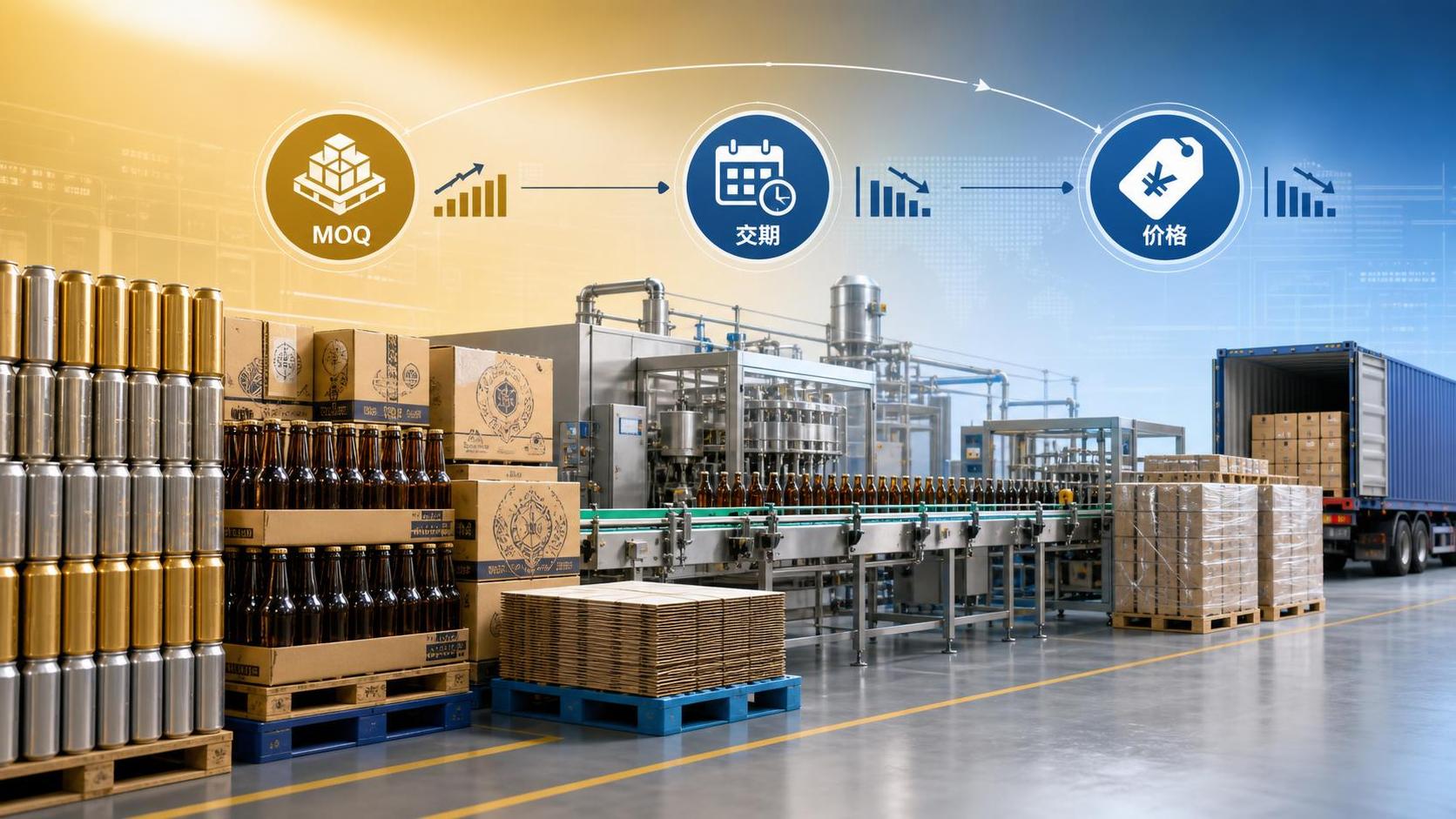
MOQ, Lead Time, and Price Are Not Separate Questions at a Chinese Beer Factory
Procurement teams often compare a Chinese beer factory by asking three direct questions: What is the MOQ? How long is the lead time? What is the unit price? On paper, that looks sensible. In practice, these three numbers are tied together so tightly that reviewing them one by one can lead to the wrong supplier choice.
A factory quoting a low MOQ may be building that flexibility into a higher unit cost. A factory offering a short lead time may only be doing so for standard SKUs, not for custom recipes, cans, or outer cartons. A factory showing a very attractive price may be assuming a packaging format, alcohol level, or order volume that does not match your actual channel. This is especially common in beer sourcing, where liquid production, packaging procurement, pasteurization or cold-chain considerations, labeling compliance, and container loading all affect the final commercial picture.
If you are comparing classic lager, German wheat, fruit beer, sugar-free low-calorie beer, or functional specialty beer, the right question is not which quotation is cheapest. It is whether the factory’s MOQ structure, scheduling logic, and price composition fit your sales rhythm and inventory risk.
What MOQ Really Means in Beer Manufacturing
MOQ is often misunderstood as a simple minimum purchase quantity. At a Chinese beer factory, it usually reflects a production threshold created by brewing batch size, packaging line setup, material procurement, and sometimes regulatory labeling requirements for a given export market.
For beer, MOQ can exist at several levels at once. There may be one MOQ for the liquid itself, another for a specific can or bottle format, and another for printed packaging materials such as labels, trays, shrink film, or cartons. That matters because a buyer may hear “small MOQ is acceptable” and assume the whole project is flexible, only to discover later that the custom printed cans or flavor-specific cartons require much larger runs.
This becomes more visible in OEM and ODM work. A standard lager packed in an existing can size with generic secondary packaging is one thing. A customized fruit-flavored beer with branded artwork, a tailored sweetness profile, and market-specific compliance text is another. The second project may still be feasible, but its MOQ is being driven by more than beer volume alone.
A useful way to read MOQ is to ask what exactly is setting the floor. If the constraint comes from brewing tank utilization, the supplier may have some room to consolidate flavors or combine SKUs. If the constraint comes from printed materials, there may be more flexibility through label changes, neutral packaging, or staged packaging plans. If the limitation is on a particular format, such as sleek cans or specialty bottles, the answer may depend on that packaging supplier rather than the beer factory itself.
Lead Time Is Usually a Chain, Not a Single Number
Lead time in beer sourcing is rarely just “production days.” It is better understood as a chain of decisions and dependencies. Recipe confirmation, sample approval, raw material readiness, can or bottle availability, artwork confirmation, production scheduling, filling, packaging, quality checks, and shipment booking all sit inside that number.
That is why a short lead time quotation can be technically true but commercially misleading. A factory may quote quickly for an in-house mature SKU, especially for classic lager or wheat beer already running on a regular plan. But once you ask for custom ABV, sugar-free positioning, fruit additions, functional ingredients, or market-specific labeling, the calendar changes. Some of that extra time is not factory delay. It is the normal result of coordination across formula, packaging, and compliance.
There is also a difference between first order lead time and repeat order lead time. Procurement teams sometimes compare those two as if they were interchangeable. They are not. First orders usually carry more friction because the factory has to align packaging specs, artwork, approval samples, and sometimes translation accuracy for mandatory information. Repeat orders, especially for established SKUs, are often more predictable if demand planning is handled properly.
When reviewing a Chinese beer factory, ask the supplier to separate lead time into at least three parts: packaging material preparation, production window, and shipment readiness. That breakdown tells you far more than one total number.
A Low Price Quote May Be Hiding the Real Cost Structure
Beer pricing is easy to oversimplify. Buyers often compare FOB quotes line by line and assume the lowest number is the strongest commercial option. But the quoted price may be built on different assumptions about recipe input, filling format, packing method, and even shelf-life handling.
In practical sourcing, beer cost is usually influenced by five main layers: the liquid itself, packaging materials, customization complexity, order scale, and logistics arrangement. The liquid cost can shift with malt content, hop profile, adjunct use, alcohol content, and whether the product is a standard lager or a more customized specialty line. Packaging is often a bigger variable than buyers expect, particularly when printed cans, special bottle shapes, or retail-ready cartons are involved. Customization adds cost not only through formulation but through production switching and material handling. Order scale affects unit economics because setup losses and packaging procurement become easier to absorb. Logistics matters because beer is bulky, heavy, and highly sensitive to how efficiently a container is loaded.
That means a price comparison only becomes meaningful when quotation assumptions are normalized. You need the same Incoterm basis, the same container logic, the same packaging specification, and the same product definition. If one supplier is quoting on standard 330ml cans and another is quoting on a custom can size with upgraded carton print, the numbers are not directly comparable even if they appear to describe the same beer category.
The Better Comparison Method
In procurement work, the most reliable evaluation is not a single quote sheet. It is a structured comparison of commercial assumptions. A simple review framework helps:
This kind of comparison is particularly useful when the product mix includes both fast-moving standard beer and more experimental lines such as fruit beer or functional specialty beer. The procurement logic for those categories is different. One rewards stability and replenishment efficiency; the other rewards flexibility and launch responsiveness.
Where Buyers Commonly Misread Chinese Factory Quotes
One common mistake is assuming MOQ tells you how easy a supplier is to work with. Sometimes the opposite is true. A factory with a slightly higher MOQ but clearer scheduling discipline and more transparent packaging coordination may be easier to manage than a supplier promising very small runs with repeated changes to delivery timing.
Another mistake is treating lead time as a promise instead of a production condition. If artwork approval, formula confirmation, or deposit timing changes, the lead time changes with it. Serious suppliers usually explain those dependencies. Vague suppliers often hide them inside a headline number.
Price is misread when buyers do not distinguish between a factory that is good at large wholesale supply and one that is structured for customized OEM/ODM projects. The lowest-cost model for a standard supermarket lager may not be the best model for a bar-focused private label wheat beer or a lower-calorie line aimed at a niche retail channel.
How Product Type Changes the Commercial Equation
Not all beer categories behave the same in sourcing. A classic lager is usually easier to standardize, which can make MOQ, scheduling, and pricing more stable. German wheat beer may involve its own process and flavor expectations, but it is still a relatively familiar category for many manufacturers. Fruit-flavored beer and functional specialty beers are different because ingredients, sensory profile, and positioning often require more back-and-forth before production is locked.
Sugar-free or low-calorie beer also needs careful commercial review. Buyers sometimes focus on label claims and consumer positioning while underestimating how specification control, ingredient selection, and market labeling rules can affect the sourcing process. That does not automatically mean long lead times or high MOQs, but it does mean the comparison should go beyond a generic base-beer quotation.
What a Reliable Supplier Discussion Should Sound Like
A credible Chinese beer factory usually does not answer every sourcing question with a single neat figure. It asks how the product will be sold, whether the order is for wholesale distribution or private label, which channels are involved, whether packaging is fixed, and how often replenishment is expected. Those are not stalling questions. They are the questions that determine whether MOQ, lead time, and pricing are commercially realistic.
For a supplier with broad manufacturing capability, such as one covering classic lager, wheat beer, fruit beer, sugar-free low-calorie options, and OEM/ODM customization, the advantage is not simply variety. The real advantage is the ability to align product type with the right production and packaging path. That matters much more to procurement than a polished quotation template.
The Practical Decision Standard
When comparing a Chinese beer factory, do not ask which supplier offers the best MOQ, the shortest lead time, or the cheapest price in isolation. Ask which supplier can explain the trade-off behind each number and keep those trade-offs consistent across repeat orders.
That is usually the clearest sign you are dealing with a factory that understands procurement reality rather than just export quoting. In beer sourcing, stable margins rarely come from the headline price alone. They come from matching order quantity, production rhythm, packaging strategy, and market requirements before the first purchase order is issued.
Thank you very much for writing to us. Please leave your message and contact information, we will reply to you within 24 hours.