



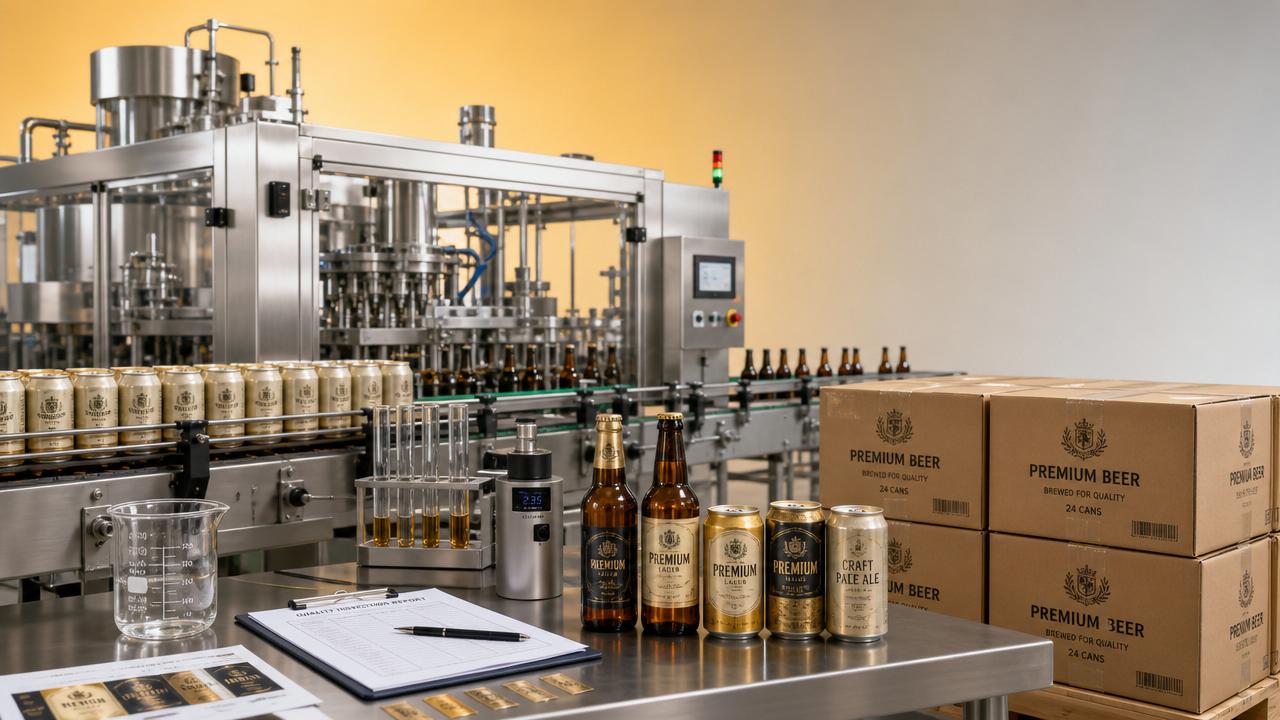
Choosing a reliable Chinese beer factory is a critical first step for procurement teams looking to balance quality, compliance, pricing and long-term supply stability. Before placing your first order, it is essential to assess production capabilities, certifications, customization options and export experience to reduce risk and secure a trusted manufacturing partner that can support your brand and market goals.
Why Scenario-Based Evaluation Matters Before You Choose a Chinese Beer Factory
For procurement professionals, evaluating a Chinese beer factory is not a one-size-fits-all exercise. The right supplier for a supermarket private label may not be the best fit for a bar chain, a health-oriented low-calorie product launch, or a fruit beer line targeting young consumers. The factory’s brewing range, packaging flexibility, quality systems, and export support can vary widely depending on the business scenario.
That is why the first order should never be judged by unit price alone. A buyer needs to match factory capability with real sales channels, target flavor profile, shelf-life requirements, compliance standards, and reorder expectations. In practical terms, procurement teams should ask not only “Is this Chinese beer factory qualified?” but also “Is this factory qualified for my exact product and market scenario?”
For example, a factory experienced in classic lager may perform very well on volume consistency, but a buyer planning a customized German wheat or sugar-free low-calorie beer needs stronger formulation support, stability testing, and more responsive OEM/ODM service. Similarly, an importer serving restaurants and bars often cares more about keg options, freshness, and delivery rhythm than a retail distributor focused on can design and carton durability.
Common Procurement Scenarios and What to Check First
Before shortlisting any Chinese beer factory, define your use case clearly. The table below shows how evaluation priorities change across common business scenarios in the beverage industry.
Scenario 1: Private Label Retail Programs Need Consistency More Than Promises
If you are sourcing from a Chinese beer factory for supermarket shelves or chain retail, consistency is usually the top concern. In this scenario, packaging appearance, barcode accuracy, label compliance, and repeatable taste matter as much as the beer itself. A beautifully presented first batch is not enough if later batches vary in foam retention, bitterness, color, or alcohol level.
Procurement teams should review the factory’s standard operating procedures, batch testing routines, and packaging defect controls. Ask for documentation on raw material sourcing, carbonation control, dissolved oxygen management, and finished product inspection. For retail products, transport durability also matters. Cans, glass bottles, trays, and master cartons must withstand warehousing and distribution conditions without leakage or crushing.
A suitable Chinese beer factory for this scenario should also support OEM/ODM efficiently. That includes design proofing, multilingual label adjustment, and the ability to align with market regulations in different countries. If the supplier cannot explain how they manage compliance for ingredients, allergens, dates, and alcohol declarations, the risk level rises quickly.
Scenario 2: Bars, Restaurants, and Hospitality Buyers Should Focus on Freshness and Style Fit
For on-premise channels, the best Chinese beer factory is often the one that can align beer style with customer experience. Restaurants may need a smooth classic lager with broad appeal, while craft-focused bars may want German wheat, seasonal fruit beer, or functional specialty beers with a distinctive story. In this setting, purchase decisions are closely tied to taste profile, serving format, and how well the beer complements food or venue identity.
Instead of only asking for a product catalog, request recent sample batches and compare them under real serving conditions. Check aroma, mouthfeel, foam persistence, aftertaste, and drinking stability after refrigeration. If the Chinese beer factory supplies kegs or draft products, ask about sanitation procedures, filling standards, and cold-chain recommendations. Freshness risk is higher when procurement ignores logistics details and assumes all beer formats behave the same way.
This scenario also rewards suppliers with flexible batch sizes. A bar group may want to test multiple SKUs before committing to scale. A factory with strong craft beer R&D and responsive sample development is often a better partner than one optimized only for mass production.
Scenario 3: Health-Focused and Functional Beer Projects Require Strong R&D Support
Demand for sugar-free low-calorie beer and functional specialty beers continues to grow, but these projects are more complex than standard lager sourcing. If your business model targets fitness-conscious consumers, convenience stores, or modern retail channels, your Chinese beer factory must do more than brew a light product. It should be able to support formulation validation, nutritional targets, shelf-life performance, and product claims that can stand up to scrutiny.
In this scenario, procurement should involve both technical and regulatory review. Ask whether the factory has in-house R&D, pilot testing capability, and laboratory support for alcohol, sugar, calorie, and microbiological analysis. Clarify whether any functional ingredients affect stability, flavor balance, or customs documentation in the destination market.
A capable Chinese beer factory should be able to explain trade-offs clearly. For instance, lowering calories may change body and mouthfeel; reducing sugar may affect consumer acceptance if flavor design is weak. The right partner helps buyers judge whether the formula is commercially viable, not just technically possible.
Scenario 4: Fast-Moving E-Commerce and Trend Products Need Speed and Customization
When the sales channel is e-commerce, social commerce, or a limited-time promotional launch, speed matters almost as much as quality. Fruit-flavored beer, gift-box products, and visually distinctive can designs often depend on trend timing. In this case, the ideal Chinese beer factory is one that can move quickly from concept to sample, then from sample to production without creating confusion around packaging, formula approval, or lead times.
Buyers should test the supplier’s responsiveness early. How fast do they issue quotations, confirm specifications, and revise artwork? Can they provide multiple flavor options in one sampling cycle? Can they coordinate packaging procurement without delaying brew schedules? A factory may look attractive on paper, but weak project management can ruin a time-sensitive launch.
For this scenario, it is useful to check whether the Chinese beer factory has served cross-border online sellers, distributors, or branded startups before. Experience with small-to-medium customized runs, mixed SKU orders, and visual packaging execution is often more valuable than very large installed capacity.
What Procurement Teams Should Verify on Every Factory Visit or Audit
Regardless of scenario, several checkpoints should be part of any Chinese beer factory evaluation. First, confirm production capability: brewing equipment, fermentation capacity, filtration approach, packaging formats, and annual output. Second, verify quality management: certifications, laboratory routines, sanitation control, traceability, and complaint handling process.
Third, review export readiness. A factory serving global markets should understand shipping documents, labeling rules, shelf-life declarations, pallet standards, and container loading practices. Fourth, assess communication quality. Delayed answers, vague technical replies, or inconsistent sample records often signal larger operational issues. Finally, ask about contingency planning. Reliable supply depends on raw material backup, maintenance planning, and production scheduling discipline.
Practical Audit Checklist
- Can the Chinese beer factory produce your target beer style consistently?
- Do certifications and test reports match your destination market requirements?
- Is OEM/ODM support mature enough for label, flavor, and packaging customization?
- Are sample quality and bulk order quality controlled by the same standards?
- Can the supplier support your reorder rhythm and seasonal peaks?
Common Misjudgments When Selecting a Chinese Beer Factory
A common mistake is assuming that low price equals procurement success. In reality, low initial pricing may hide weaker ingredients, unstable packaging quality, or poor after-sales coordination. Another mistake is overvaluing certifications without checking whether they translate into strong execution for your product category.
Buyers also misjudge factories by testing only one SKU. A Chinese beer factory may be excellent at classic lager but less proven in fruit-flavored beer or functional specialty beers. That is why scenario fit matters. Procurement should validate the exact product family, not just the factory’s general reputation.
Finally, some teams ignore communication and timeline control during sampling. Yet these are early indicators of future order execution. If approvals, revisions, and documentation are already difficult before payment, the risk usually increases after order confirmation.
How to Match Factory Strengths to Your Business Model
The smartest way to choose a Chinese beer factory is to map supplier strengths to your channel strategy. If you need broad retail coverage, prioritize packaging quality, compliance, and volume stability. If you serve bars or restaurants, focus on style authenticity, freshness, and flexible brewing options. If you are building a health-oriented brand, put R&D, nutritional control, and formula documentation at the center of evaluation. If you depend on e-commerce speed, test project responsiveness and customization execution before you commit.
Suppliers like Jinpai Beer, with capabilities across craft beer R&D, production, wholesale supply, and OEM/ODM customization, may be especially relevant for buyers who need a wider product portfolio rather than a single mainstream item. A factory offering classic lager, German wheat, sugar-free low-calorie beer, fruit-flavored beer, and specialty functional lines can better support channel diversification and phased product expansion.
FAQ for First-Time Buyers Evaluating a Chinese Beer Factory
How many samples should I request before the first order?
For a new Chinese beer factory, request at least one benchmark sample and one customized sample if private label or formula adjustment is involved. If multiple flavors or formats are planned, compare them side by side.
Is a factory audit necessary for small first orders?
Yes, either an on-site audit or a credible third-party audit is highly recommended. Even a small first order can expose your brand to quality and compliance risk.
What matters more: product range or specialization?
It depends on your scenario. A broad product range helps if you plan multi-channel expansion. Specialization may be better if you need one highly specific craft beer style with premium positioning.
Final Recommendation for Procurement Teams
Before placing your first order, evaluate a Chinese beer factory through the lens of your real business scenario, not through generic supplier claims. Define your sales channel, product type, compliance needs, packaging format, and reorder expectations first. Then verify whether the factory’s brewing capability, quality system, export experience, and OEM/ODM support truly match those needs.
A good procurement decision is rarely about finding the cheapest beer supplier. It is about finding the Chinese beer factory that can consistently support your brand, protect your market entry, and scale with your commercial plan. If your project involves craft beer development, customized packaging, wholesale distribution, or differentiated products such as low-calorie and fruit-flavored beer, a structured factory evaluation will help you reduce risk and build a stronger long-term supply partnership.
Thank you very much for writing to us. Please leave your message and contact information, we will reply to you within 24 hours.